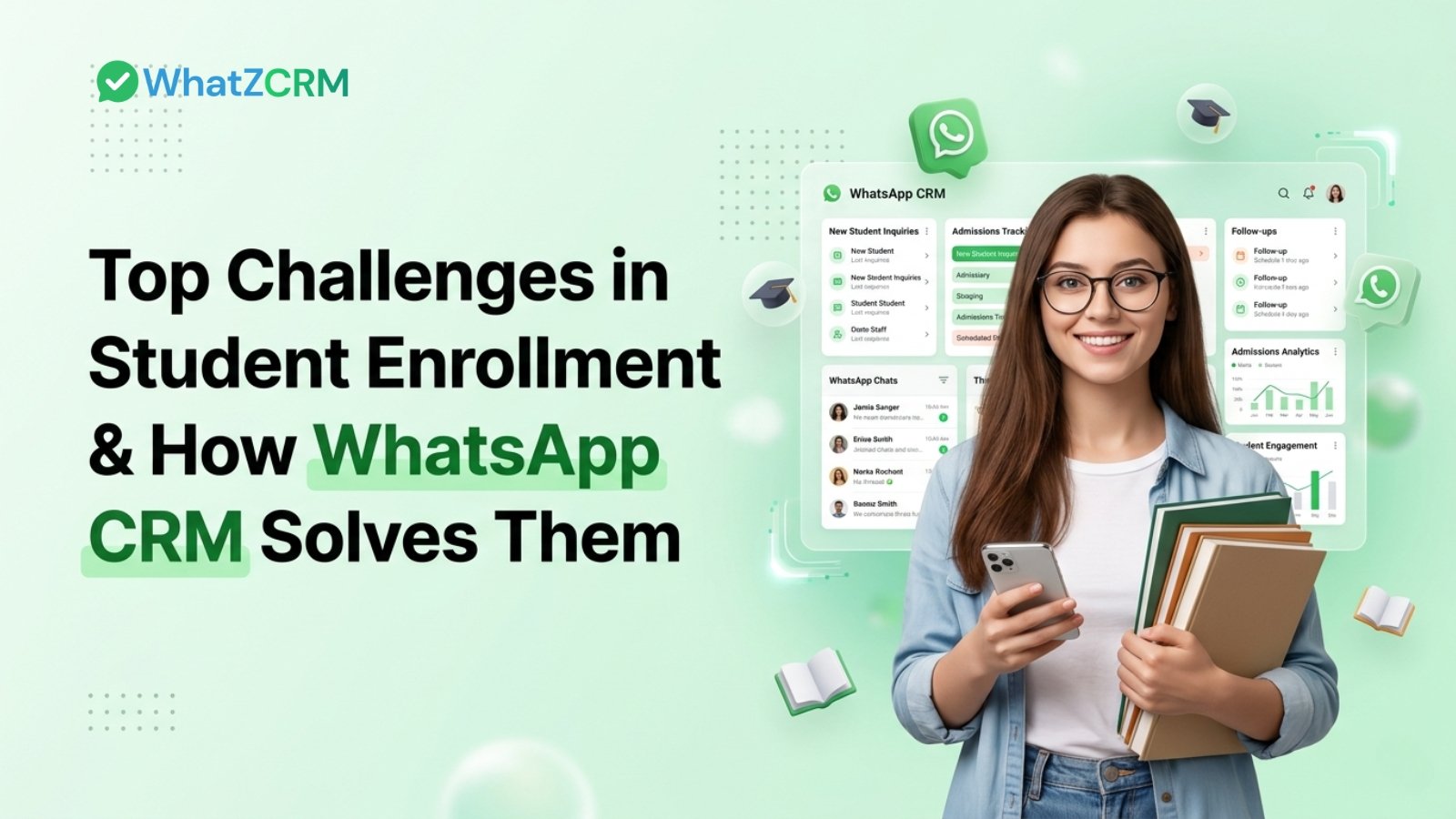

In an era when students live on their smartphones, educational institutions still rely on email threads, notice boards, and missed calls to communicate. The disconnect is real and costly. From low application completion rates to high dropout inquiries, poor student communication directly affects enrollment, satisfaction, and retention.
This is where a WhatsApp CRM for education becomes a game-changer. With over 3 billion active users globally and open rates exceeding 90%, WhatsApp is not just where students already are; it’s where they actually respond. Combine that with intelligent CRM automation, and institutions can finally solve the communication breakdowns that have plagued them for years.
Let’s break down the top student communication challenges and exactly how a WhatsApp CRM solves each one.
1. Why Do Students Ignore Emails and Calls from Institutions?
Students ignore institutional emails and calls because email open rates in education average only 20–25%, and students associate unknown phone numbers with spam.
Three-quarters of institutional emails are never opened. Cold calls perform even worse students rarely return calls from unrecognized numbers. By the time a counselor reaches a student, that student has often already enrolled elsewhere.
Key Facts
- Education sector email open rates: 20–25% (industry benchmark)
- Students associate cold calls with telemarketing and avoid answering
- Delayed contact is a primary driver of enrollment loss to competing institutions
How WhatsApp CRM Solves Low Response Rates
WhatsApp messages achieve open rates above 90% and are typically read within minutes of delivery. A WhatsApp CRM automates follow-up sequences based on student behavior. If a message is read but not replied to, a contextual follow-up triggers automatically after a set interval. This closes the response gap without requiring additional counselor effort.
Also Read: What is a WhatsApp CRM for Education and Why Do you Need one
2. Can Educational Institutions Personalize Communication at Scale?
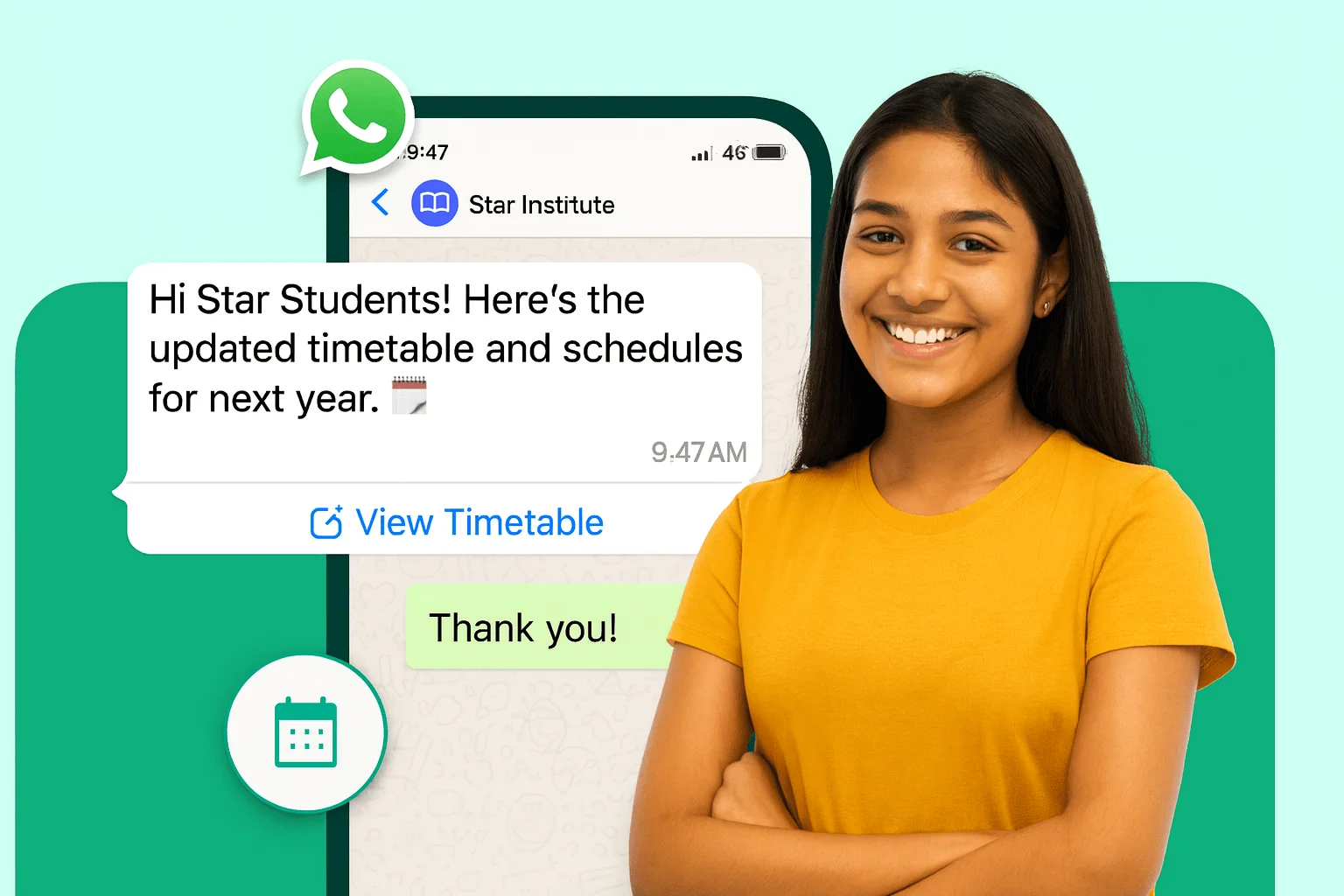
Yes. WhatsApp CRM platforms allow institutions to segment students by course interest, application stage, or location and automatically send messages personalized with individual names, program details, and next steps, eliminating manual effort.
Generic broadcast messages feel impersonal and drive disengagement. Every student has different questions, scholarship requirements, hostel availability, and admission deadlines, but manually tailoring messages for thousands of students is impractical.
What Personalization at Scale Looks Like
Example: An MBA applicant who submitted documents receives an automated WhatsApp message: “Hi Rohan, your documents are under review. Our counselor will reach out by Thursday. Here’s what to expect next.” This message is generated and sent automatically by the CRM workflow; no human triggers it.
Personalization Capabilities in WhatsApp CRM
- Dynamic fields: student name, program, application stage, assigned counselor
- Segmentation by course interest, geography, inquiry date, or custom tags
- Conditional logic: different message paths based on student responses
- Language localization for multilingual student populations
3. How Can Institutions Respond to Student Inquiries Faster?
By deploying a WhatsApp education chatbot that responds to student inquiries 24/7, instantly answering FAQs and routing complex questions to counselors with full conversation context pre-loaded.
Speed to response is a conversion factor. Research shows that leads contacted within 5 minutes are 100 times more likely to convert than those reached after 30 minutes. Most institutions lack the counselor bandwidth to meet this threshold manually across hundreds of simultaneous inquiries.
The Hybrid Response Model
A WhatsApp CRM combines two layers of response:
- Chatbot layer: handles FAQs (fees, eligibility, deadlines, campus info) instantly, around the clock
- Human layer: counselors receive routed conversations with full context already visible, enabling faster, more informed responses
This model ensures that every student inquiry receives immediate acknowledgment, while human attention is reserved for high-intent, conversion-ready conversations.
Also Read: How to Build a WhatsApp Chatbot Without Coding (2026 Step-by-Step Guide)
4. What Causes Fragmented Student Communication and How Is It Fixed?
Fragmentation occurs when email, phone, SMS, and chat operate on separate systems without a shared student record. WhatsApp CRM fixes this by creating one unified student profile that every team member can access.
A typical student enrollment journey spans email, phone, website chat, SMS, and social media, often managed by different team members with no visibility into each other’s interactions. Students are forced to repeat themselves at each touchpoint, eroding trust and accelerating drop-off.
What a Unified Student Profile Contains
- All message history across channels
- Document submission status
- Counselor notes and follow-up reminders
- Application stage and last interaction date
- Assigned team member and escalation history
With this shared record, any counselor can pick up a student conversation mid-stream with full context, reducing repetition and improving the student experience.
5. Why Do Students Drop Off During Enrollment and How Can Re-Engagement Work?
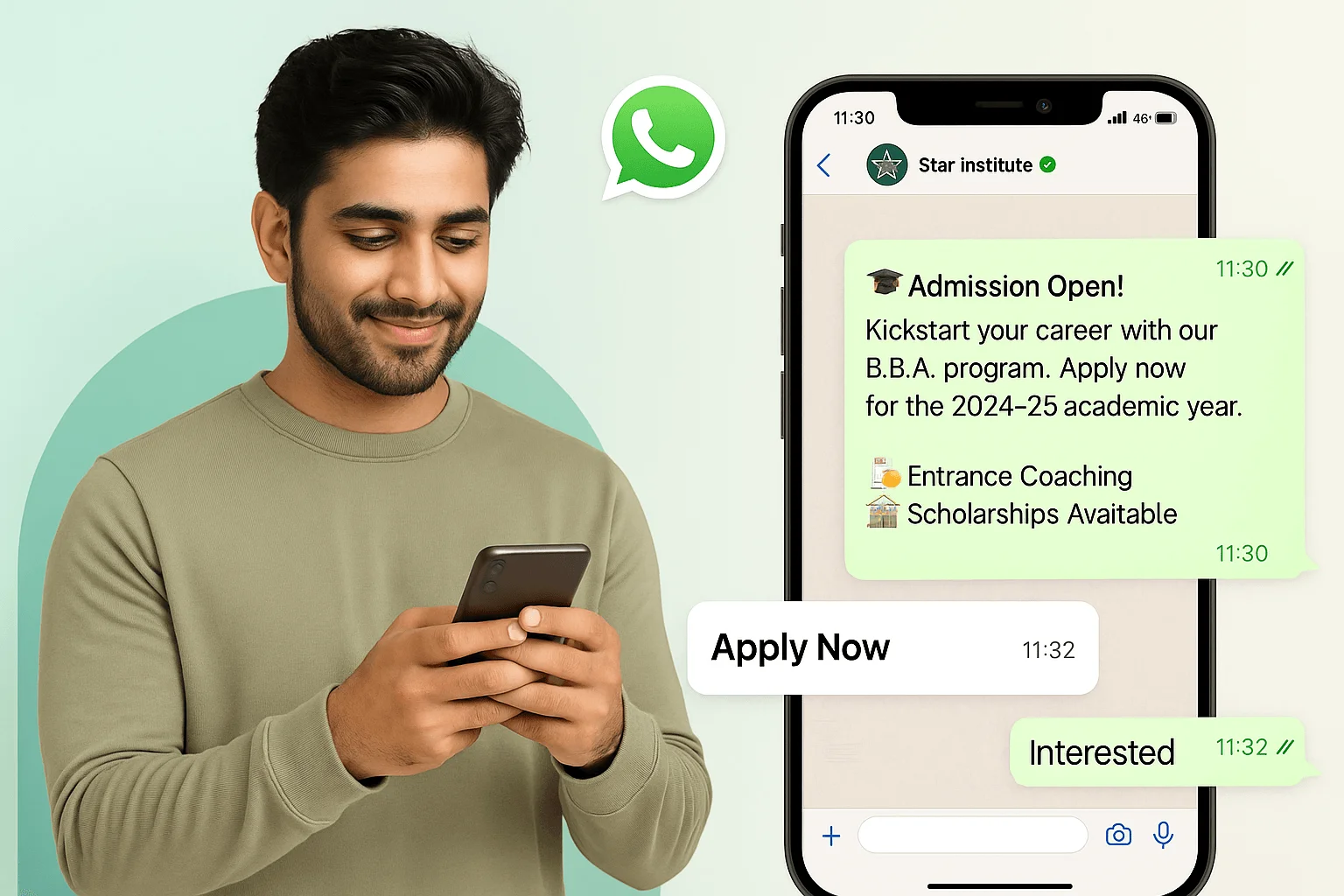
Students drop off when institutions fail to follow up at the right moment. WhatsApp CRM uses behavior-triggered automation to re-engage students who abandon forms, miss deadlines, or go silent via a channel they actually read.
Drop-off is not always a sign of disinterest; it often signals friction, distraction, or a missed nudge. A student who starts an application but doesn’t finish is still a high-intent lead. Traditional re-engagement via email rarely succeeds in bringing them back.
How Behavior-Triggered Re-Engagement Works
WhatsApp CRM workflows monitor specific student actions and inaction, then trigger contextual messages:
- Incomplete application form → reminder sent after 24 hours with direct link
- Webinar attended, but no follow-up action → “What questions can we answer for you?” message
- Document not uploaded after 3 days → step-by-step upload guide via WhatsApp
- No response after 7 days → re-engagement with an incentive or deadline reminder
⚡Example trigger message:
“Hey Priya, you started your application 3 days ago. Complete it today, and we’ll waive your processing fee offer expires Sunday!
What Makes WhatZCRM Different from Basic WhatsApp Tools?
WhatZCRM goes beyond simple messaging by combining a full CRM, AI chatbot builder, no-code automation, sales pipeline, multi-agent inbox, analytics, and payment collection into a single platform, all built on the official WhatsApp Business API.
Most institutions start with the free WhatsApp Business App. It works for small volumes but breaks down as student inquiries increase. WhatZCRM is the enterprise layer that transforms WhatsApp into an institutional-grade engagement platform.
- AI Chatbot Builder: No-code drag-and-drop. Automates 80% of FAQs.
- CRM & Pipeline: Full lead management and application stage tracking.
- Bulk Broadcast: Send personalized campaigns to thousands at once.
- Multi-Agent Inbox: Unlimited agents, one shared WhatsApp number.
- No-Code Automation: Trigger workflows in response to any student action.
- Real-Time Analytics: Campaign, counselor, and funnel performance data.
- Payments on WhatsApp: Collect fee payments directly in the chat.
- Integrations: Connects to SIS, Salesforce, LeadSquared, and more.
- Multilingual Support: Communicate in students’ preferred languages.
6 Challenges & WhatsApp CRM Solutions
| ✦ Low response rates → WhatsApp achieves 90%+ open rates vs. 20–25% for email | ✦ No personalization at scale → CRM auto-segments and dynamically personalizes messages |
| ✦ Slow inquiry response → 24/7 chatbots handle FAQs instantly; humans handle complex queries | ✦ Fragmented channels → Unified student profile across all touchpoints |
| ✦ High enrollment drop-off → Behavior-triggered re-engagement workflows | ✦ No performance data → Real-time dashboards with conversion and response analytics |
WhatsApp CRM vs. Traditional Channels: Side-by-Side Comparison
| Metric | Traditional Channels | WhatsApp CRM |
| Message Open Rate | 20–25% (email) | 90%+ open rate |
| Average Response Time | Hours to days | Minutes (automated) |
| Personalization | Manual, limited scale | Automated at scale |
| Student Record | Siloed by channel | Unified CRM profile |
| Re-engagement | Low effectiveness | Behavior-triggered flows |
| Performance Analytics | Basic or disconnected | Real-time dashboards |
| 24/7 Availability | Staffing-dependent | Chatbot always-on |
Final Thoughts
WhatsApp CRM gives educational institutions a single platform to communicate with students on the channel they already use (WhatsApp), at a response rate email cannot match (90%+), with automation that scales personalization, 24/7 chatbot coverage, unified data, and measurable outcomes.
Student communication failures are not caused by a lack of effort; they’re caused by using the wrong tools. Email and cold calls were designed for a different era. Students now live in messaging apps, and WhatsApp is where they respond fastest and most comfortably.
The institutions gaining enrollment share are those treating communication infrastructure as a strategic priority, not an afterthought. A WhatsApp CRM is not simply a messaging tool. It is a student engagement operating system.