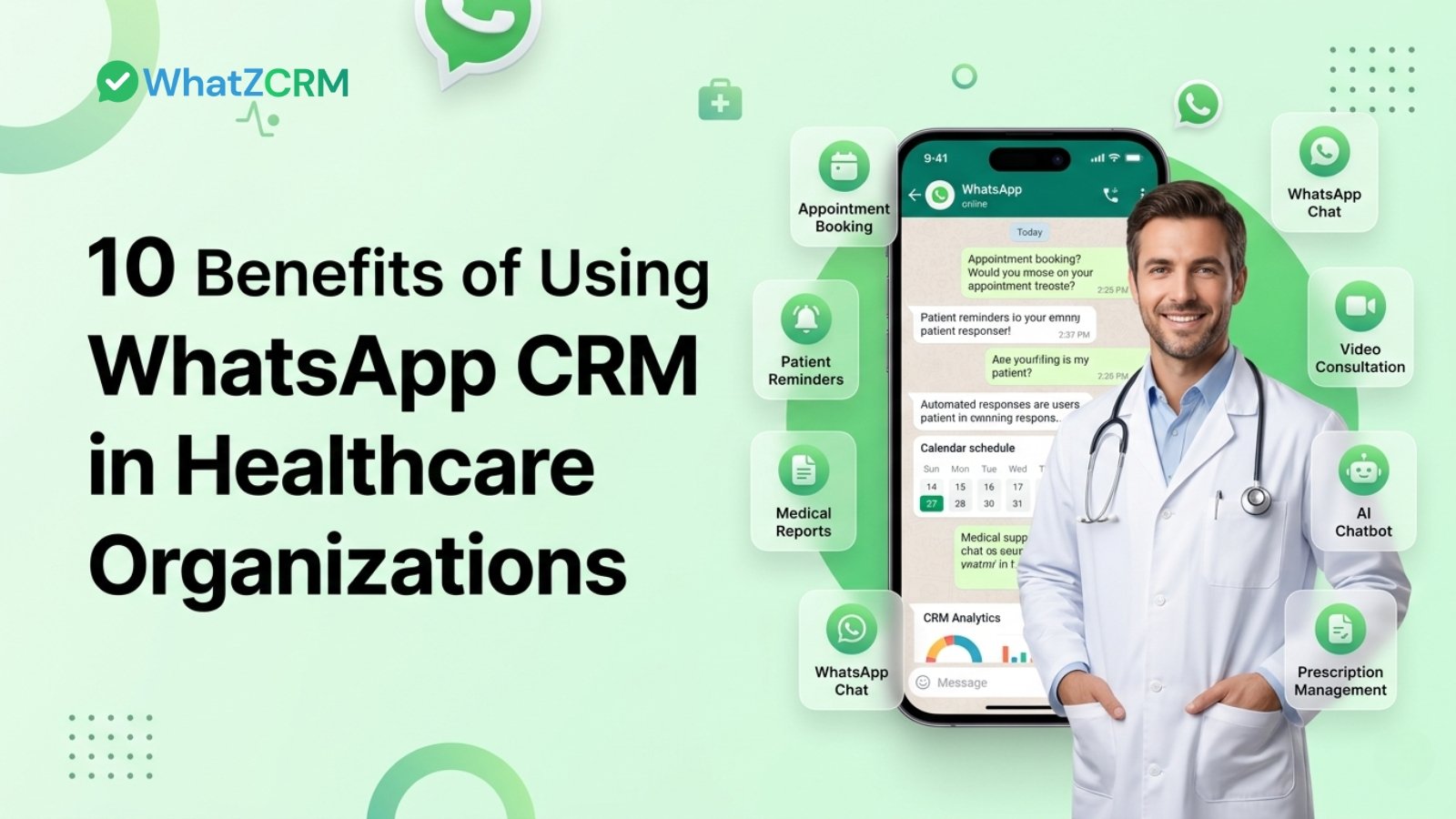

A WhatsApp CRM for healthcare is software built on the WhatsApp Business API. It lets clinics, hospitals, labs, and pharmacies manage patient conversations in one shared inbox. It automates appointment reminders, follow-ups, report delivery and FAQs, and keeps a searchable record of every interaction. Its biggest gains are fewer no-shows, less front-desk workload, and faster patient response.
Table of Contents
ToggleWhat is a WhatsApp CRM for healthcare?
A WhatsApp CRM connects your patient database, appointment system and team inbox to the WhatsApp Business API. Patients message you on the app they already use, with nothing to download. Your staff replies from a shared dashboard, and automation handles the repetitive work.
It differs from the free WhatsApp Business app in four ways:
|
Feature |
WhatsApp Business app |
WhatsApp CRM (Business API) |
|
Team access |
One phone, up to a few linked devices |
Unlimited agents on a shared inbox |
|
Automation |
Basic away and greeting messages |
Chatbots, triggered follow-ups, workflows |
|
Bulk messaging |
Limited broadcast lists |
Approved template campaigns at scale |
|
Patient records |
Manual |
Tags, history, notes, EMR/CRM integration |
|
Analytics |
Minimal |
Response times, agent performance, campaign metrics |
“Studies show that healthcare providers who use WhatsApp-based communication tools see up to a 40% reduction in appointment no-shows and a 60% decrease in inbound call volumes.”
Why healthcare is moving to WhatsApp
WhatsApp has more than 3 billion monthly users worldwide and is the default messaging app for most Indian patients. Patients already ask about timings, reports and bookings on it. Clinics that answer on phone calls alone lose time and miss enquiries. A CRM turns those informal chats into a managed, measurable process.
Also Read: How Small Clinics Can Grow Patients Using WhatsApp
10 benefits of WhatsApp CRM for healthcare organizations
1. Instant replies to patient enquiries
An AI chatbot answers questions about timings, doctors, fees, and services at any hour. Enquiries from your website, Google Ads, social media and directories land in one inbox, so none are missed.
2. Fewer appointment no-shows
Patients book, reschedule or cancel inside WhatsApp. Automated reminders (for example, 24 hours and 2 hours before) cut forgotten visits. Syncing with Google Calendar, Outlook, Practo or Calendly keeps slots accurate. WhatZCRM clients report up to a 40% drop in no-shows.
3. Automated follow-ups and prescription alerts
Trigger messages by visit status or patient tag: post-visit care instructions, medicine refill alerts, lab-result notifications and follow-up reminders. Patients stay on their treatment plan without staff chasing them by phone.
4. Faster sharing of reports and documents
Send lab reports, e-prescriptions, invoices and consent forms inside the conversation. Every file is logged against the patient’s record, which removes paper handling and reduces misdirected sharing.
5. Stronger privacy and compliance controls
A healthcare-ready CRM gives you role-based access, consent-based messaging, conversation logs and audit trails. See the compliance section below for what this does and does not cover.
6. 24/7 multilingual patient support
AI assistants can detect the patient’s language and reply in it, which matters across India’s regional languages. Complex or urgent queries pass to a human agent with the full chat history attached.
7. One view of each patient
Appointments, chat history, notes and treatment updates sit in one searchable record. Integration with EMR/EHR tools such as Practo and HealthPlix means doctors see context before the consultation.
8. Patient retention campaigns
Send approved-template campaigns for vaccination drives, health camps, preventive checkup reminders, birthday greetings and reactivation of lapsed patients. WhatsApp messages typically get higher engagement than SMS or email.
9. Lower operating cost and staff workload
Automating confirmations, FAQs, reminders and report delivery frees front-desk staff. WhatZCRM clients report up to a 65% drop in front-desk call volume. No-code setup means small clinics don’t need developers.
10. Analytics you can act on
Dashboards show message volume, response time, agent performance, appointment adherence and campaign results. Managers can see where patients wait longest and where staffing needs to change.
Also Read: WhatsApp Chatbot for Healthcare: Use Cases, Benefits & How to Get Started
Is WhatsApp CRM compliant for healthcare? What to know
Compliance depends on where you operate, so check these points:
- WhatsApp itself and HIPAA: Meta does not sign a Business Associate Agreement (BAA) for WhatsApp. US providers covered by HIPAA should not send protected health information (PHI) over WhatsApp without legal advice. Use WhatsApp for logistics such as reminders and scheduling, and keep clinical detail inside secure systems.
- India: The Digital Personal Data Protection Act, 2023 governs how you collect, store and process patient data. You need clear consent, a stated purpose and sensible security practices.
- Consent: WhatsApp requires patient opt-in before you send business-initiated messages.
- Templates: Messages sent outside the 24-hour customer service window must use Meta-approved templates. Reminders and confirmations usually qualify as utility templates.
- Sensitive content: Keep diagnoses and detailed clinical information out of message text. Send a secure link or ask the patient to visit instead.
- Vendor controls: Ask your CRM provider about encryption, access roles, audit logs, data hosting location and data deletion.
How to choose a WhatsApp CRM for a clinic or hospital
Check that the platform has:
- Official WhatsApp Business API access through a Meta Business Partner
- A no-code chatbot and workflow builder your staff can run
- Appointment tools and calendar or EMR integrations you already use
- Role-based access, audit logs and consent tracking
- Multilingual support for your patient base
- Transparent pricing that covers Meta’s per-message charges
How to set up WhatsApp CRM in 5 steps
- Apply for WhatsApp Business API access and verify your business.
- Connect your patient list, calendar and EMR or other tools.
- Submit templates for reminders, confirmations, and follow-ups for Meta approval.
- Build Healthcare chatbot flows for FAQs, booking, and escalation to staff.
- Assign roles, test with a small patient group, then go live and review the analytics weekly.
Most clinics complete setup in a few days, depending on Meta approval time.
Common use cases by facility type
- Clinics: booking, reminders, follow-up and review requests
- Hospitals: department routing, discharge instructions, health camp campaigns
- Diagnostic labs: sample-collection scheduling, report delivery, repeat-test reminders
- Pharmacies: refill alerts, order status, payment links
- Telehealth: consultation links, e-prescriptions, post-call follow-up
How WhatZCRM supports healthcare teams
WhatZCRM is a no-code WhatsApp CRM on the official WhatsApp Business API. Healthcare teams use it to run chatbots, shared inboxes, appointment reminders, template campaigns, and reports from one dashboard. It integrates with Google Calendar, Razorpay, Stripe, and other tools. You can start with a free trial or book a live demo.
Final thoughts
Patients already use WhatsApp. A CRM adds structure, automation, and reporting so your team can respond faster without adding headcount. Start with reminders and enquiry handling, measure the results, then expand to follow-ups and campaigns.
Book a free WhatZCRM demo to see these workflows built for your clinic or hospital.
Frequently Asked Questions (FAQs)
A WhatsApp CRM for healthcare is a specialized customer relationship management platform that uses WhatsApp Business API to manage patient communication, automate appointment reminders, share medical documents, and streamline follow-ups — all within a HIPAA-compliant environment.
Standard WhatsApp is not inherently HIPAA-compliant. However, purpose-built platforms like WhatZCRM layer HIPAA-compliant infrastructure — including end-to-end encryption, consent-based messaging, audit logs, and data access controls — onto the WhatsApp Business API to meet healthcare compliance standards.
WhatsApp CRM benefits healthcare organizations of all sizes. Solo practitioners can automate appointment reminders and patient queries without any technical skills, while large hospital chains can leverage multi-agent routing, bulk campaigns, and EMR integrations. WhatZCRM offers scalable pricing designed for both.
WhatsApp CRM reduces no-shows by sending automated, personalized reminders at strategic intervals before the appointment — for example, 24 hours and 2 hours prior. Patients can confirm, reschedule, or cancel directly via WhatsApp, giving the clinic advance notice and enabling rebooking of freed slots.
Leading platforms like WhatZCRM integrate with Google Calendar, Outlook, Practo, HealthPlix, custom EMR/EHR systems, Salesforce, Zoho CRM, HubSpot, DocuSign, Google Drive, Stripe, Razorpay, and Facebook/Google Ads — creating a unified healthcare communication and data ecosystem.
Yes. Advanced WhatsApp CRM platforms like WhatZCRM include AI assistants that automatically detect patients' languages and respond in over 50 languages — making them ideal for healthcare organizations serving diverse patient populations across regions.
With a no-code platform like WhatZCRM, most clinics can be up and running within hours. The drag-and-drop chatbot builder allows non-technical staff to design automated workflows without developer resources. WhatZCRM also offers a free trial and live demo to help healthcare teams get started quickly.