
A WhatsApp CRM for education connects the WhatsApp Business API to a lead pipeline, shared inbox, and automation engine. Institutes use it to reply to inquiries instantly, personalize follow-ups, re-engage students who stall mid-application, and track every lead from first message to enrollment. It fixes six common problems: ignored emails, generic messaging, slow replies, scattered records, application drop-off, and missing data.
Most students and parents in India already use WhatsApp daily, so inquiries and follow-ups land where they actually get read. Email and cold calls rarely reach them.
What is a WhatsApp CRM for education?
A WhatsApp CRM for education is software that lets admissions teams run student conversations on WhatsApp through the official Business API, with CRM features on top: lead capture, tagging, pipeline stages, automated follow-ups, chatbots, a multi-agent inbox, and analytics. It differs from the free WhatsApp Business App because it supports many agents on one number, bulk template campaigns, and workflow automation.
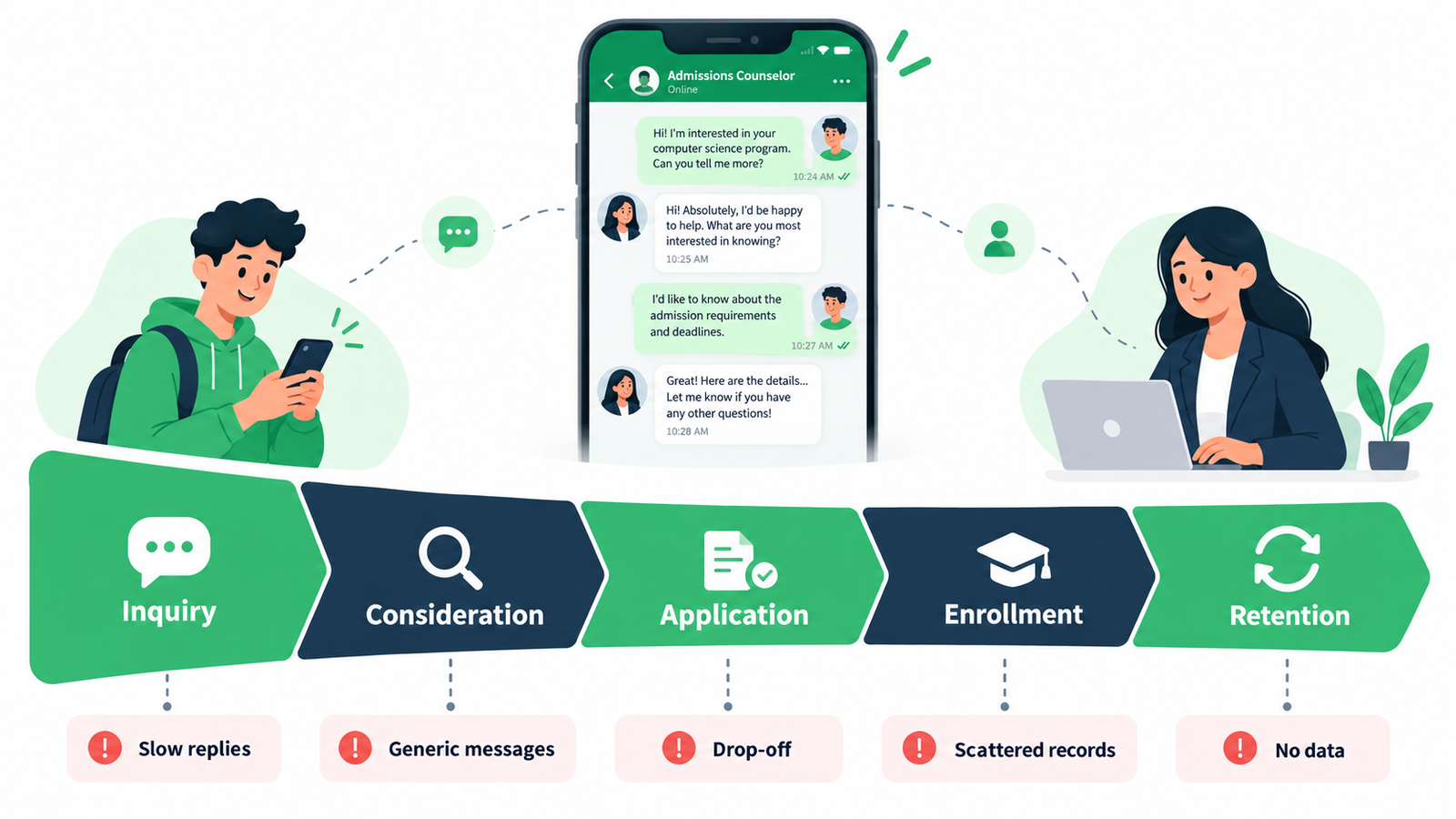
The Student Communication Funnel: where enrollment is lost
We break the journey into five stages. Each problem below maps to one.
Stage | What the student needs | Where institutes lose them |
1. Inquiry | Fast answer on fees, eligibility, dates | Slow or missed replies |
2. Consideration | Relevant details for their course | Generic broadcasts |
3. Application | Reminders and help with documents | Silent drop-off |
4. Enrollment | Payment, confirmation, onboarding | Fragmented records |
5. Retention | Updates, support, re-enrollment | No visibility into engagement |
Problem 1: Why do students ignore emails and calls from institutions?
Emails get buried, and unknown numbers look like spam, so students never see your message. WhatsApp is checked many times a day, and business messages commonly report open rates above 90%, versus roughly 20–25% for education email in typical industry benchmarks.
By the time a counselor finally reaches a student by phone, that student has often spoken to two other institutes.
The fix: Send the first reply on WhatsApp, then automate a nudge if the message is read but unanswered. For example, trigger a contextual follow-up after 4 hours, then again after 24 hours, without counselor effort.
Problem 2: Can institutes personalize communication at scale?
Yes. Segment students by course interest, city, application stage, or lead source, then send messages that pull in their name, program, and next step automatically.
Example workflow message: “Hi Rohan, we’ve received your documents for the MBA program. Your counselor, Priya, will call you by Thursday. Here’s what happens next.”
What to set up:
- Dynamic fields: name, program, stage, assigned counselor
- Tags: course interest, inquiry date, source (ad, walk-in, website)
- Branching: different paths based on button replies
- Regional language templates (Hindi, Telugu, Tamil, and others) for parents
Also Read: How to Utilize End-to-End WhatsApp CRM Platform for Coaching Institutes
Problem 3: How can institutes reply to student inquiries faster?
Use a chatbot to answer common questions instantly, 24/7, and route complex ones to counselors with the full chat history attached.
Speed matters. A widely cited lead-response study found that contacting a lead within 5 minutes made it about 100 times more likely you’d reach them, and about 21 times more likely to qualify them, than waiting 30 minutes. Most admissions teams can’t hit 5 minutes manually across hundreds of simultaneous inquiries.
The hybrid model:
- Chatbot layer: handles fees, eligibility, deadlines, batch timings, and campus details instantly.
- Human layer: counselors take high-intent conversations with context already visible.
Problem 4: Why does student data end up fragmented, and how is it fixed?
Calls, walk-ins, website forms, ads, and chats usually live in different tools. A WhatsApp CRM creates one profile per student that every team member can see.
A unified profile should hold:
- Full chat history and assigned counselor
- Course interest and application stage
- Document status and fee status
- Notes, reminders and last interaction date
Any counselor can then pick up a conversation mid-stream, and students don’t have to repeat themselves.
Problem 5: Why do students drop off during enrollment, and how do you win them back?
Most drop-offs come from friction or a missed nudge, not lost interest. A student who starts an application is still a warm lead. Behavior-triggered WhatsApp messages bring them back.
Trigger | Automated action |
Form started, not submitted (24 hrs) | Reminder with a direct link |
Webinar attended, no next step | “What questions can we answer?” |
Documents pending (3 days) | Step-by-step upload guide |
No reply (7 days) | Deadline reminder or counselor call offer |
Admission offered, fee unpaid | Payment link with due date |
Example: “Hi Priya, your application is 80% done. Finish it today, and the form takes under 5 minutes: [link].”
Also Read: WhatsApp Chatbot for Education: Use Cases, Benefits, and How Institutes Set One Up
Problem 6: How do you measure what’s working?
Track response time, conversion by stage, and counselor performance in one dashboard instead of spreadsheets.
KPIs to monitor:
- First response time
- Inquiry-to-application and application-to-enrollment rate
- Template read and reply rates
- Counselor-wise follow-up completion
- Drop-off by stage and by lead source
Also Read: WhatsApp Campaign Tracking: How to Measure Results, Leads, and ROI
WhatsApp CRM vs. traditional channels
Email/calls/spreadsheets | WhatsApp CRM | |
Reach | Low open and pickup rates | High read rates |
First response | Hours to days | Seconds (chatbot), minutes (counselor) |
Personalization | Manual | Automated by segment |
Student record | Split across tools | One profile |
Re-engagement | Manual calls | Trigger-based flows |
Reporting | Basic or none | Funnel and counselor analytics |
Who benefits most?
- Coaching institutes: hundreds of daily inquiries, batch-wise follow-ups, fee reminders
- Colleges and universities: counselor routing, document collection, scholarship alerts
- Schools: admissions plus parent updates, event notices, fee collection
- EdTech platforms: demo bookings, trial-to-paid nurturing, renewal reminders
How to stay compliant (India)
- Get opt-in before messaging, and honor opt-outs quickly.
- Use Meta-approved templates for business-initiated messages. Free-form replies are allowed inside the 24-hour customer service window.
- Handle student data under India’s Digital Personal Data Protection (DPDP) Act: collect only what you need, state the purpose, and be careful with data on minors, where parental consent rules apply.
- Check Meta’s current pricing: WhatsApp Business API charges are per message by category (marketing, utility, authentication, service). Review Meta’s latest rate card before budgeting campaigns.
How WhatZCRM supports student enrollment
WhatZCRM is built on the official WhatsApp Business API and covers the full funnel:
- AI chatbot builder: no-code, drag-and-drop; automates up to 80% of FAQs
- CRM and pipeline: lead management and application-stage tracking
- Bulk broadcasts: personalized template campaigns
- Multi-agent inbox: unlimited agents on one WhatsApp number
- No-code automation: workflows triggered by student actions
- Analytics: campaign, counselor, and funnel performance
- Payments on WhatsApp: collect fees inside the chat
- Multilingual messaging: reach students and parents in their preferred language
Most institutes go live in 2–4 weeks: API verification, platform setup, template approval, team onboarding, and integrations. Dedicated education onboarding support is included.
Quick-start checklist
- Define your funnel stages (Inquiry → Applied → Documents → Offer → Enrolled).
- Write 5–8 templates: welcome, document request, fee reminder, deadline nudge, event invite.
- Build the FAQ chatbot for your top 10 questions.
- Set follow-up timers (4 hrs, 24 hrs, 3 days, 7 days).
- Assign counselors and routing rules.
- Review the dashboard weekly and fix the biggest drop-off stage first.
Conclusion
Student communication problems are rarely about effort. They come from using channels students don’t check, tools that don’t talk to each other, and follow-ups that depend on someone remembering. A WhatsApp CRM fixes this by replying in seconds, personalizing at scale, keeping one record per student, and re-engaging applicants who stall.
Start small: automate your top 10 FAQs and your 24-hour application reminder, then fix the stage where you lose the most students. With WhatZCRM, most institutes go live in 2-4 weeks.