
Every day, hospital front desks are flooded with calls. Patients wait on hold to book appointments. Test results get delayed. Follow-up reminders never get sent. And staff burn hours on manual tasks that should have been automated years ago.
The result? Frustrated patients, overwhelmed staff, and rising no-show rates that cost healthcare facilities thousands of rupees every month.
WhatsApp CRM for healthcare is changing how hospitals and clinics communicate, and the results are remarkable. With over 3 billion active users, WhatsApp is already on every patient’s phone. Combine that reach with the WhatsApp Business API for healthcare and a purpose-built CRM like WhatZCRM, and you have a communication engine that automates patient workflows, reduces administrative workload, and delivers better care at scale.
In this guide, you’ll learn exactly how hospitals and clinics use WhatsApp to transform patient care from appointment scheduling to AI-powered 24/7 support, along with best practices, a real-world comparison, and a step-by-step implementation roadmap.
What Is WhatsApp CRM for Healthcare?
WhatsApp CRM for Healthcare is a dedicated communication and workflow management system that integrates the WhatsApp Business API with healthcare CRM software. It enables hospitals, clinics, diagnostic labs, and telehealth providers to manage patient conversations, automate outreach, schedule appointments, share medical documents, and provide 24/7 support all within WhatsApp.
Also Read: What Is WhatsApp CRM and How It Works for Businesses in 2026
Why WhatsApp Is the Right Channel for Healthcare Communication
Before diving into use cases, it’s worth understanding why WhatsApp outperforms traditional communication channels in healthcare settings.
| Feature | WhatsApp CRM | SMS / Email | Phone Calls |
| Open Rate | 98% | 20-30% | ~70% (voicemail risk) |
| Media Sharing | Docs, Images, Video, Voice | Text only | None |
| Automation | Full (chatbots, flows) | Partial | None |
| Two-Way Chat | Yes (real-time) | Limited | Yes (manual) |
| Cost per Message | Very low via API | Low-medium | High (staff time) |
| HIPAA Compliance | Yes (via API + CRM) | Partial | Yes |
| Patient Familiarity | Very high (2B+ users) | Medium | High |
WhatsApp’s instant messaging provides a direct line between patients and healthcare providers that no other channel can match. The combination of near-universal adoption, rich media support, and real-time responsiveness makes it the clear winner for modern healthcare communication.
How Hospitals and Clinics Use WhatsApp Business API?
1. Appointment Scheduling, Booking & Automated Reminders
Manual appointment booking is one of the biggest drains on front-desk staff. Integrating WhatsApp communications with your existing hospital CRM through WhatZCRM enables patients to book, reschedule, or cancel appointments directly via WhatsApp, no phone calls, no waiting.
- Schedule appointments instantly via WhatsApp chat
- Sync with Google Calendar, Outlook, Practo, and more
- Automate appointment reminders 24, 12, and 1 hour before visits
- Send automated follow-up booking prompts after consultations
The result: hospitals using WhatZCRM report a 40% reduction in no-show rates through consistent, automated reminder sequences and appointment confirmation rates climbing to 80%.
2. WhatsApp Chatbots for Patient Inquiry Automation
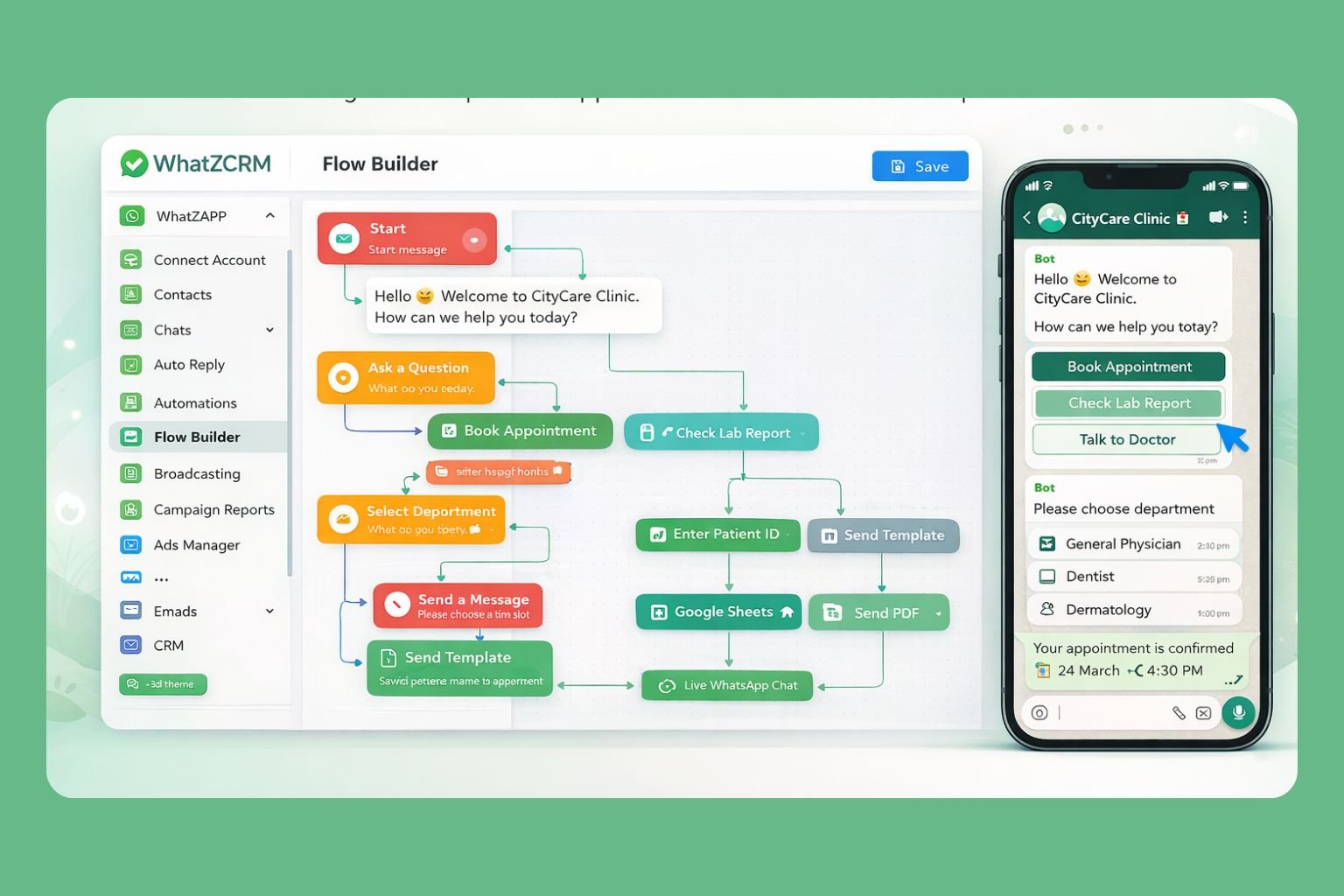
A WhatsApp chatbot for healthcare acts as a 24/7 virtual front desk. When patients message your clinic from ads, directories, or your website, the chatbot responds instantly with relevant information, collects symptoms, and routes complex queries to the right staff member.
- Handle FAQs about timings, services, and availability automatically
- Collect patient name, symptoms, and contact details before staff engagement
- WhatsApp chatbots improve patient engagement by reducing wait times from minutes to seconds
- Escalate urgent medical queries to on-call staff in real time
For clinics overwhelmed with inbound calls, WhatsApp chatbot healthcare automation can reduce call volumes by up to 65%, freeing your team to focus on in-person care.
3. Prescription & Medication Reminders
Medication non-adherence is a major challenge in patient care. WhatsApp medication reminders in healthcare directly address this. Automated, personalised messages keep patients on track with their prescribed treatment.
- Trigger refill reminders based on prescription date and dosage schedule
- Send post-discharge care instructions immediately after release
- Automate follow-up check-ins at 3, 7, and 30 days post-treatment
- Pharmacies using WhatZCRM report 60% of repeat orders completed via WhatsApp
4. Secure Medical Document Sharing
Sharing lab reports, prescriptions, discharge summaries, and invoices via WhatsApp is now secure, instant, and auditable. WhatZCRM’s document sharing module uses end-to-end encryption with full audit trails.
- Lab results delivered to patients within minutes of upload (90% accessed in under 10 minutes)
- Digital signatures and consent forms collected via WhatsApp, no paperwork
- Secure e-prescription delivery with read receipts
- Reduce admin overhead and inbound queries by 40%
6. Patient Education, Health Alerts & Preventive Campaigns
WhatsApp can help healthcare providers streamline communication beyond transactional messages. Proactive campaigns build long-term patient relationships and drive preventive care.
- Send seasonal health alerts (flu season, dengue outbreaks, vaccination drives)
- Personalised birthday greetings and annual checkup reminders
- Share evidence-based wellness tips and post-treatment rehabilitation content
- Multi-specialty hospitals using bulk WhatsApp campaigns see 3x more patient responses vs. SMS
7. Integration with Hospital Information Systems (HIS) and EMR/EHR
Hospital Information Systems (HIS) store the complete patient data ecosystem from medical history to billing. Integrating WhatsApp communications with your existing hospital CRM and HIS through WhatZCRM creates a unified, searchable record of every patient interaction.
- Sync appointment data with Practo, HealthPlix, and custom EMR/EHR systems
- Auto-log every WhatsApp conversation in patient CRM profiles
- Real-time access for care teams across departments
Also Read: How WhatsApp Chatbots Can Improve Healthcare Communication?

How WhatZCRM Elevates WhatsApp Communication for Hospitals
WhatZCRM is purpose-built for healthcare providers who need more than a messaging app; they need a complete patient communication engine. Here is what makes it the leading WhatsApp CRM for hospitals and clinics:
| Feature | How It Helps Healthcare Teams |
| Centralized Team Inbox | Multiple agents manage patient chats across departments, no duplicate replies, no missed messages |
| No-Code Chatbot Builder | Build WhatsApp automation workflows without technical skills using drag-and-drop tools |
| Automated Reminders & Alerts | Schedule appointments, medication, and follow-up messages triggered by patient events |
| Secure Document Delivery | Send reports, prescriptions, and consent forms with encryption and audit trails |
| AI Assistant (50+ Languages) | 24/7 multilingual patient support that escalates urgent cases to staff in real time |
| HIS / EMR Integration | Sync with Practo, HealthPlix, Google Calendar, and custom healthcare systems |
| Analytics Dashboard | Track response times, no-show patterns, campaign engagement, and agent performance |
| HIPAA / GDPR Compliance | End-to-end encryption, audit logs, and consent-based messaging built in |
Best Practices and Challenges: What Every Hospital Should Know
Best Practices
- Always use the official WhatsApp Business API, never personal accounts, to ensure compliance, scalability, and security
- Obtain explicit patient consent before initiating automated messages
- Maintain a professional, empathetic tone in all automated templates
- Use WhatsApp automation for routine tasks; escalate clinical queries to qualified staff
- Regularly review analytics to identify bottlenecks in patient communication flows
Key Challenges to Plan For
- Data privacy and HIPAA compliance: Ensure your CRM vendor (like WhatZCRM) provides end-to-end encryption, audit logs, and GDPR-ready data handling
- Message template approval: WhatsApp Business API requires pre-approved message templates for an outbound communications plan for a 24-72 hour review cycle
- Human oversight for clinical queries: AI chatbots handle FAQs well, but any symptom-based or medical advice query must reach a trained staff member
- Over-messaging risk: Limit outbound campaigns to high-value, consent-based messages avoid frequency patterns that lead to patients blocking your number
Also Read: How WhatZCRM Simplifies Automated WhatsApp Follow-Ups for Businesses
How WhatZCRM Elevates WhatsApp Communication for Hospitals
Centralized Team Inbox: Manage multiple patient chats across departments without chaos.
Automated Workflows & Chatbots: Automate appointment scheduling, reminders, and follow-ups, reducing manual workload and speeding response time.
Secure Document Sharing: Send lab reports, prescriptions, and test results securely, ensuring compliance and protecting patient privacy.
Analytics & Reporting: Monitor response times, patient engagement, and follow-up success, enabling hospitals to optimize communication workflows effectively.
Improved Patient Outcomes: Automated reminders, telehealth support, and real-time communication improve adherence, reduce no-shows, and enhance overall patient care.
Conclusion:
In modern healthcare, patient communication is no longer a back-office function, it is a clinical differentiator. Hospitals and clinics that automate appointment reminders, reduce no-shows, speed up report delivery, and engage patients proactively are simply delivering better care.
WhatsApp CRM for healthcare, powered by the WhatsApp Business API and purpose-built platforms like WhatZCRM, gives every healthcare provider, from solo GPs to multi-specialty hospitals, the tools to make this transformation without overhauling their existing systems.
The technology is proven. The patient demand is there. The only question is how quickly your team gets started.