
WhatsApp has crossed 3 billion active users in 2026, and businesses that aren’t leveraging WhatsApp Broadcast are leaving serious revenue on the table.
Whether you’re a growing e-commerce brand, an education provider, a healthcare clinic, or a service business, WhatsApp broadcast messaging remains one of the most powerful ways to reach customers where they already are. But doing it wrong in 2026 can get your number banned permanently.
This guide covers everything you need to know about WhatsApp Broadcasting in 2026, what it is, how it works, the right way to do it at scale, and how to avoid the most common mistakes that get businesses blocked.
Table of Contents
ToggleWhat Is WhatsApp Broadcast?
A WhatsApp Broadcast is a one-to-many messaging feature that lets your business send the same message to multiple contacts, but each recipient receives it as a private, personal message in their own chat.
Unlike WhatsApp Groups, recipients in a Broadcast cannot see each other. It feels personal to them. That’s exactly why it works so well.
Common use cases include:
- Promotional offers and seasonal campaigns
- New product or service announcements
- Appointment reminders and follow-ups
- Payment confirmations and delivery updates
- Re-engagement messages for cold leads
WhatsApp Broadcasting consistently delivers open rates above 90%, far exceeding those of email, SMS, or social media ads. In 2026, that number remains, making it the most reliable direct communication channel for businesses.
WhatsApp Broadcast: Business App vs. Business API
There are two ways to send broadcasts, and the method you choose determines your reach, scalability, and risk of getting blocked.
WhatsApp Business App
The free WhatsApp Business App has a built-in broadcast feature, but it comes with hard limitations:
- Maximum 256 contacts per broadcast list
- Recipients must have saved your number in their contacts
- No automation, no scheduling, no analytics
- Limited to 2 devices simultaneously
For small businesses just getting started, this works fine. But the moment you want to scale and reach thousands of customers, personalize messages automatically, and track results, the Business App quickly becomes a bottleneck.
WhatsApp Business API
The WhatsApp Business API is the official solution for businesses that need to broadcast at scale. With the API, you can:
- Reach unlimited contacts in a single broadcast
- Message users who have not saved your number
- Automate follow-up sequences and drip campaigns
- Personalize messages dynamically with contact attributes
- Track delivery, open, and reply rates in real time
- Build full WhatsApp CRM workflows around your broadcasts
The API is not a standalone app; it requires a platform like WhatZCRM to operate through, which provides a complete dashboard for managing campaigns, contacts, and automation.
How to Send WhatsApp Broadcast in 2026 Using WhatZCRM
WhatZCRM connects directly to the WhatsApp Business API, giving you a powerful broadcast system built inside a full CRM platform.
Here’s how to send a broadcast campaign step by step:
Step 1: Connect Your WhatsApp Business API Account. Link your approved WhatsApp Business API number to WhatZCRM. The setup is quick and requires no coding.
Step 2: Import and Segment Your Contacts. Upload your contact list or sync leads directly. Use WhatZCRM segmentation tools to filter contacts by industry, behavior, tags, or pipeline stage. Send the right message to the right group, not a generic blast to everyone.
Step 3: Create a Pre-Approved Message Template. WhatsApp requires broadcast messages to use approved templates for contacts outside the 24-hour activity window. WhatZCRM makes template creation and submission straightforward, with built-in approval tracking.
Step 4: Schedule or Send Immediately: Choose to send instantly or schedule your broadcast for optimal timing. WhatZCRM lets you queue campaigns and manage multiple broadcasts from a single dashboard.
Step 5: Monitor Performance in Real Time. Track delivery rates, read rates, reply rates, and link clicks all inside WhatZCRM’s analytics dashboard. Use these insights to improve every subsequent campaign.
Also Read: WhatsApp Broadcast vs WhatsApp Group: Key Differences
WhatsApp Broadcast Limits in 2026: Understanding the Tier System
One question we get asked frequently: how many people can I message?
The answer depends on your trust tier with WhatsApp:
Tier | Daily Broadcast Limit |
Tier 1 | 2,000 unique users/day |
Tier 2 | 10,000 unique users/day |
Tier 3 | 100,000 unique users/day |
Tier 4 | Unlimited |
You start at Tier 1 after API approval. Moving up tiers happens automatically as you demonstrate responsible sending behavior, consistent delivery, low block rates, and strong engagement. Most active businesses reach Tier 3 within a few weeks.
How to Avoid Getting Blocked When Broadcasting on WhatsApp
This is the question that matters most in 2026. WhatsApp’s quality enforcement has become significantly stronger. Here are the non-negotiable rules:
- Only message opt-in contacts. Every contact in your broadcast list must have actively given consent to receive messages from your business. Sending to cold, purchased, or scraped lists is the fastest way to get your number banned.
- Use approved templates. For contacts you haven’t interacted with recently, always use pre-approved template messages. Trying to bypass this with regular messages triggers WhatsApp’s spam detection.
- Personalize your messages. Generic mass blasts get blocked at higher rates. Use dynamic variables — names, order details, or relevant context to make each message feel relevant to the recipient.
- Keep your quality rating green. WhatsApp assigns your business number a quality score based on how recipients interact with your messages. High block rates or spam reports lower your score and can result in broadcast limits or bans.
- Maintain a two-way conversation. Encourage replies. WhatsApp rewards businesses that generate real conversation, not just outbound broadcasts. A simple CTA that invites a response improves your quality score over time.
- Avoid spammy frequency. Messaging the same contacts multiple times within short windows signals spam behavior. Space your campaigns thoughtfully.
Also Read: How to Send Bulk WhatsApp Messages Without Getting Banned in 2026
WhatsApp Broadcast + CRM: Why 2026 Demands an Integrated Approach
Here’s what most broadcast guides miss: broadcasting without a CRM behind it is just noise.
In 2026, the businesses winning with WhatsApp are not the ones blasting the most messages; they’re the ones following up intelligently after the broadcast lands.
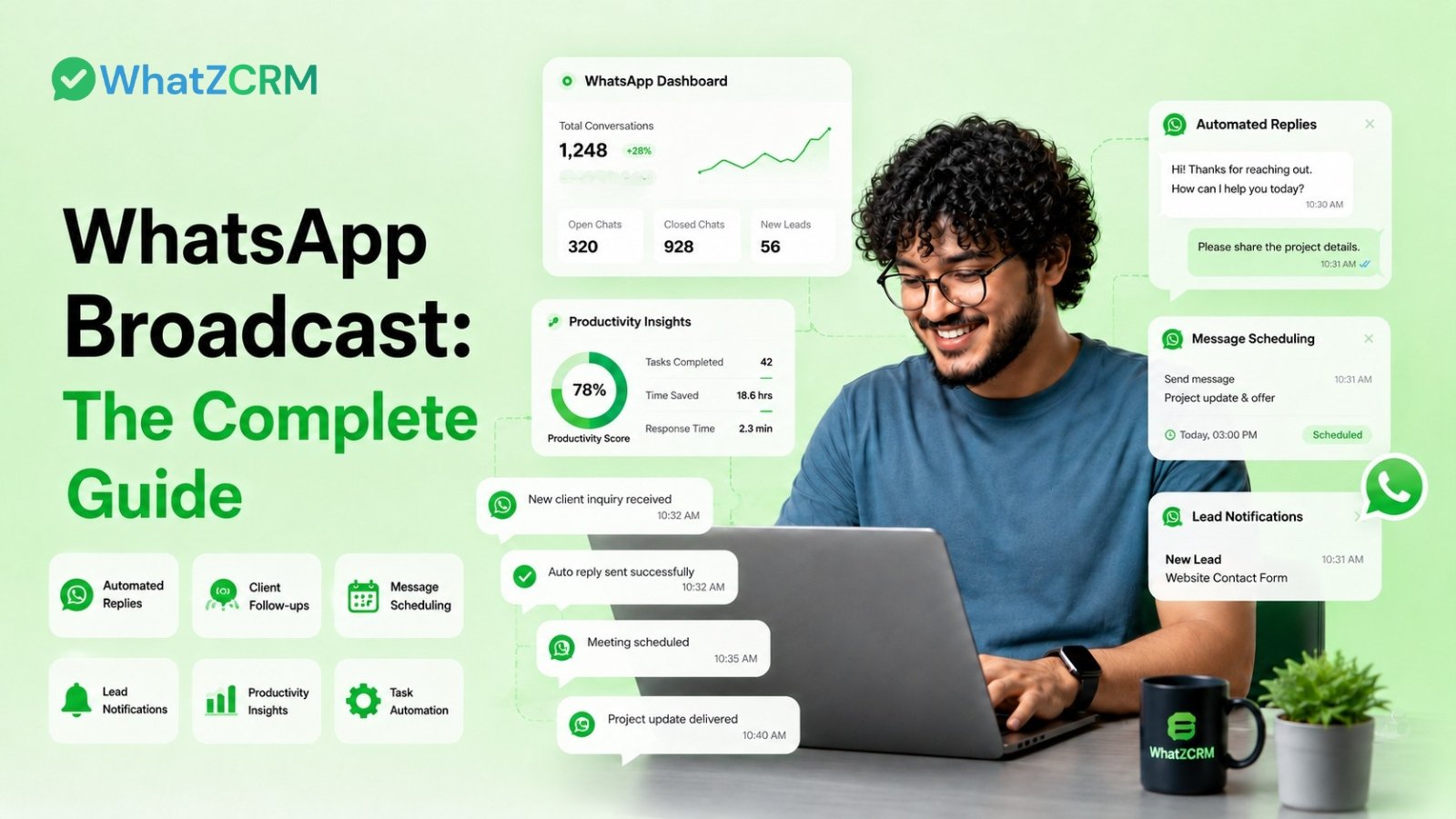
With WhatZCRM, your broadcast campaigns connect directly to your sales pipeline. When a contact replies to a broadcast, their conversation opens automatically in your team inbox. Your sales team can pick up from exactly where the broadcast left off with full context, tags, and history visible. No switching tabs. No missed leads.
You can also trigger automation workflows based on broadcast replies, automatically moving a lead to the next pipeline stage, assigning a follow-up task, or sending a personalized follow-up message.
This is the difference between a broadcast tool and a broadcast system.
What’s New With WhatsApp Broadcasting in 2026
A few important updates businesses need to be aware of this year:
- AI-powered template generation: WhatZCRM now offers AI-assisted message drafting, helping you create broadcast templates faster while staying compliant with WhatsApp’s policies.
- Retargeting broadcasts: Rebroadcast specifically to contacts who read but didn’t reply or who clicked a link but didn’t convert, creating multi-touch follow-up campaigns entirely within WhatsApp.
- Rich media broadcasts: Sending images, PDFs, videos, and interactive buttons in broadcast messages is now standard, dramatically improving engagement compared to text-only campaigns.
- Stronger quality enforcement: WhatsApp’s spam detection is smarter than ever. Businesses not following opt-in rules are being banned faster than in previous years.
Common WhatsApp Broadcast Mistakes to Avoid
- Importing contacts who never opted in — instant quality score damage
- Sending the same template repeatedly without variation triggers spam flags
- Ignoring replies — wasted opportunities and signals poor engagement with WhatsApp
- Using unofficial bulk sender tools — these violate WhatsApp’s Terms of Service and result in permanent bans
- No segmentation — sending the same message to all contacts regardless of their stage, industry, or interest destroys relevance
Final Thoughts
WhatsApp Broadcasting in 2026 is not about sending more; it’s about sending smarter.
WhatZCRM gives your business everything you need to run compliant, personalized, and high-converting broadcast campaigns, all connected to a full CRM pipeline, so every lead who responds gets the follow-up they deserve.
→ Start your free WhatZCRM trial and launch your first WhatsApp Broadcast campaign today.
Frequently Asked Questions (FAQs)
The WhatsApp Business App is free but limited to 256 contacts. The WhatsApp Business API requires conversation-based pricing from Meta. WhatZCRM offers plans to suit businesses at every stage. Check pricing here.
No. Each recipient receives the message as a private chat, identical to a direct message from your business.
Yes, WhatZCRM supports broadcast scheduling, so you can plan campaigns in advance and reach contacts at the right moment.
In a broadcast, each recipient receives a private message and cannot see other recipients. In a group, everyone sees each other, and all messages are visible to the whole group.
Most businesses move through broadcast tiers within 2–4 weeks by maintaining consistent quality metrics. WhatZCRM's analytics dashboard helps you monitor quality ratings throughout.