


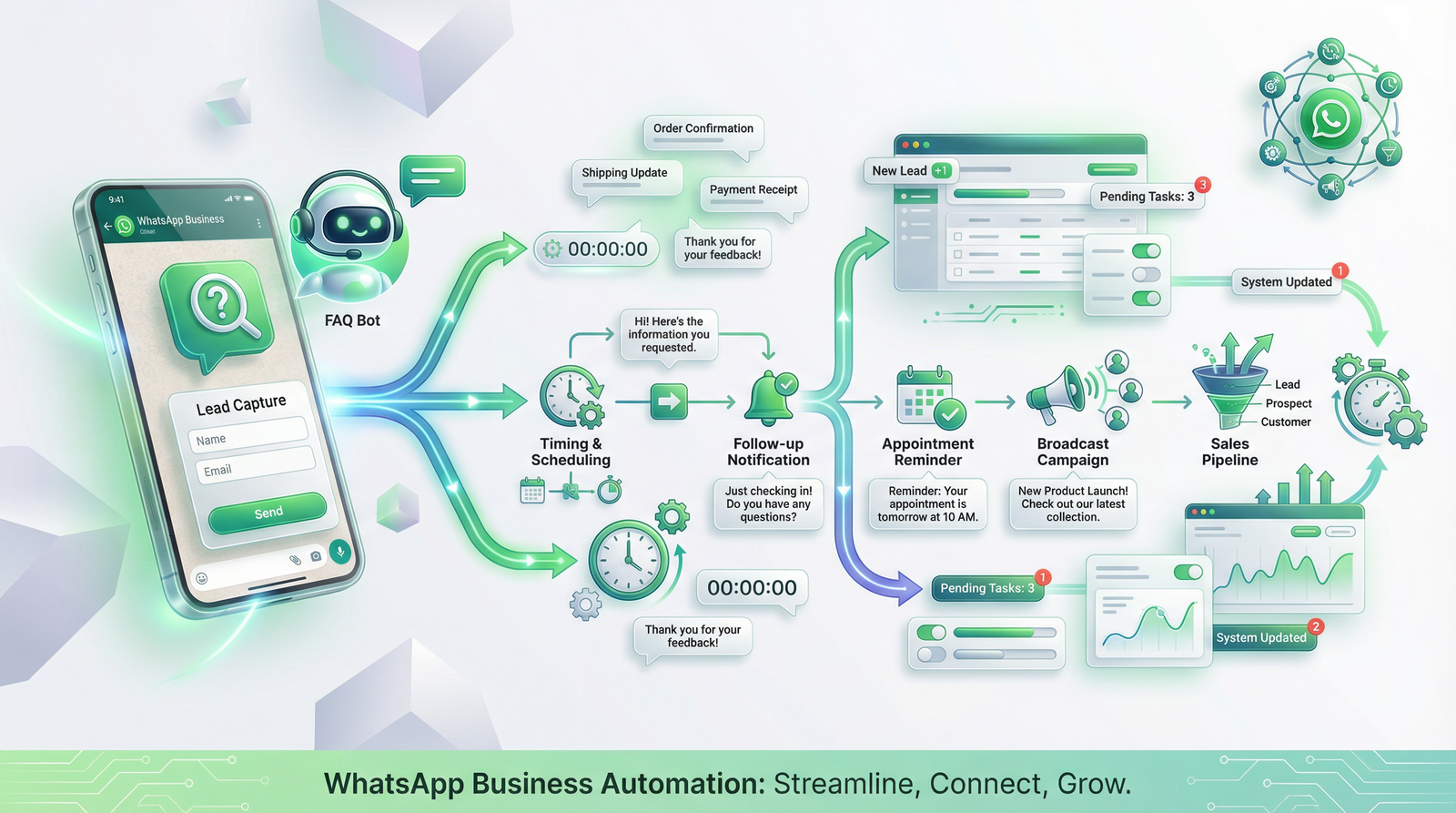
 Small businesses today are expected to respond to customers instantly. Whether it’s a product inquiry, service request, or pricing question, customers expect quick replies. But for most small teams, managing conversations across phone calls, social media, website forms, and WhatsApp messages becomes overwhelming.
This is where WhatsApp automation becomes extremely valuable.
Instead of replying to every message manually, businesses can automate replies, capture leads, assign conversations to the right team members, and send follow-ups automatically. In fact, WhatsApp automation can reduce manual workload and improve productivity, helping businesses respond to customers faster and close more sales.
In this guide, you’ll learn how WhatsApp automation strategies help small businesses manage conversations efficiently, improve customer engagement, and generate more leads using automation tools and workflows.
What Do We Know About WhatsApp Automation?
WhatsApp automation refers to the use of software, chatbots, workflows, and CRM systems to automatically handle customer communication on WhatsApp.
With automation, businesses can respond instantly to messages, capture customer information, schedule follow-ups, and run marketing campaigns without manual effort.
For example, when a customer sends a message asking for product pricing, an automated WhatsApp system can instantly respond, collect the customer’s details, and assign the lead to a sales agent.
This is why WhatsApp automation helps businesses handle high message volumes without increasing staff.
Many companies now use a WhatsApp automation tool to streamline communication, improve response times, and manage customer interactions from a single platform.
Why Small Businesses Should Adopt WhatsApp Automation?
Customers expect quick responses, especially on messaging platforms. When businesses reply slowly or miss inquiries, potential customers often move to competitors.
WhatsApp message automation can help your business respond instantly, capture leads automatically, and maintain consistent communication with customers. Instead of spending hours replying to repetitive questions, teams can focus on sales and customer relationships.
Automation also improves productivity by handling repetitive tasks such as greeting messages, appointment confirmations, and follow-ups.
When implemented properly, WhatsApp automation can reduce manual workloads and improve productivity, allowing small teams to manage large volumes of conversations efficiently.
Also Read: How WhatsApp Business Greeting Message Works and 50+ Message Templates
How WhatsApp Automation Works for Businesses
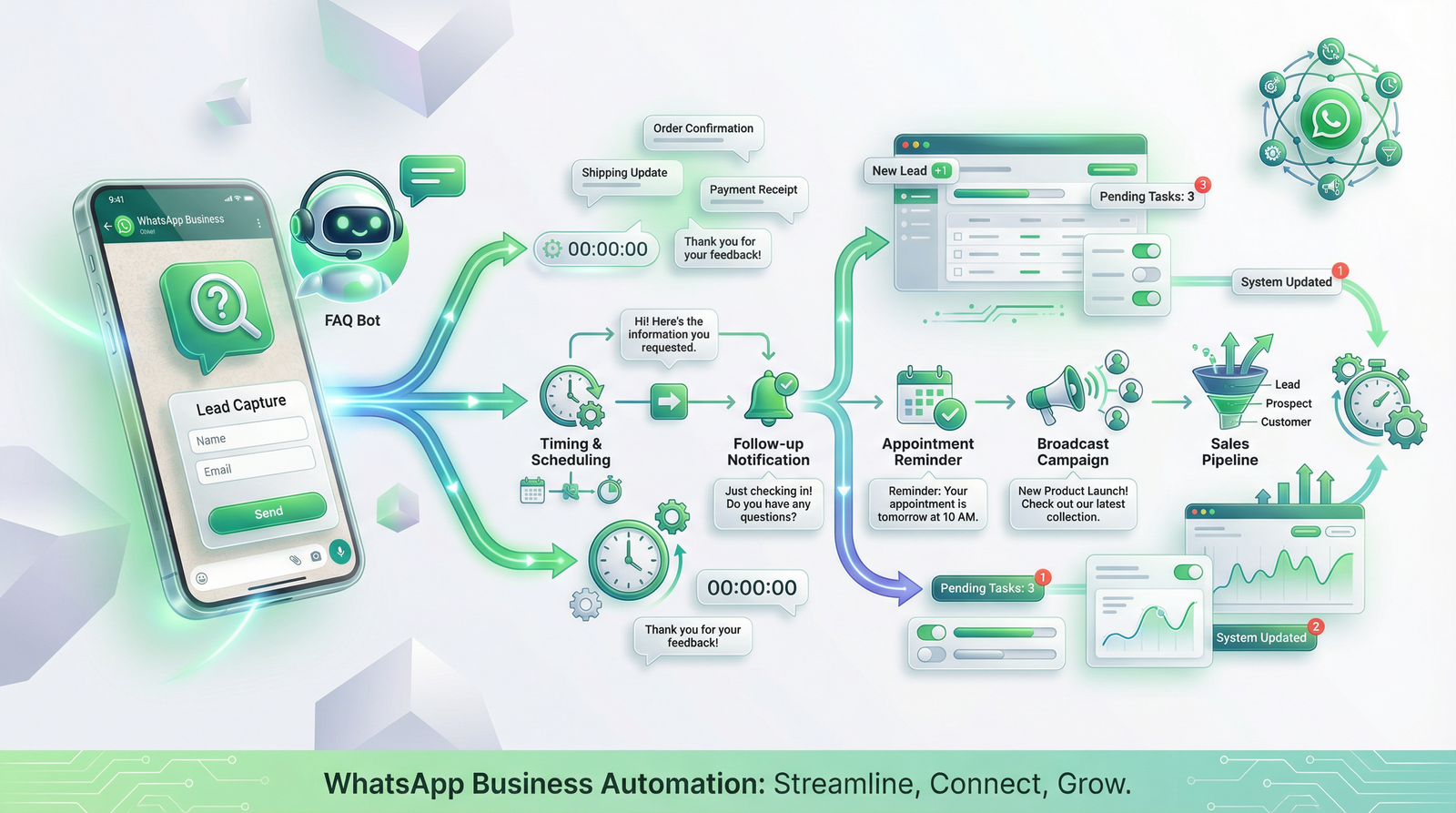
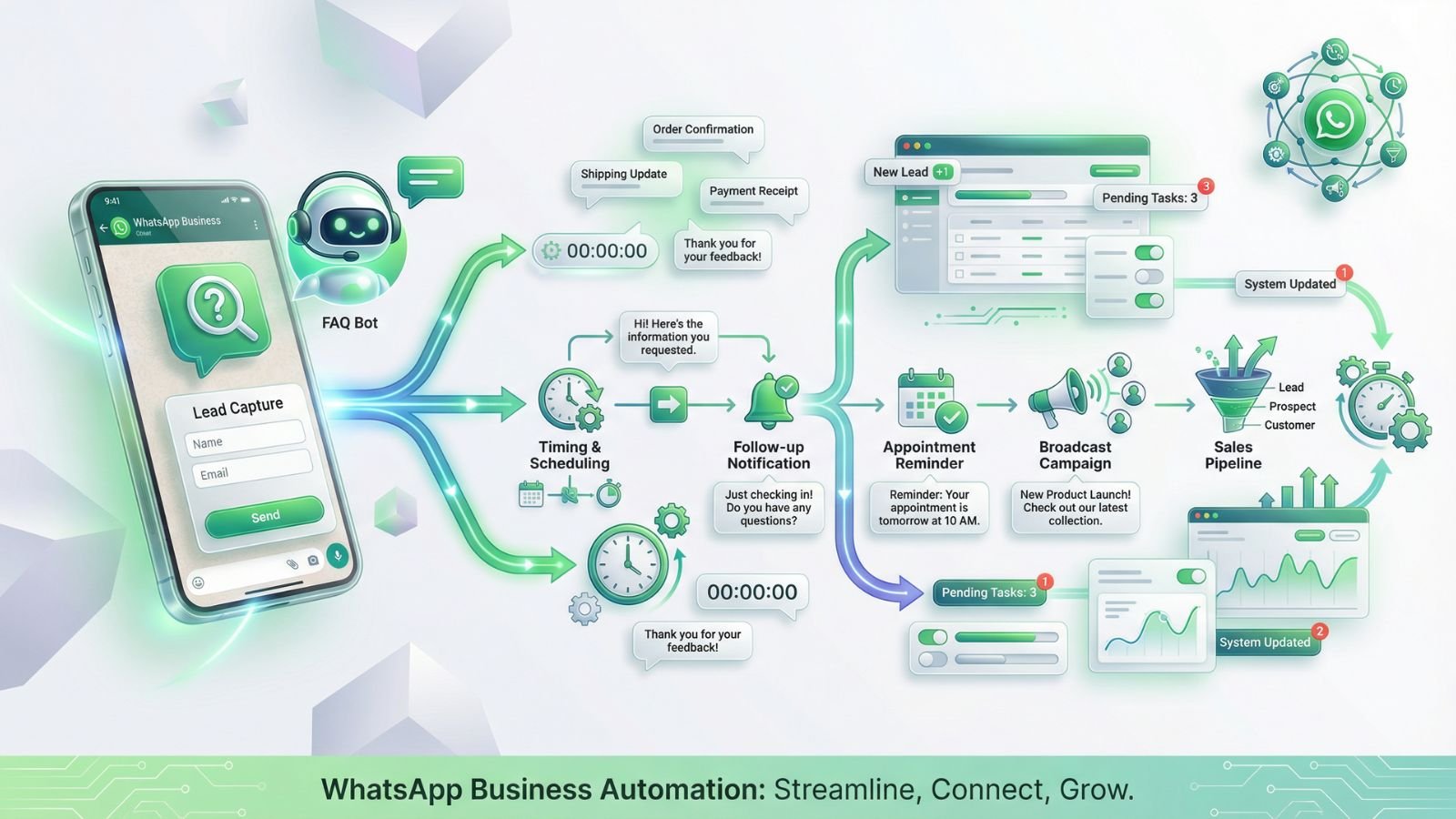
In a typical business workflow, WhatsApp automation operates behind the scenes using chatbots, automated replies, and CRM integrations.
For example, when a customer sends a message, the system can automatically greet the customer, ask for relevant details, and categorize the inquiry. The lead can then be assigned to a sales representative while automated reminders ensure that the conversation continues until the inquiry is resolved.
This type of system ensures that no message is missed and every lead receives timely responses.
Many businesses adopt these solutions because WhatsApp automation helps businesses handle high message volumes, making it easier to manage hundreds of conversations simultaneously.
6 Proven WhatsApp Automation Strategies for Small Businesses
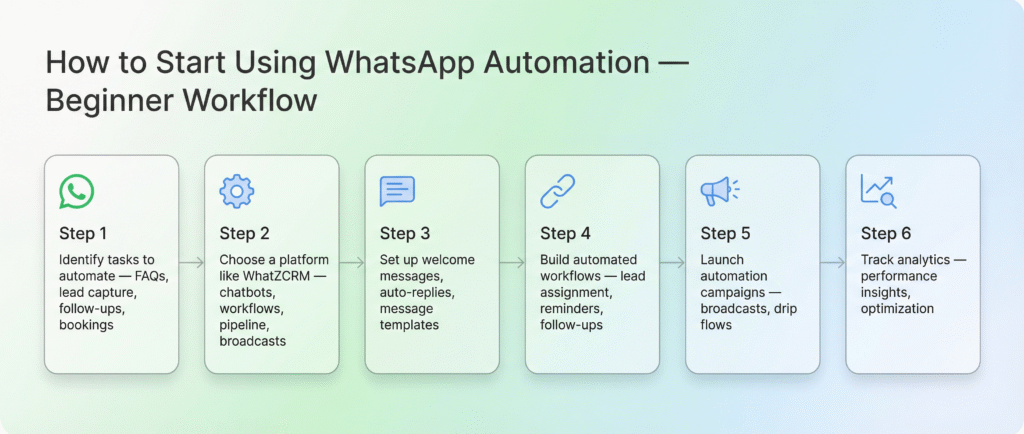
1. Use Chatbots to Handle Frequently Asked Questions
One of the most effective WhatsApp automation strategies is implementing chatbots that answer common customer questions.
Customers often ask similar questions about pricing, services, availability, or delivery timelines. A chatbot can instantly respond to these questions and provide accurate information at any time of the day.
Using automation in this way ensures that customers receive quick responses even outside business hours.
Chatbots also help businesses deliver consistent communication and reduce support team workload.
2. Automate Lead Capture and Qualification
Another powerful strategy is using automation to capture leads.
When someone sends a message on WhatsApp, an automated workflow can collect important details, such as name, location, service requirements, or product interests. This information can then be stored in the CRM and assigned to a relevant sales agent.
Lead capture automation turns WhatsApp into a lead-generation channel, ensuring businesses never miss potential customers.
This approach works particularly well for industries such as real estate, education, healthcare, and e-commerce.
3. Use Instant Auto-Replies for Faster Communication
Customers appreciate quick responses, and automated replies help deliver them instantly.
Businesses can create welcome messages for new conversations, away messages during non-business hours, and quick replies for frequently asked questions.
When businesses learn to use WhatsApp Business effectively with automation, they can maintain professional communication and ensure customers feel acknowledged immediately.
Even simple automated messages can significantly improve customer experience and trust.
4. Automate Follow-Ups and Drip Campaigns
Follow-ups are critical in converting leads into customers. However, many small businesses forget to follow up due to busy schedules.
With automation, follow-up messages can be scheduled to go out after a customer inquiry, product demo, or consultation.
For example, if a customer asks about a service but does not make a purchase immediately, the system can send a reminder message after two days or offer a promotional discount.
This is where WhatsApp marketing automation becomes extremely powerful, as it ensures every lead receives consistent communication until the sale is completed.
5. Run Targeted WhatsApp Marketing Campaigns
WhatsApp broadcasts allow businesses to send promotional messages to multiple customers at once. However, successful campaigns require proper targeting and segmentation.
Businesses can group customers based on interests, previous purchases, or inquiries. Once the audience is segmented, marketing campaigns can be sent with relevant offers and updates.
This approach improves engagement by delivering messages that match customers’ needs.
Many businesses explore WhatsApp marketing automation ideas, such as product launches, seasonal promotions, and loyalty rewards, to keep customers engaged and increase repeat purchases.
6. Automate Internal Team Workflows
Automation is not only useful for customer communication but also for internal business processes.
For example, when a new lead arrives, the system can automatically assign it to an available sales representative. Notifications can alert the team about new inquiries, and lead status can be updated automatically within the CRM.
These workflows ensure that teams stay organized and accountable as they manage large numbers of conversations.
By implementing these WhatsApp automation strategies, businesses can create a structured system to track and manage every conversation efficiently.
Best WhatsApp Automation Tools for Small Businesses
Choosing the right WhatsApp automation tool is important for managing customer conversations, automating responses, and running marketing campaigns. The best platforms combine chatbot automation, CRM features, and campaign management to help businesses efficiently handle large volumes of messages.
Here are some popular lists of WhatsApp automation software providers used by small businesses.
WhatZCRM – An Enterprise AI-WhatsApp CRM Provider
WhatZCRM is an all-in-one CRM and WhatsApp automation platform designed to streamline customer communication and lead management for businesses. The platform provides a shared team inbox, allowing multiple agents to manage conversations from a single WhatsApp number.
With built-in automation workflows, businesses can automatically capture leads, assign conversations to team members, and trigger follow-up messages based on customer activity. The platform also supports setting up WhatsApp marketing campaigns and automations, as well as sales pipeline tracking. This makes it an ideal solution for small businesses seeking both automation and CRM functionality in a single system.
WATI
WATI is a popular WhatsApp Business API platform that focuses on team collaboration and chatbot automation. It allows businesses to automate replies, manage conversations in a shared inbox, and send broadcast messages to customers.
Interakt
Interakt provides WhatsApp automation and customer communication tools for small and medium businesses. It helps companies send automated messages, manage customer conversations, and run marketing campaigns.
AiSensy
AiSensy is mainly focused on WhatsApp marketing automation. Businesses can send broadcast campaigns, automate customer engagement, and manage conversations through chatbot workflows.
Zoko
Zoko is a WhatsApp commerce platform built for e-commerce brands. It helps businesses automate order updates, customer support, and marketing communication directly through WhatsApp.
Also Read: Detailed Overview of Top 5 WhatsApp Automation Tools: Features, Benefits & Comparison
How to Choose the Right WhatsApp Automation Tool?
When selecting a WhatsApp automation platform, small businesses should consider several factors, including ease of use, automation capabilities, CRM integration, and support for marketing campaigns.
A good tool should allow businesses to automate lead capture, manage conversations across multiple agents, run targeted campaigns, and track performance through analytics dashboards. By choosing the right platform, businesses can significantly improve customer engagement and reduce the manual workload of communication.
Key Benefits of WhatsApp Automation for Small Businesses
Businesses that adopt automation experience several advantages. Automation improves response time, allowing businesses to respond instantly to customers. It also helps manage large volumes of conversations without increasing staff.
Since repetitive tasks are automated, teams can focus on more important activities such as closing deals and providing personalized support.
Most importantly, WhatsApp automation helps businesses handle high message volumes while maintaining consistent communication with customers.
Why WhatZCRM Is Ideal for WhatsApp Automation?
For small businesses looking to implement automation quickly, WhatZCRM offers a powerful yet simple platform designed specifically for WhatsApp communication.
The platform includes features such as a shared multi-agent inbox, chatbot automation, automated follow-up sequences, and WhatsApp marketing campaigns. Businesses can also track leads through a visual sales pipeline and analyze campaign performance using built-in analytics.
By bringing messaging, automation, and CRM functionality together in one system, WhatZCRM helps businesses streamline communication and convert more leads into customers.
To Conclude
As customer expectations continue to rise, businesses must adopt smarter communication systems to stay competitive.
Automation enables businesses to respond instantly, manage conversations efficiently, and maintain consistent customer engagement. It reduces repetitive tasks, improves productivity, and ensures that no lead is missed.
When implemented effectively, WhatsApp marketing automation becomes a powerful tool for generating leads, nurturing customer relationships, and scaling business operations.
For small businesses looking to grow without increasing operational complexity, adopting WhatsApp automation is no longer optional. It is a strategic step toward improving customer experience and achieving sustainable growth.