
WhatsApp has become one of the most widely used communication channels worldwide, with over 2.7 billion active users. Businesses now rely on WhatsApp to communicate with customers because it allows real-time responses, multimedia messaging, and a familiar interface.
However, managing customer communication manually from a single phone becomes difficult as message volume increases. A WhatsApp CRM solves this problem by centralizing communication and integrating WhatsApp with structured CRM tools, including automation, lead tracking, segmentation, and reporting.
What Is a WhatsApp CRM?
A WhatsApp CRM combines WhatsApp with CRM functionalities. It allows businesses to:
- View and manage all WhatsApp chats in one dashboard
- Assign conversations to different team members
- Track lead stages and customer interactions
- Automate replies and follow-up workflows
- Segment customers based on tags or behavior
- Run broadcast campaigns using WhatsApp templates
- Access analytics for performance monitoring
These core WhatsApp CRM features help businesses maintain structured communication.
A platform like WhatZCRM integrates the WhatsApp Business API directly into the CRM, offering WhatsApp CRM automation, including chatbots, automated workflows, multi-agent access, lead scoring, quotations, invoices, and detailed communication timelines.
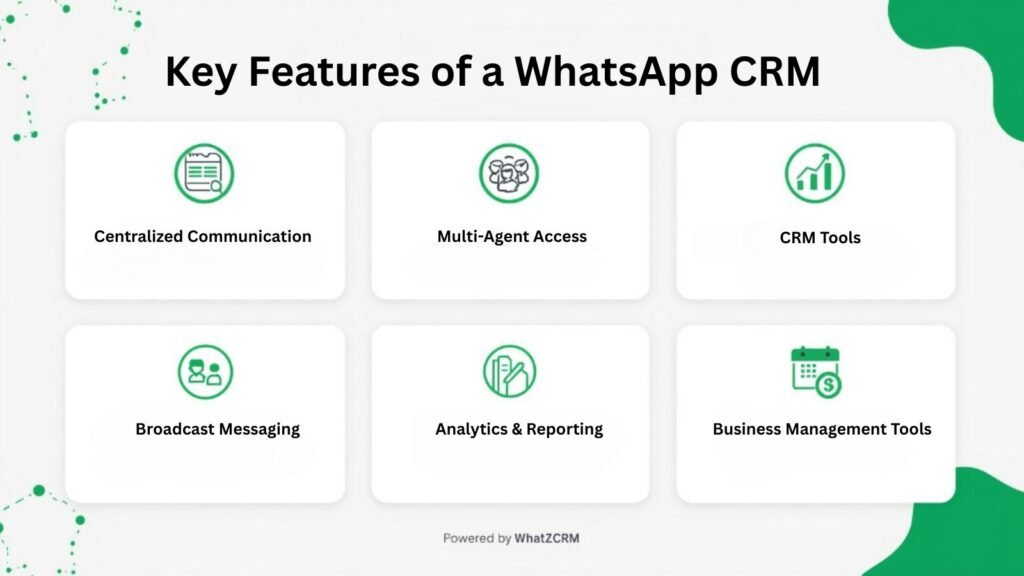
Key Features of a WhatsApp CRM
1. Centralized Communication
All WhatsApp messages, from sales, support, or marketing, are stored in one place. Businesses no longer need multiple phones or accounts to handle communication.
2. Multi-Agent Access
Multiple team members can respond to customers from one WhatsApp number. Departments such as Sales, Support, and Billing can access separate chat panels.
3. Automation and Chatbots
Automated workflows handle tasks such as:
- Greeting messages
- Auto-replies outside working hours
- Lead assignment
- Follow-up reminders
- Drip campaigns
- Appointment reminders
Chatbots help answer common questions, collect customer details, or guide users through basic processes. These are essential parts of WhatsApp workflow automation.
4. CRM Tools
WhatsApp CRMs include features like:
- Contact management
- Lead scoring
- Tagging and segmentation
- Notes and tasks
- Activity timelines
- Sales pipelines
These tools help teams track the customer journey from first inquiry to final sale.
5. Broadcast Messaging
Businesses can send approved WhatsApp template messages for:
- Promotions
- Updates
- Announcements
- Alerts
Commonly used in e-commerce, education, travel, and service providers.
6. Analytics and Reporting
WhatsApp CRMs measure key metrics such as:
- Message delivery and read rates
- Team response time
- Lead conversion rates
- Campaign performance
- Agent productivity
7. Business Management Tools
Advanced platforms (like WhatZCRM) include:
- Sales pipeline views
- Quotation and invoicing tools
- Appointment scheduling
- Task and team management
These tools help businesses manage end-to-end operations.
WhatZCRM is an advanced WhatsApp-based CRM that brings all these features together in one platform. It includes centralized communication, multi-agent access, automation workflows, chatbots, campaign analytics, and sales features such as deal quotations, invoicing, sales pipelines, and sales meeting scheduling. Designed for small and medium businesses.
WhatZCRM helps teams manage leads, sales, customers, and support entirely via WhatsApp in a structured and efficient way.
6 Proven Reasons Why Businesses Need a WhatsApp CRM?
1. Customer Preference for WhatsApp
Most customers prefer communicating via WhatsApp for its convenience and speed. A WhatsApp CRM helps businesses meet this expectation.
2. Efficient Response Handling
Automation and multi-agent features ensure customers receive timely replies, even during high message volume.
3. Improved Lead Conversion
Automatic lead capture and timely follow-ups help prevent missed opportunities. Every incoming message is added to a structured sales pipeline.
4. Organized Internal Communication
The CRM assigns chats, records interactions, and stores customer details, reducing confusion and manual tracking.
5. Enhanced Personalization
Segmentation and CRM data enable businesses to send relevant, personalized messages based on behavior, location, or previous interactions.
6. Cost-Effective Marketing
WhatsApp broadcasts are more cost-effective and often achieve higher engagement rates than email or SMS.
Which Industries Can Benefit from a WhatsApp CRM?
- E-commerce: Order updates, confirmations, and support
- Education & Coaching: Student inquiries and class updates
- Healthcare: Appointment reminders and follow-ups
- Real Estate: Property details and site-visit coordination
- Travel & Hospitality: Itineraries and booking alerts
- Service Providers: Support tickets and renewal reminders
- All Businesses: Any business requiring frequent customer interaction
This highlights the universal Benefits of WhatsApp CRM across industries.
Key Benefits of Using a WhatsApp CRM
- Faster customer support
- Higher lead conversion
- Better response time
- Centralized communication
- Lower operational effort
- Organized sales pipelines
- 24/7 automated assistance
- Clear performance insights
These are the core Benefits of WhatsApp CRM for any organization.
WhatZCRM extends these benefits further by offering end-to-end communication automation, sales pipeline tools, advanced analytics, and integrated CRM features, all driven by efficient WhatsApp CRM automation.
Future of WhatsApp CRM
Future developments include:
- AI-powered chatbots capable of natural conversation
- Predictive analytics for customer behavior
- Omnichannel CRM platforms integrating WhatsApp, Instagram, Facebook, websites, etc.
- Advanced personalization based on user activity
- WhatsApp-based payments and commerce tools
In addition, WhatZCRM is already preparing for these advancements by building deeper automation capabilities, smarter chatbots, and expanded integrations to help businesses manage their entire customer journey through WhatsApp.
Conclusion
A WhatsApp CRM provides a structured way for businesses to manage customer communication at scale. By integrating WhatsApp with CRM tools, businesses can automate workflows, manage leads, assist customers more efficiently, and improve engagement.
As WhatsApp continues to introduce new features, businesses using a CRM like WhatZCRM will be better equipped to communicate effectively, respond faster, and operate more efficiently.
Frequently Asked Questions (FAQs) – WhatZCRM
A WhatsApp CRM integrates WhatsApp with CRM features like lead management, automation, and team collaboration. WhatZCRM centralizes chats, automates workflows, and helps businesses manage sales and support.
To deliver instant replies, automate follow-ups, manage leads, and provide real-time customer support, all through a single dashboard.
Automation, chatbots, multi-agent access, broadcast campaigns, lead management, sales pipelines, appointment scheduling, and advanced analytics.
Yes. It’s simple, affordable, and ideal for small teams that want to manage customer communication professionally.
With instant replies, personalized messaging, broadcast campaigns, and 24/7 automation.
E-commerce, education, healthcare, real estate, travel, agencies, service providers, and any business that actively uses WhatsApp.
WhatsApp Business App is basic. WhatZCRM provides automation, team access, CRM features, analytics, and business tools perfect for growing businesses.
AI chatbots, predictive analytics, omnichannel messaging, payments, and hyper-personalization.