
A WhatsApp chatbot for education is an automated assistant, built on the WhatsApp Business API, that answers admission queries, sends fee and exam reminders, and shares study material with students and parents without a staff member typing every reply. It runs 24/7 on the app students and parents already use, so institutes don’t need anyone to download a new tool.
Most institutes searching for this aren’t looking for a definition, though they’re trying to fix a specific problem: admissions calls piling up, fee follow-ups eating staff time, or parents complaining they never hear back. Here’s how a WhatsApp chatbot actually solves each of those, with real numbers from institutes that have deployed one.
Why Education Institutes Are Moving Admissions and Support to WhatsApp
Email open rates for education communication hover around 20%. WhatsApp messages get opened by nearly all recipients within minutes, that gap alone is why admissions teams, coaching centres, and university outreach cells are shifting routine communication there first. Add India’s WhatsApp penetration (the highest of any messaging app in the country), and the case for a dedicated channel gets hard to ignore, especially during peak admission season when a single counsellor can be fielding 150-200 repetitive queries a day.
The problem was never that institutes didn’t want to respond faster it’s that doing it manually doesn’t scale past a certain inquiry volume. That’s the gap a chatbot fills.
WhatsApp Chatbot Use Cases for Education
1. Admission inquiries and lead nurturing
The highest-volume use case, and usually the first one institutes automate. The bot answers eligibility, fee structure, and deadline questions instantly, sends digital brochures, and routes anything complex- a scholarship query, a special-case application to a human counsellor with the full chat history attached.
Example: A Delhi coaching institute fielding 200+ daily admission calls during peak season cut response time from roughly 48 hours to instant, using automated FAQs and follow-ups. Admission conversions rose 25% in a single quarter, largely because fewer leads went cold waiting for a reply.
2. Entrance exam coaching support
For JEE, NEET, CAT, and GRE coaching centres, engagement between enrollment and exam day is what keeps attendance up. Chatbots push mock test schedules, assignment reminders, and study material links automatically.
Example: An IIT-JEE coaching centre in Kota that automated mock test and deadline reminders saw a 40% jump in mock test attendance students simply stopped forgetting.
3. Overseas admissions and visa guidance counselling
Study-abroad consultants deal with high-anxiety, repetitive questions about visa timelines, document checklists, and application status. A bot handles the FAQ volume and gives instant status updates, freeing counsellors for the advice students actually need a human for.
Example: A Delhi-based overseas education consultant automated 60% of repetitive visa and application queries, letting counsellors focus on personalized guidance instead of status-update calls.
4. Fee payment reminders and compliance
Late fees are as much a communication problem as a payment one. Automated reminders with embedded payment links, sent before the deadline rather than after, measurably move the needle.
Example: A private university in Bengaluru added WhatsApp-based fee reminders with payment links and saw on-time payments increase 18% in a single semester.
5. Exam timetables and results notifications
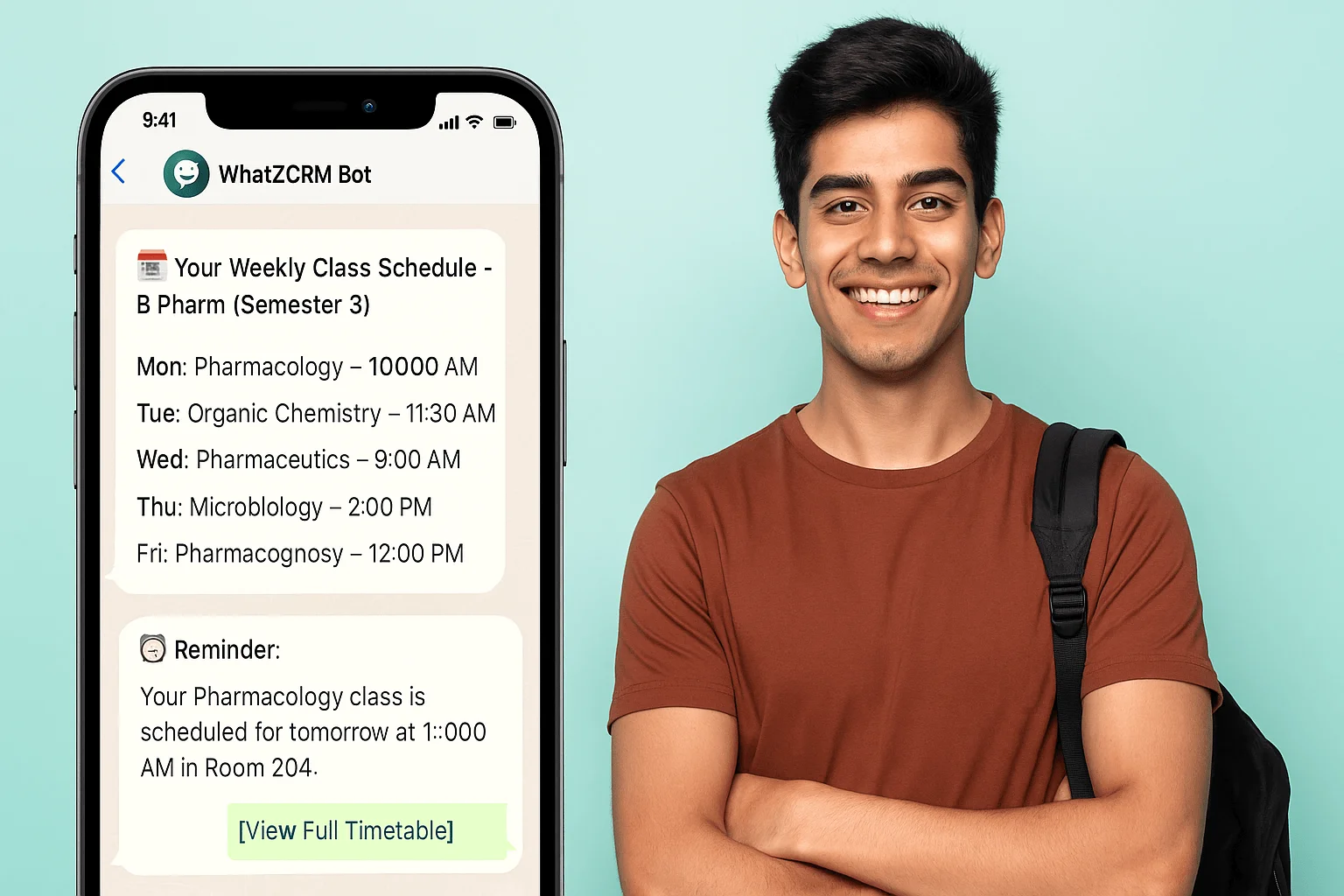
Printed timetables get lost; emails get missed. WhatsApp messages from a verified business account reach students and parents directly, and results can be shared securely without the confusion of a public noticeboard.
Example: A Noida school switched exam schedule and results communication to WhatsApp and measured a 30% rise in parent satisfaction scores.
6. Student support and non-academic FAQs
Hostel timings, transport routes, library hours, questions that don’t need a human but still generate call volume. A chatbot handles them around the clock and escalates only the genuinely unusual ones.
Example: A Pune MBA institute automated non-academic queries and cut helpdesk call volume by 50%, freeing staff for higher-value student engagement work.
7. Alumni and parent engagement
Institutes lose touch with alumni networks once placements end, and with parents once a student graduates; both are missed opportunities for referrals, mentorship, and donations. A low-frequency WhatsApp channel (newsletters, event invites, job postings) keeps the relationship alive without feeling intrusive.
Example: An engineering college in Hyderabad built an alumni WhatsApp group that re-engaged 500+ alumni in six months through career talks and mentorship drives.
8. Application, registration, and enrollment processing
Beyond answering questions, chatbots can collect documents, run initial eligibility screening, and confirm seat registrations, turning a multi-step, multi-channel process into a single WhatsApp thread the student can complete from their phone.
Also Read: What is a WhatsApp CRM for Education and Why Do you Need one?
WhatsApp Software for Colleges and Universities vs. Schools and Coaching Institutes
The core mechanics are the same, but priorities shift by institution type:
Institution type | Primary use case | Secondary use case |
Schools (K-12) | Exam/timetable notifications, fee reminders | Parent engagement, extracurricular updates |
Coaching institutes | Admission inquiries, mock test reminders | Study material distribution |
Colleges/universities | Multi-campus admissions, CRM/ERP integration | Alumni engagement, placement updates |
Study-abroad consultants | Visa/document tracking, application status | Lead nurturing across long decision cycles |
Universities and multi-campus colleges typically need one additional layer that schools and coaching centres don’t: integration with an existing CRM or student information system, so a WhatsApp conversation updates the same record a counsellor sees on their dashboard, not a separate silo.
Getting Started: A Practical Checklist
- Pick one use case to pilot: admissions or fee reminders are usually the highest-ROI starting points, not everything at once.
- Get WhatsApp Business API access: through a verified provider; this is required for scaled, official automation (not the free WhatsApp Business app).
- Map your chat flows: decide what the bot answers directly and what it escalates to a human, before writing a single message.
- Connect it to your CRM: so every WhatsApp conversation updates the same lead or student record your team already works from.
- Track response time, lead-to-admission conversion, and query resolution rate from week one, and adjust flows based on where students actually drop off.
Also Read: Detailed Overview of Top 5 WhatsApp Automation Tools: Features, Benefits & Comparison
How WhatZCRM Fits In
WhatZCRM runs on the official WhatsApp Business API and is built for Indian SMBs and institutes that need this without a six-week implementation. Admission bots, fee reminder sequences, and CRM lead tracking are set up as templates you configure, not code you write, useful if your team wants the use cases above live in days rather than a quarter.
Conclusion
None of this requires overhauling how your institute communicates; it just requires moving the repetitive parts to a channel students and parents already check dozens of times a day. Start with the use case costing you the most staff hours right now, whether that’s admission calls or fee follow-ups, get it running well, then expand from there. The institutes in the examples above didn’t automate everything on day one; they picked one bottleneck, fixed it, and let the results justify the next step.
If you’re ready to put this into practice, WhatZCRM can have your first WhatsApp chatbot flow for admissions, fee reminders, or student support live in days, connected to the CRM your team already uses.