

WhatsApp marketing allows businesses to communicate with customers through direct, permission-based conversations for promotions, lead nurturing, customer service, transactional updates, and sales.
Its importance as a business channel continues to grow. WhatsApp reported in September 2025 that more than 3 billion people across more than 180 countries use the platform. In 2026, Meta also reported that /bxbpaid WhatsApp messaging had crossed a $2 billion annual run rate in Q4 2025, indicating growing commercial adoption of business messaging.
For businesses, however, successful WhatsApp marketing is not simply about sending more messages. It depends on customer permission, relevant content, appropriate frequency, automation, segmentation, and integration with customer data.
This guide explains the major benefits of WhatsApp marketing in 2026, how it works, how CRM integration improves it, and the trends businesses should understand.
What Is WhatsApp Marketing?
WhatsApp marketing is the use of WhatsApp to communicate with opted-in customers and prospects for marketing, sales, engagement, service, and relationship-building activities.
Businesses may use WhatsApp for product announcements, promotional offers, appointment reminders, lead follow-ups, customer support, order information, re-engagement campaigns, and other customer communications.
Importantly, WhatsApp marketing is permission-based. WhatsApp says businesses should receive permission before sending people offers and announcements, and users can block businesses, provide feedback, or change their messaging preferences.
For businesses operating at scale, the WhatsApp Business Platform can add capabilities such as automation, CRM integration, team collaboration, approved message templates, workflow management, and campaign tracking.
Also Read: Top 10 WhatsApp CRM Tools Compared (2026)
WhatsApp Marketing at a Glance
Area | How WhatsApp Can Help | Example Use Case | Useful Metric |
Lead generation | Starts direct conversations with prospects | Click-to-WhatsApp campaign | Qualified leads |
Customer engagement | Enables two-way conversations | Product enquiries | Reply rate |
Personalization | Uses CRM and customer information | Personalized follow-up | Conversion rate |
Automation | Triggers messages based on actions | Appointment reminder | Completion rate |
Customer support | Centralizes customer conversations | Support enquiry | Resolution time |
Sales | Moves prospects through a conversation | Product consultation | Sales conversion |
Retention | Re-engages existing customers | Repeat-purchase campaign | Repeat purchase rate |
Rather than treating WhatsApp as another broadcast channel, businesses can use it as part of a connected customer journey.
Also Read: How a Lead Generation Strategy Actually Drives Your Business Growth
How Does WhatsApp Marketing Work?
A typical WhatsApp marketing process begins when a customer gives permission to receive communications or initiates a conversation with a business.
The business can then use WhatsApp to continue the interaction based on the customer’s needs and applicable WhatsApp policies.
For businesses using the WhatsApp Business Platform, WhatsApp states that business-initiated messages must use approved message templates. WhatsApp also uses message-quality controls and user feedback to help reduce irrelevant or excessive marketing communication.
🚀 Pro Tip
Personalized WhatsApp messages triggered by user actions (like cart abandonment or inquiry responses) can dramatically increase engagement and conversion rates.
At scale, a CRM or automation platform can connect WhatsApp conversations with customer records, lead stages, tags, assignments, follow-up workflows, and campaign analytics.
Also Read: How WhatsApp API Integration Works & Why Your Business Needs It
10 Key Benefits of WhatsApp Marketing in 2026
1. Access to a Large Global Messaging Audience
One of WhatsApp marketing’s biggest advantages is its scale.
WhatsApp stated in September 2025 that it was being used by more than 3 billion people in over 180 countries. This gives businesses access to a communication channel already familiar to customers across many markets.
The opportunity varies by country and audience, so businesses should evaluate WhatsApp adoption among their own customers rather than assuming equal usage everywhere.
There is particularly strong evidence for business messaging in some markets. For example, Meta cited a 2025 Kantar study reporting that 91% of online adults in India chat with a business weekly. That statistic relates specifically to online adults in India and should not be generalized globally.
2. Direct Two-Way Customer Communication
WhatsApp enables customers and businesses to have ongoing conversations rather than relying entirely on one-way advertisements.
A customer can ask about pricing, product availability, bookings, delivery, returns, or service requirements and continue the interaction within the same messaging environment.
WhatsApp itself describes business messaging use cases ranging from customer questions and purchases to receipts, booking services, delivery updates, and utility payments.
This conversational format is particularly valuable when a purchase requires questions to be answered before the customer is ready to proceed.
3. Personalized Customer Journeys
When WhatsApp is connected to a CRM, businesses can organize conversations using customer information such as lead stage, previous interactions, interests, purchases, location, or other consented data.
That enables more relevant communication than sending the same message to every contact.
For example, a business could create different follow-up journeys for a new lead, an existing customer, an abandoned enquiry, an upcoming appointment, or a customer due for renewal.
The goal should be relevance rather than simply increasing message volume.
4. Faster Lead Follow-Up
Speed matters when customers actively contact a business.
WhatsApp can help sales and service teams respond within the same channel where an enquiry originated, while automation can acknowledge enquiries when employees are unavailable.
AI is increasingly becoming part of this process. In June 2026, Meta said more than one million businesses were already using a Meta Business Agent on WhatsApp and Messenger to respond to customers.
This shows how business messaging is evolving from manual chat toward automated and AI-assisted customer interaction.
5. Marketing Automation
WhatsApp automation can reduce repetitive manual work by connecting customer actions to predefined workflows.
Common examples include welcome messages, lead follow-ups, appointment reminders, order notifications, payment reminders, customer reactivation, and post-purchase communication.
Automation does not eliminate the need for human support. A stronger model combines automation for predictable interactions with human intervention when a customer has a complex or high-value requirement.
Meta’s 2026 rollout of Business AI for eligible small businesses in India follows this model: AI can answer common questions, capture leads, recommend products and book appointments, while business owners can take over more complex conversations.
6. Better Sales Conversations
WhatsApp can support multiple stages of the sales journey within a single conversation.
Businesses can use messaging to understand customer requirements, answer questions, recommend relevant products or services, share supporting information, arrange demonstrations or appointments, and follow up after an enquiry.
Meta has continued expanding commerce-related capabilities around WhatsApp. In its February 2026 research with the Retailers Association of India, Meta described WhatsApp as increasingly connecting discovery, purchase, and post-purchase interactions within the customer journey.
Businesses should measure the actual impact using metrics such as qualified leads, appointments, conversions, revenue, and sales-cycle duration.
7. Support for Rich Customer Interactions
WhatsApp conversations can go beyond plain text.
Depending on the WhatsApp and implementation being used, businesses can incorporate images, documents, product information, interactive options and other formats that make it easier for customers to understand an offer or complete an action.
WhatsApp is also expanding business communication beyond text. Meta announced broader calling and voice capabilities for businesses using the WhatsApp Business Platform in 2025, including customer-initiated calls and planned voice and video communication options.
These capabilities can make WhatsApp useful across marketing, sales and customer service workflows.
8. Customer-Controlled Business Messaging
A major principle of WhatsApp business messaging is user control.
WhatsApp states that customers can choose whether to receive business communications, stop chatting with businesses, block or report businesses, and provide feedback about promotional messages.
Businesses therefore need to treat permission and message relevance as central parts of their WhatsApp marketing strategy.
Sending too many irrelevant promotions may reduce customer engagement and can also affect a business’s ability to communicate through the platform.
9. Measurable Campaign Performance
WhatsApp marketing does not need to operate as an isolated communication channel.
WhatsApp provides businesses with performance information for certain messaging products, including data such as messages read and replies. WhatsApp notes that read information may be affected when recipients disable read receipts.
When WhatsApp is integrated with CRM and analytics systems, businesses can go further by measuring outcomes such as lead source, response time, appointments, qualified opportunities, conversions, repeat purchases, and revenue.
These business outcomes are often more useful than evaluating a campaign based only on message delivery.
10. Integration With a Broader Marketing Strategy
WhatsApp increasingly sits alongside other digital marketing channels rather than operating independently.
In 2025, Meta announced centralized campaign capabilities designed to help businesses manage campaigns across WhatsApp, Facebook, and Instagram through Ads Manager.
This creates opportunities for businesses to connect advertising with conversational journeys.
For example, a prospect may discover a company through an advertisement, initiate a WhatsApp conversation, become a qualified CRM lead, receive automated follow-ups, speak with a sales representative, and eventually become a customer.
Also Read: WhatsApp Automation for Small Businesses: 6 Strategies That Generate Leads
Why Is CRM Important for WhatsApp Marketing?
Managing a small number of WhatsApp conversations manually may be practical. Managing hundreds or thousands of leads across multiple employees becomes much harder.
A WhatsApp CRM adds structure to those conversations.
Instead of leaving customer information scattered across individual chats, businesses can associate conversations with contacts, leads, sales stages, tasks and workflows.
A CRM-driven WhatsApp operation can support:
- Shared team inboxes and conversation assignments
- Customer segmentation and tagging
- Automated follow-up journeys
- Lead and deal management
- Customer history
- Campaign tracking
- Workflow triggers
- Team performance monitoring
- Sales and service analytics
The result is not simply more messaging. It is greater visibility into what happens after a customer sends a message.
⚡ Smart Strategy Tip
The real power of WhatsApp marketing comes when messaging is combined with CRM systems, automation workflows, and campaign tracking tools to manage conversations, nurture leads, and measure performance effectively.
How WhatZCRM Supports WhatsApp Marketing
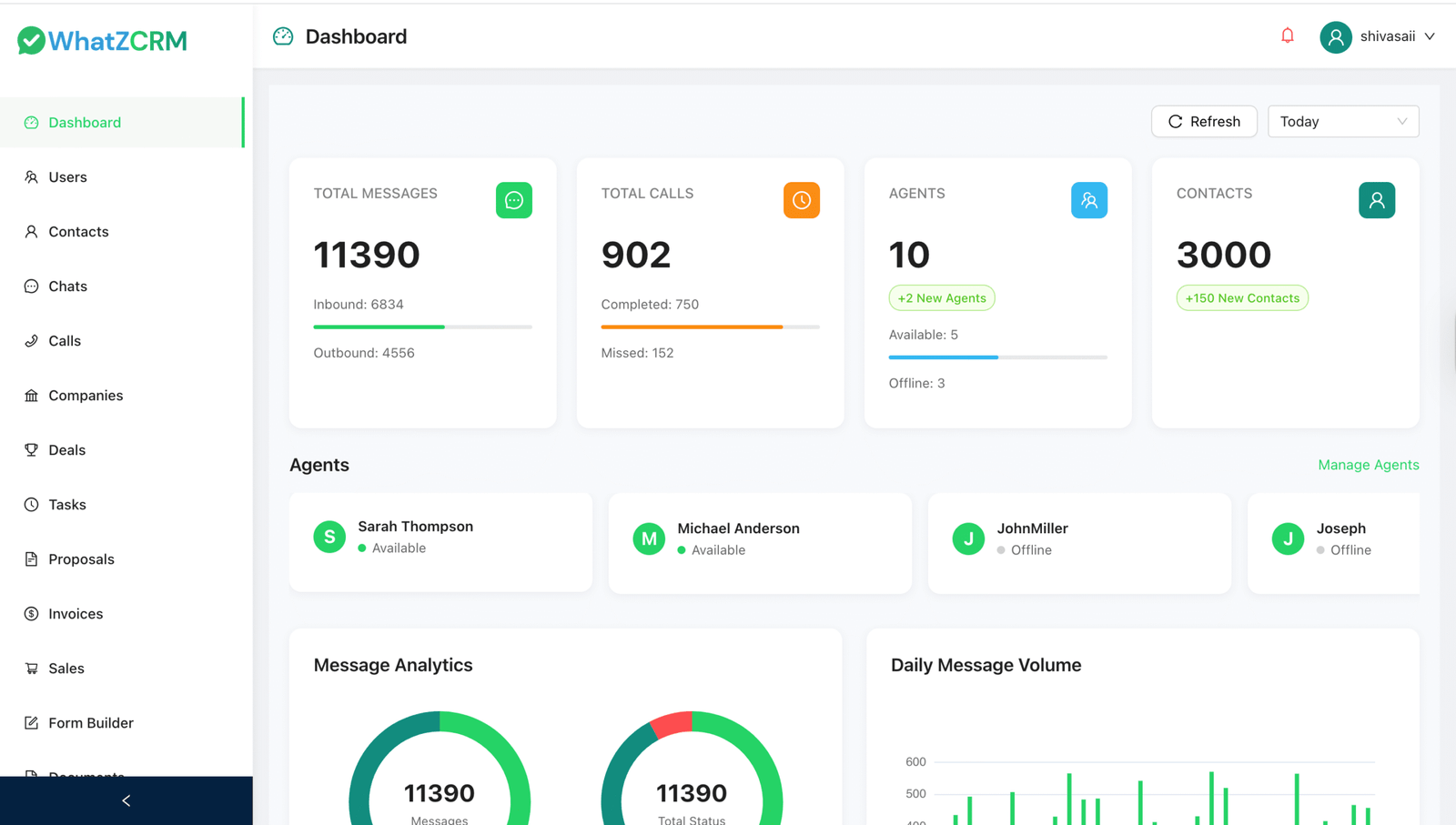
WhatZCRM is designed to combine WhatsApp communication with CRM, sales, marketing and customer-management workflows.
Its capabilities include a unified shared inbox, built-in lead management, sales pipelines, automated workflows and drip campaigns, customer segmentation, targeted broadcasts, multi-agent support, conversation routing, email marketing integration, and performance analytics.
For businesses, this means a WhatsApp conversation can become part of a structured customer lifecycle rather than remaining an isolated chat.
For example, an incoming enquiry can be captured as a lead, assigned to a sales representative, tagged based on interest, added to an automated follow-up sequence, moved through pipeline stages, and measured through CRM reporting.
This is where WhatsApp CRM differs from basic business messaging: the objective is to manage the full customer journey, not simply send and receive messages.
Also Read: 7 WhatsApp Marketing Trends That Businesses Can’t Ignore in 2026
WhatsApp Marketing Trends to Watch in 2026
AI-Powered Business Conversations
AI is becoming increasingly integrated with business messaging. Meta launched Business Agent in 2026 and reported that more than one million businesses were already using a Meta Business Agent across WhatsApp and Messenger.
Businesses are likely to increasingly combine AI with human teams for FAQs, qualification, product discovery, appointments and customer support.
Conversational Commerce
WhatsApp is increasingly being used across discovery, customer questions, purchase consideration and post-purchase interaction rather than only for customer support.
CRM Integration
As message volumes increase, connecting conversations with CRM records becomes more important for attribution, follow-up, segmentation and pipeline management.
Cross-Channel Campaign Management
Meta’s integration of WhatsApp marketing with Facebook and Instagram campaign management demonstrates a broader movement toward connected advertising and messaging journeys.
Greater Focus on Message Quality
Businesses should expect permission, relevance and message frequency to remain important. WhatsApp has introduced mechanisms including opt-in controls, template reviews, user feedback and restrictions intended to reduce unwanted business messaging.
Is WhatsApp Marketing Worth Using in 2026?
WhatsApp marketing can be valuable for businesses whose customers already use the platform and prefer conversational communication.
Its strongest advantages are not simply message visibility. They include direct customer conversations, automation, CRM integration, personalization, sales follow-up and the ability to connect marketing with service and commerce workflows.
With more than three billion users globally and continued investment by Meta in business messaging, AI, campaign management and commerce capabilities, WhatsApp remains an important customer-engagement channel in 2026.
The most effective strategy is therefore not to send more WhatsApp messages. It is to send relevant messages to customers who have chosen to hear from the business, at the appropriate stage of their journey, and connect those interactions to measurable business outcomes.
To Summarize
WhatsApp marketing helps businesses engage customers through direct, personalized, and conversational communication. In 2026, it continues to support faster responses, automated follow-ups, lead nurturing, and customer engagement across the sales journey.
A well-planned WhatsApp marketing strategy 2026, supported by automation, segmentation, CRM integration, and analytics, can turn everyday conversations into measurable business opportunities.
For businesses focused on scalable customer engagement and sales automation, WhatsApp has become an important part of the digital marketing mix.