

WhatsApp messages are opened 98% of the time. Email messages are opened 20–25% of the time. If you stopped reading right there, you’d have a headline answer, but the full picture is more nuanced, and getting it right could meaningfully change how you allocate your marketing budget.
This guide compares WhatsApp marketing vs email marketing across every dimension that matters to businesses: open rates, click-through rates, ROI, cost, use cases, and when to use each. By the end, you’ll know exactly which channel fits your goals and how combining both can multiply your results.
What Do We Know About WhatsApp Marketing?
WhatsApp marketing uses the WhatsApp Business API to send promotional messages, transactional alerts, and customer support messages directly to users’ phones. Because WhatsApp is already the primary communication app for over 3 billion users globally and the default messaging app across India, Southeast Asia, Latin America, and the Middle East, messages land in a channel that people genuinely pay attention to.
WhatsApp marketing formats include:
- Broadcast campaigns to opt-in contact lists
- Automated drip sequences (abandoned cart, post-purchase, re-engagement)
- Two-way conversational flows powered by chatbots or live agents
- Click-to-WhatsApp ads that bridge Facebook/Instagram traffic into chat
- Rich media messages: images, PDFs, videos, location pins, and quick-reply buttons
Overview of Email Marketing?
Email marketing sends promotional or informational content to a subscribed audience via email. It is one of the oldest digital marketing channels, and with an average ROI of $36–$42 per $1 spent (Litmus, 2023), it remains among the most cost-effective for certain business models.
Email marketing formats include:
- Newsletters and content digests
- Promotional campaigns with discount codes
- Onboarding and drip sequences
- Transactional emails (order confirmations, shipping updates)
- Re-engagement and win-back campaigns
Also Read: How to Choose the Best WhatsApp Marketing Software for Business Growth
WhatsApp Marketing vs Email Marketing – In-depth Comparison
The table below covers all key metrics businesses consider when choosing a marketing channel.
| Metric | WhatsApp Marketing | Email Marketing |
| Open Rate | 95–98% | 20–25% |
| Click-Through Rate | 45–60% | 2–5% |
| Response Time | Minutes | Hours to days |
| Spam / Filtering Risk | Very Low | High |
| Personalization | High (1:1 conversational) | Medium (segment-based) |
| Rich Media Support | Images, Video, Docs, Buttons | HTML email, limited interactivity |
| Cost (per message) | ₹0.50–₹1.50 | Very low (bulk plans) |
| Best For | Conversions, follow-ups, support | Nurturing, newsletters, awareness |
| Opt-in Requirement | WhatsApp Business API consent | Email subscription |
| Deliverability | Direct to inbox/notification | Subject to spam filters |
Open Rates: WhatsApp Wins by a Wide Margin
WhatsApp messages achieve open rates of 95–98%, typically within minutes of delivery. Email open rates across industries average 20–25%, according to Mailchimp’s benchmark report, with B2C retail at 18% and SaaS at 22%.
The gap exists because WhatsApp delivers a push notification that appears on the lock screen in the same place as a friend’s text. Email, by contrast, competes against hundreds of other messages in an inbox most users check on a schedule.
Use If you send a time-sensitive promotion to 10,000 contacts, WhatsApp will show your message to ~9,800 people. Email will reach ~2,200. The remaining 7,800 will never see it.
Click-Through Rates: WhatsApp Outperforms by 10–20x
WhatsApp click-through rates range from 45–60% for well-structured campaigns. Email CTR averages 2–5% across industries.
The reason is twofold. First, WhatsApp messages are read in full; there are no preview panels or collapsed threads. Second, interactive buttons (e.g., ‘View Offer’, ‘Book Now’, ‘Track Order’) are tappable inline, removing friction between reading and acting.
ROI Comparison: Which Channel Delivers Better Returns?
Direct cost per message is lower for email (~₹0.002–₹0.01 via platforms like Mailchimp at scale). WhatsApp Business API costs ₹0.50–₹1.50 per marketing conversation in India.
However, cost per conversion tells a different story:
| KPIS | ||
| Audience Size | 10,000 | 10,000 |
| Open Rate | 98% = 9,800 | 22% = 2,200 |
| CTR | 50% of openers = 4,900 | 3% of openers = 66 |
| Conversion Rate | 25% of clickers = 1,225 | 20% of clickers = 13 |
| Cost (₹0.90/msg vs ₹0.005/email) | ₹9,000 | ₹50 |
| Revenue at AOV ₹800 | ₹9,80,000 | ₹10,400 |
| ROAS | ~108x | ~208x (on cost alone) |
Email appears cheaper on cost alone because its send price is near-zero. But WhatsApp’s absolute conversion volume, driven by dramatically higher open and click rates, generates significantly more revenue per campaign. The right metric for your business depends on whether you’re optimizing for cost efficiency or revenue volume.
How Each Industry Gets Benefited with Email & WhatsApp Marketing
- E-commerce: Lead with WhatsApp for cart recovery, post-purchase upsells, and flash sales. Use email for weekly newsletters and loyalty programme updates.
- Real estate: WhatsApp for instant property alerts, site visit confirmations, and lead follow-up. Email for detailed property brochures and quarterly market reports.
- Healthcare / Clinics: WhatsApp for appointment reminders, prescription refill alerts, and lab result notifications. Email for health tips content and annual reports.
- Education / EdTech: WhatsApp for admission inquiry follow-ups, class reminders, and fee payment alerts. Email for course catalogues and long-form academic content.
- B2B / SaaS: Email remains dominant for nurture sequences and product update announcements. WhatsApp works well for trial onboarding and enterprise account support.
Also Read: Top 9 Bulk WhatsApp Sender Software for Business Growth
The Hybrid Strategy of Combining Both Channels
High-performing marketing teams don’t choose between WhatsApp and email — they design each channel to do what it does best, then coordinate them:
- User signs up on your website → Welcome email with full onboarding sequence
- User abandons cart → WhatsApp message within 30 minutes with direct checkout link
- User makes a purchase → WhatsApp order confirmation + email invoice
- 7 days post-purchase → Email asking for review + WhatsApp upsell offer
- 60-day inactive user → Email re-engagement sequence; if unopened, WhatsApp win-back message
This coordinated approach ensures no lead is lost to channel mismatch while using each platform at its optimal cost-to-conversion point.
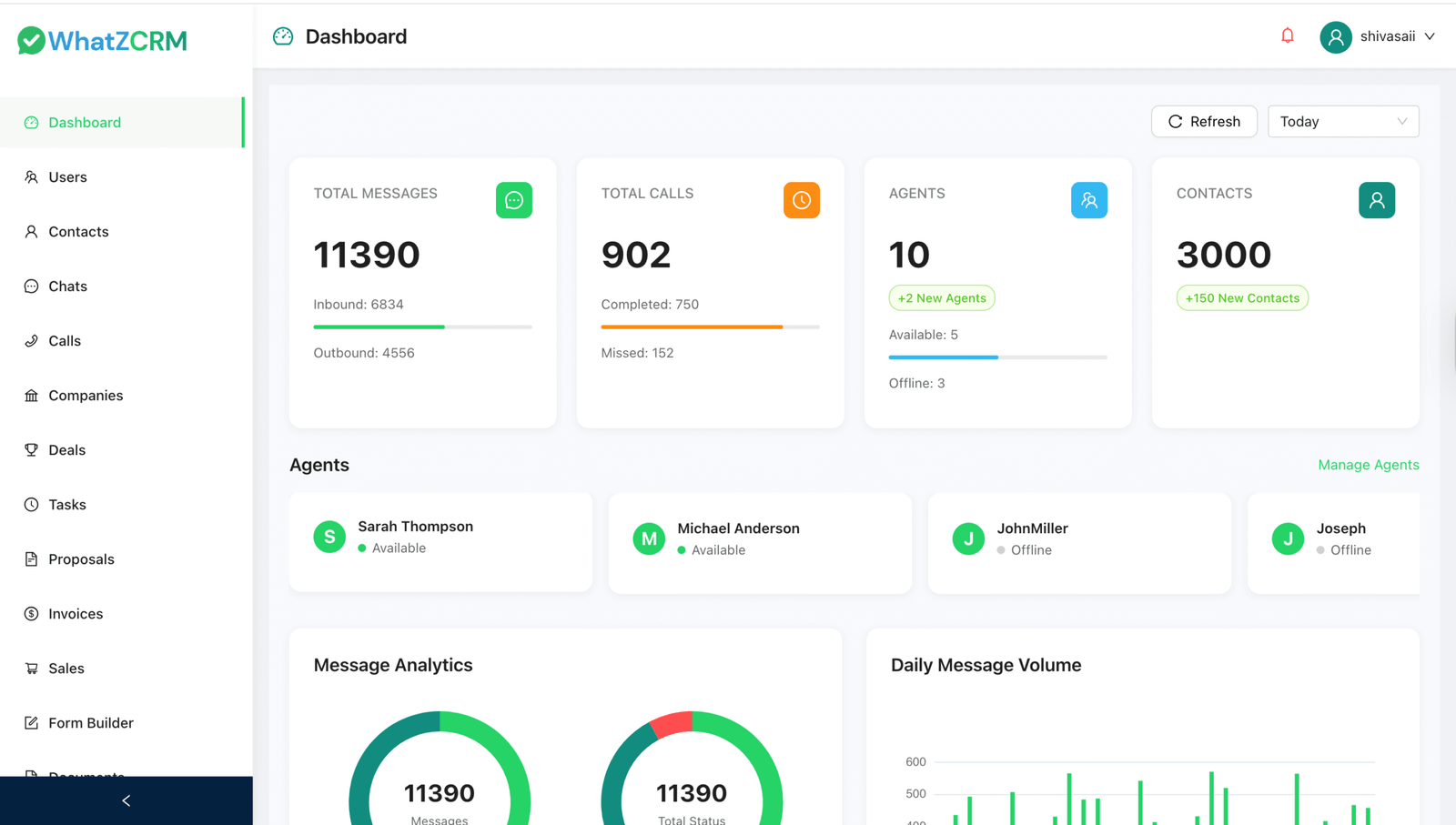
How WhatZCRM Helps You Run Both Channels From One Platform
Managing WhatsApp and email marketing separately creates operational overhead with different tools, different dashboards, and disconnected customer data. WhatZCRM eliminates that by bringing both channels under one roof.
Send WhatsApp broadcasts, automate follow-up sequences, and run email campaigns all from a single platform, without touching a separate email tool. If you already use Mailchimp, HubSpot, or another email platform, WhatZCRM integrates directly with them, so your existing workflows stay intact.
Key capabilities for marketing teams:
- Broadcast campaigns to segmented WhatsApp contact lists
- Built-in email marketing creates, sends, and tracks campaigns without a third-party tool
- Native integrations with Mailchimp, HubSpot, and other email platforms for teams that prefer their existing stack
- Automated drip sequences triggered by CRM events, across both WhatsApp and email
- AI chatbot for 24/7 lead qualification and support
- Team inbox for multi-agent WhatsApp management
- Unified analytics dashboard tracking opens, clicks, and conversions across both channels
Final Thoughts
WhatsApp marketing outperforms email on every conversion metric 98% open rates, 45–60% CTR, and near-instant response times make it a stronger channel for real-time engagement.
Email remains valuable for long-form nurturing and awareness. The highest-performing businesses combine both: email builds relationships over time; WhatsApp closes the loop.
For teams managing WhatsApp at scale, a purpose-built CRM like WhatZCRM handles automation, lead tracking, and conversation management, turning chats into measurable revenue.