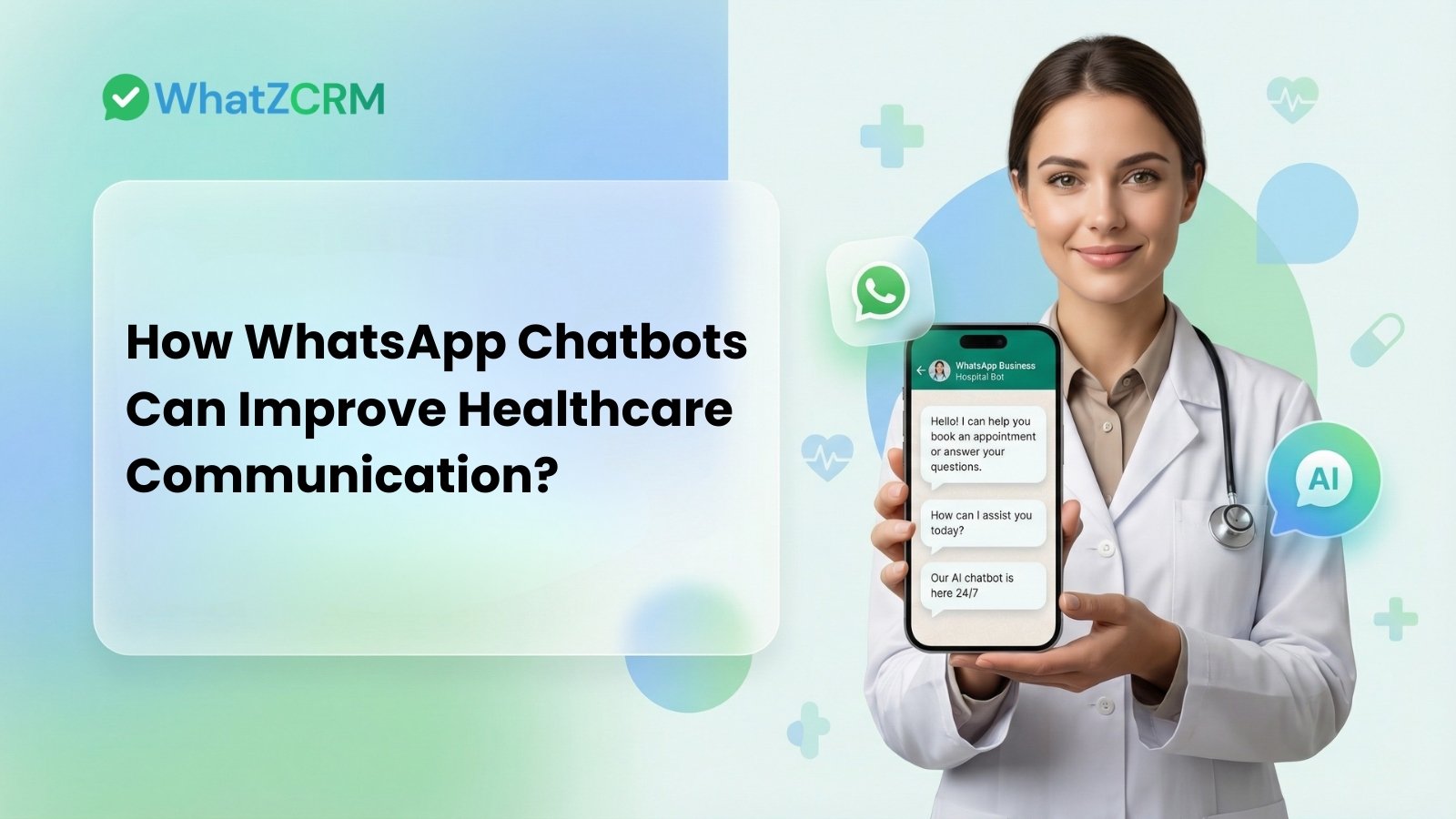

A WhatsApp chatbot for healthcare is an automated assistant, built on the official WhatsApp Business API, that handles patient-facing tasks like appointment booking, reminders, FAQs, and non-clinical notifications directly inside WhatsApp. For hospitals and clinics evaluating options, the real decision usually isn’t chatbot or no chatbot; it’s whether to buy a standalone messaging bot or a WhatsApp-native CRM that keeps every patient interaction, appointment, and follow-up organized in one place.
This guide breaks down both.
WhatsApp Chatbots for Healthcare
- WhatsApp chatbots automate appointment booking, reminders, FAQs, and follow-ups on a channel patients already check dozens of times a day without needing an app download or login.
- See the platform comparison if you’re evaluating vendors; the right choice depends on whether you need a messaging bot or a full patient communication CRM.
- Chatbots should never share Protected Health Information (PHI) directly in chat, since WhatsApp does not sign a Business Associate Agreement (BAA). Compliant setups send a notification plus a secure portal link instead. See compliance details.
- Hospitals that automate scheduling and reminders on WhatsApp typically see fewer no-shows and lower front-desk call volume; see real examples further down.
- WhatZCRM approaches this as a CRM problem first, messaging problem second: patient records, appointment pipeline, and follow-up sequences live in one system, not scattered across a chatbot’s session logs.
Why Hospitals Are Moving Patient Communication to WhatsApp
Healthcare providers are under pressure from three directions at once: rising patient volumes, thin front-desk staffing, and patients who now expect the same instant, always-on service they get from every consumer app on their phone. A large share of healthcare communication is repetitive: booking, reminders, report delivery, basic FAQs, which makes it a natural fit for automation.
WhatsApp is the obvious channel for this shift. It’s already installed on most patients’ phones, requires no new login or app download, and sees far higher open and reply rates than email or SMS, which matters when a missed reminder means a missed appointment. It also supports rich media, so clinics can send appointment confirmations, prescription PDFs, and short instructional videos in the same thread a patient already uses to message friends and family.
Also Read: WhatsApp CRM for Hospitals: Faster Patient Communication
What Is a WhatsApp Chatbot for Healthcare?
A WhatsApp chatbot for healthcare is a rule-based or AI-powered assistant connected to a hospital’s or clinic’s WhatsApp Business number. It uses natural language processing (NLP) to understand routine patient questions and either resolves them automatically or routes them to the right staff member.
There are two broad types worth knowing before you evaluate vendors:
- Rule-based (traditional) chatbots work off fixed menus and button flows, good for predictable, high-volume tasks like booking, FAQs, and basic logistics, with low compliance risk since responses are pre-approved.
- AI-powered agents understand free-text patient messages, hold multi-step conversations, and can pull live data from a calendar or CRM (e.g., “Is Dr. Rao available Thursday?”). They’re more flexible but need tighter guardrails around what they’re allowed to say.
Most hospitals end up using a hybrid: rule-based flows for scheduling and FAQs, with an AI layer for symptom intake, routing, and follow-up conversations.
What Can a WhatsApp Chatbot for Hospitals Actually Do?
The core, WhatsApp-policy-safe use cases healthcare providers deploy today:
- Appointment booking, rescheduling, and reminders: patients confirm or reschedule with a single tap; automated reminders are one of the most effective tools against no-shows.
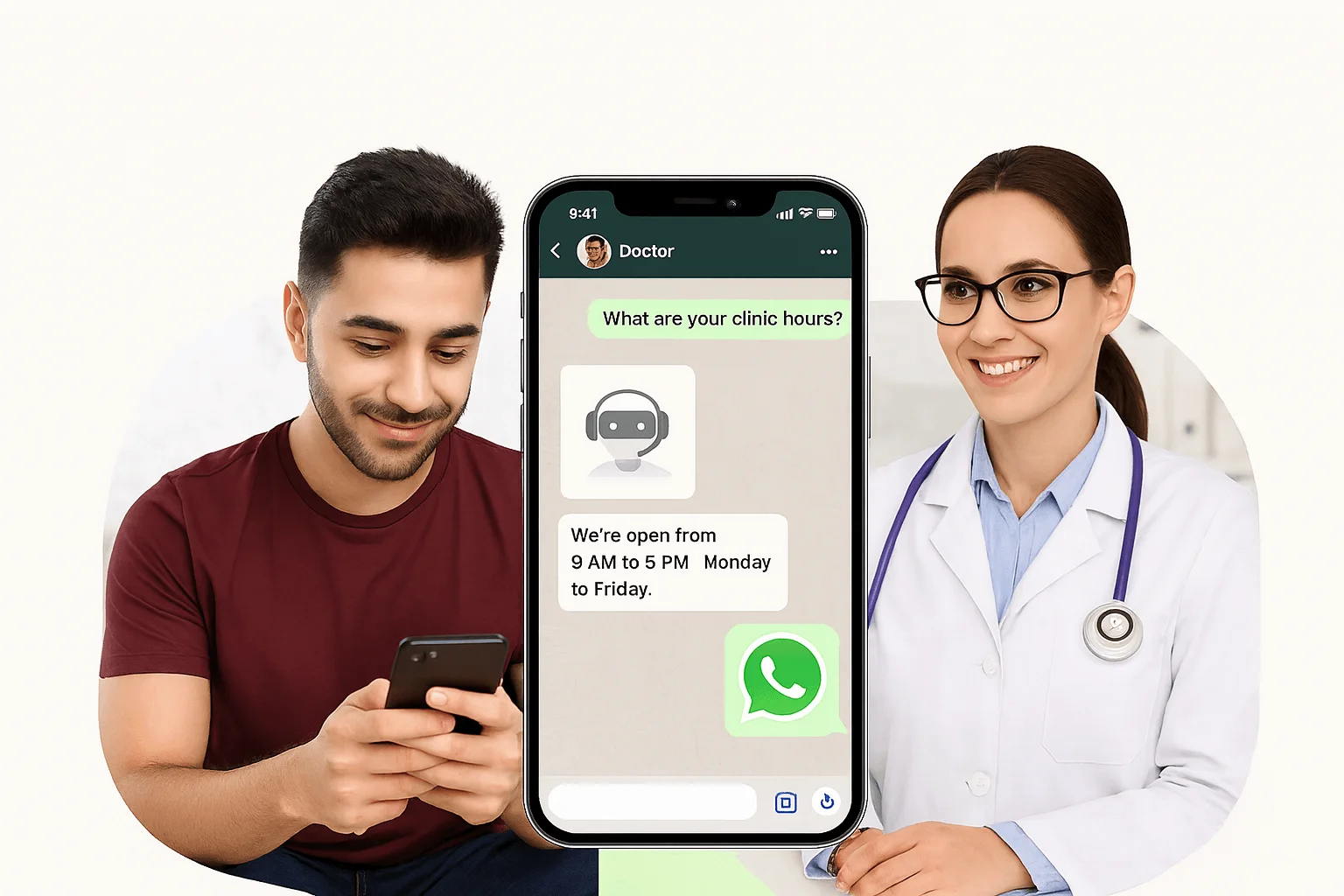
- Patient inquiry automation: instant answers to clinic hours, insurance panels, required documents, and directions, without tying up a call center line.
- Intelligent routing: an in-chat menu (“Book appointment,” “Billing,” “Talk to a nurse”) sends patients to the right department instantly instead of a hold queue.
- Prescription and follow-up alerts: refill reminders, post-treatment instructions, and visit follow-ups triggered automatically by appointment or treatment status.
- Non-clinical notifications: “your lab results are ready,” “your document is available,” queue-number updates.
- Feedback and satisfaction surveys: a simple 1–5 rating sent right after a visit, while the experience is still fresh.
- Report and document delivery notifications: a secure link to a patient portal, not the file itself, sent the moment a result is ready.
Top Platforms for Patient Engagement Using WhatsApp (2026 Comparison)
Most platforms in this space fall into one of two categories: messaging-first tools that layer basic automation on top of a shared inbox, and CRM-native platforms that treat every WhatsApp conversation as part of a structured patient record and pipeline, not just a chat log.
Capability | WhatZCRM | Typical Messaging-First Chatbot Tool | Manual / Call-Center Process |
Appointment booking & calendar sync | Native, syncs with Google Calendar, Outlook, Practo | Often requires a third-party integration | Phone-based, manual entry |
Centralized patient record (CRM) | Built-in history, tags, chat logs, treatment notes in one place | Usually limited to chat/session history | Paper or siloed EMR only |
Automated follow-up sequences | Rule-based + AI, triggered by appointment/treatment status | Basic broadcast/reminder only | Manual follow-up calls |
Multi-agent routing & internal notes | Yes, with department-based routing | Varies by platform | N/A |
HIPAA/GDPR-ready infrastructure | Yes, with audit logs and encrypted storage | Varies; verify per vendor | Depends on internal systems |
EMR/EHR integration | Practo, HealthPlix, custom EMRs | Varies; often requires custom dev | N/A |
No-code chatbot builder | Yes | Common across the category | N/A |
Best suited for | Clinics/hospitals that want one system for conversations and the patient pipeline behind them | Teams that only need broadcast + basic auto-reply | Small practices not yet automating |
The practical difference: a messaging-first tool can tell you a conversation happened. A CRM-native platform like WhatZCRM can tell you where that patient is in their care journey booked, seen, awaiting follow-up, overdue for a refill reminder because the chat is tied to a record, not just a thread.
WhatsApp Chatbot vs. WhatsApp CRM: Why the Difference Matters for Hospitals
A chatbot answers a message. A CRM manages a relationship. For a hospital, that distinction shows up fast: a pure chatbot can confirm an appointment, but it won’t tell your front desk that the same patient missed their last two follow-ups, or that their prescription refill is due this week, or that a diagnostic lab report has been sitting unread for three days.
That’s the gap WhatZCRM is built to close every WhatsApp conversation feeds into a searchable patient record, so appointment history, follow-up status, and communication all live in one dashboard instead of a chatbot’s disconnected session logs.
Is a WhatsApp Chatbot for Healthcare HIPAA Compliant?
This is the question every hospital should ask before deploying, and it’s a nuanced one. WhatsApp itself does not sign a Business Associate Agreement (BAA), which means Protected Health Information (PHI) lab results, diagnoses, treatment details should never be sent directly inside a WhatsApp chat, even though messages are end-to-end encrypted in transit.
What a compliant setup looks like in practice:
- Send a notification, not the data: “Your lab results are ready” plus a secure, authenticated link to your patient portal, not the report itself.
- Use a platform with encrypted data storage, role-based access, and audit logs on the backend, since WhatsApp’s encryption only covers the message in transit, not how your CRM stores it afterward.
- Never collect full IDs, insurance numbers, or payment details inside the chat window; redirect to a secure form instead.
- Always provide a clear human handoff path for urgent, complex, or emotionally sensitive queries. Automation should support staff, not replace escalation.
- Avoid selling or promoting prescription drugs or medical devices directly through WhatsApp; this violates Meta’s Commerce Policy and risks getting your business number banned.
WhatZCRM is built with HIPAA/GDPR-ready infrastructure, encrypted storage, audit trails, and consent-based messaging, but no chatbot vendor can make your hospital “compliant” on its own. Compliance depends on how you configure the workflow, not just which tool you buy.
Also Read: How to Build a WhatsApp Chatbot (No Code)
How to Choose the Best WhatsApp Chatbot for Your Hospital or Clinic
When evaluating vendors, weigh these four factors:
- Official WhatsApp Business API access: confirm the vendor is a verified Meta Business Partner, not a reseller of an unofficial integration.
- CRM depth, not just chat depth: can the platform track a patient’s full journey (booking → visit → follow-up → retention), or does it only log conversations?
- Compliance-first design: encrypted storage, audit logs, and role-based access should be standard, not an add-on.
- Integration with what you already run: your calendar system, EMR, and payment gateway should connect without custom development.
How Healthcare Providers Automate Patient Engagement with WhatZCRM
- General clinics deploying a multilingual WhatsApp chatbot for scheduling and FAQs have cut phone call volume by roughly 65% while improving appointment confirmation rates.
- Multi-specialty hospitals using automated department routing and bulk campaign templates have seen up to 3x higher patient response rates versus traditional SMS campaigns.
- Diagnostic labs automating result notifications have cut delivery time from hours to minutes, with the large majority of patients accessing reports within 10 minutes of upload.
- Pharmacies automating refill reminders and payment links have seen roughly 60% of repeat customers shift to ordering via WhatsApp.
Conclusion
WhatsApp chatbots have moved past the “nice-to-have” stage for hospitals and clinics. The providers seeing real results aren’t just automating replies; they’re connecting every booking, reminder, and follow-up back to a single patient record, so nothing falls through the cracks between a first inquiry and long-term care.
That’s the difference between a chatbot that answers messages and a CRM that manages the relationship behind them. WhatZCRM is built for the second approach, giving hospitals, clinics, and diagnostic centers one system to automate patient engagement on WhatsApp while keeping the full patient journey visible in one place.