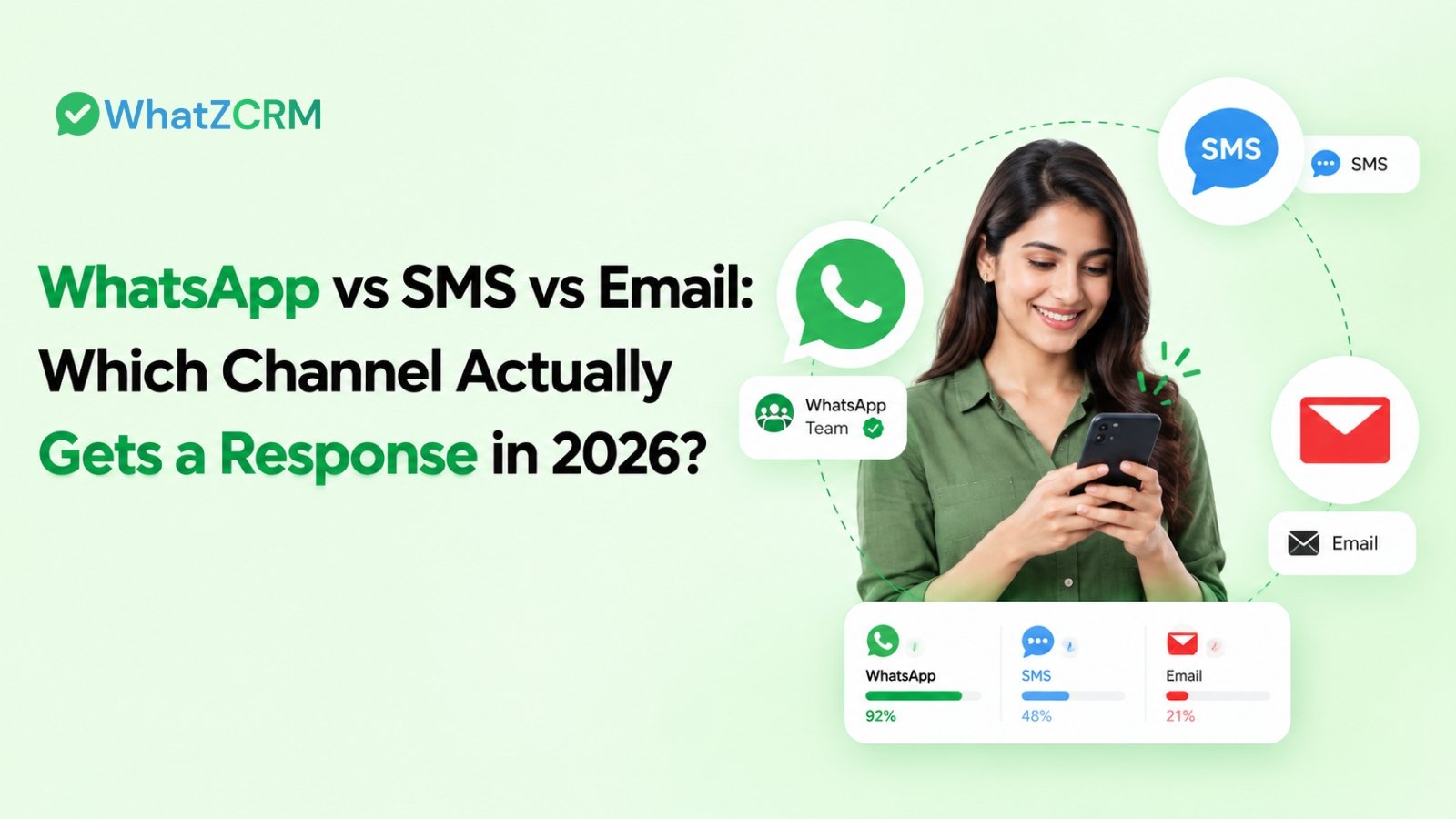

A customer can ignore an email for three days, miss an SMS in a busy notification list, or reply to a WhatsApp message within minutes. The difference isn’t simply about which channel has the highest open rate. It comes down to how people use each channel and what you are asking them to do.
For a small business, startup, or marketing agency, that distinction matters. Spending more on a channel doesn’t automatically mean getting more sales, replies, or qualified leads.
So, how do WhatsApp, SMS, and email compare in 2026?
Email remains useful for detailed communication and long-term nurturing; SMS is strong for urgent notifications; and WhatsApp is best for two-way conversations, follow-ups, support, and conversational selling. Industry benchmark articles published in 2026 report substantially higher engagement ranges for WhatsApp than email, although actual performance varies by audience, country, message quality, and consent.
Let’s look at where each channel fits.
WhatsApp vs SMS vs Email: Quick Comparison
| Factor | SMS | ||
| Response potential | High for conversations | Moderate | Usually lower for immediate replies |
| Delivery | Very fast | Very fast | Can be delayed or overlooked |
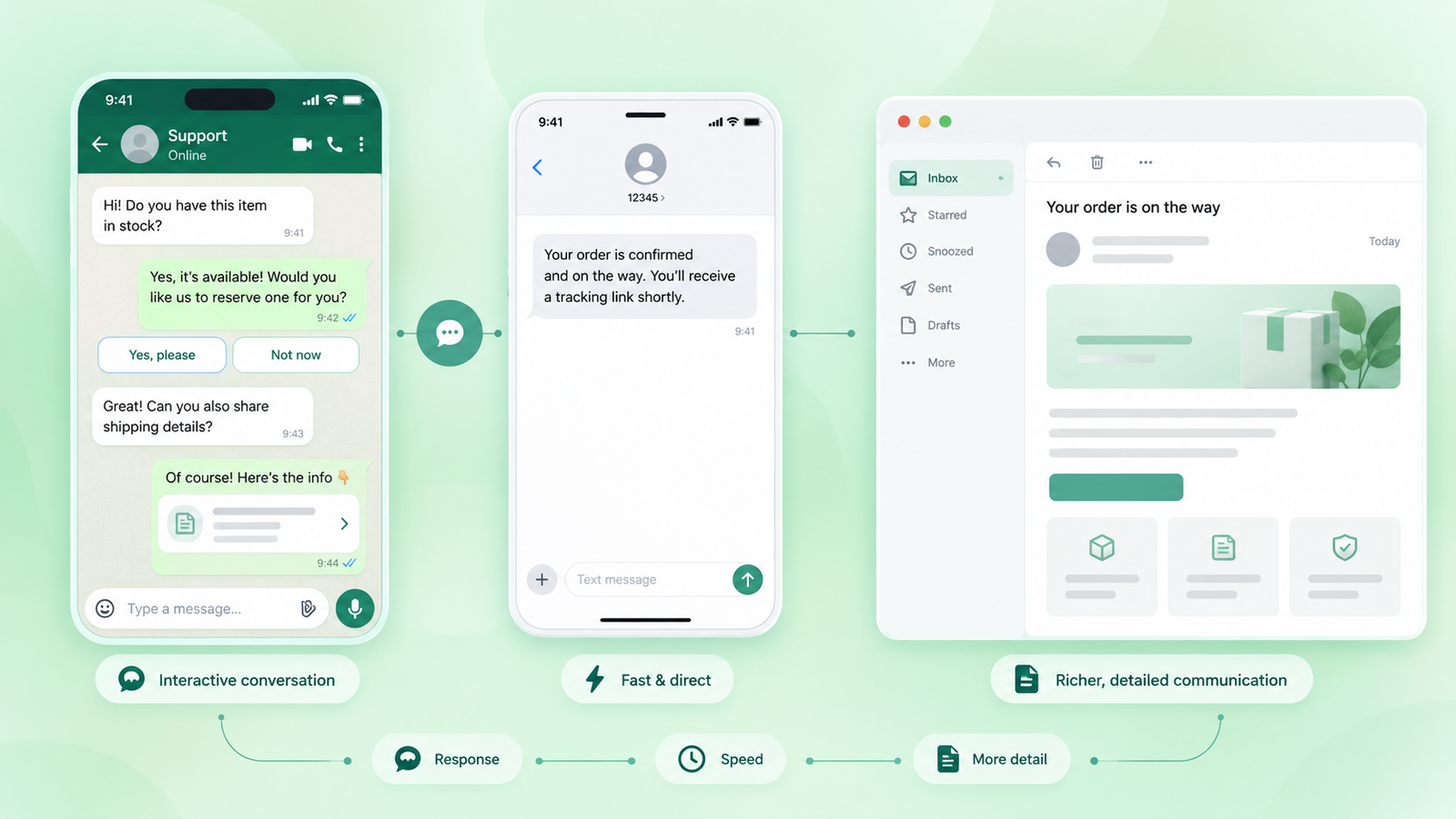
| Rich media | Images, videos, buttons, catalogs | Very limited | Strong |
| Two-way conversation | Excellent | Limited | Possible, but less immediate |
| Best for | Sales, support, follow-ups | Alerts and urgency | Nurturing and detailed content |
| Automation | Strong | Strong | Strong |
| Personalization | High | Moderate | High |
| Content length | Flexible | Short | Flexible |
| Customer support | Excellent | Basic | Better for ticket-style communication |
| Cost structure | Platform/message category dependent | Per-message | Usually volume/contact based |
These aren’t hard rules. A well-targeted email can outperform a poorly written WhatsApp campaign, just as a timely SMS can outperform both.
Also Read: How to Track the Success of Marketing Campaigns on WhatsApp
The useful question is: which channel matches the customer’s situation?
What Differences Can We Expect Between WhatsApp Marketing and Email Marketing?
Email gives businesses room to explain. A company can send a product guide, newsletter, case study, product announcement, invoice, onboarding sequence, or detailed offer without worrying about message length.
WhatsApp works differently. The conversation is closer to a salesperson or support agent speaking directly with a customer.
A customer can see an offer, ask a question, receive an answer, and continue toward a purchase in the same conversation.
That makes WhatsApp particularly useful for:
- Lead follow-ups
- Product enquiries
- Abandoned cart reminders
- Appointment confirmations
- Customer support
- Order updates
- Sales qualification
- Personalized offers
- Re-engagement campaigns
The distinction becomes clearer when the customer needs a response rather than simply information.
WhatsApp vs SMS: Which Is Better for Quick Responses?
SMS has one major advantage: simplicity.
There is no requirement for the customer to open a particular messaging app. The message goes directly to the phone number, making SMS useful for OTPs, appointment reminders, delivery alerts, payment notifications, and other time-sensitive communication.
But SMS is restrictive when the conversation becomes more complicated.
Imagine a real estate lead asking: “Is this apartment available? Can you send the floor plan? What is the price? Can I visit tomorrow?”
A short SMS can deliver the first message, but handling the entire interaction is less convenient.
WhatsApp is built around this type of back-and-forth communication. Businesses can use text, images, videos, buttons, and other supported message formats to continue the conversation.
That’s one reason WhatsApp vs SMS marketing isn’t really about replacing one with the other. SMS is useful when urgency and universal reach matter. WhatsApp becomes more useful when the customer needs to interact.
Which Channel Gets the Highest Response Rate?
There is no single universal response-rate benchmark because industries, countries, audience quality, consent, campaign type, and measurement methods differ.
Some 2026 industry benchmark articles report WhatsApp open/read rates above 90%, while email benchmarks in the same sources are generally much lower. One published comparison reports WhatsApp reply rates of 35–50%, compared with under 1% for email and 2–5% for SMS. Another 2026 comparison reports different ranges, illustrating why these figures should be treated as directional rather than guaranteed results.
So don’t build your strategy around a headline like “WhatsApp has a 98% open rate.”
A better question is: How many people took the action that matters to my business?
For example: 100 messages sent → 80 delivered → 60 read → 20 replies → 5 qualified leads → 2 sales
That funnel tells you far more than an open rate alone.
Why WhatsApp Automation Matters for Small Businesses
Getting responses is only half the challenge. The bigger problem is what happens after someone responds.
A small business might receive leads from its website, Facebook ads, Instagram, Google, or Click-to-WhatsApp campaigns. If every lead requires someone to manually reply, qualify, follow up, and update records, opportunities can easily be missed.
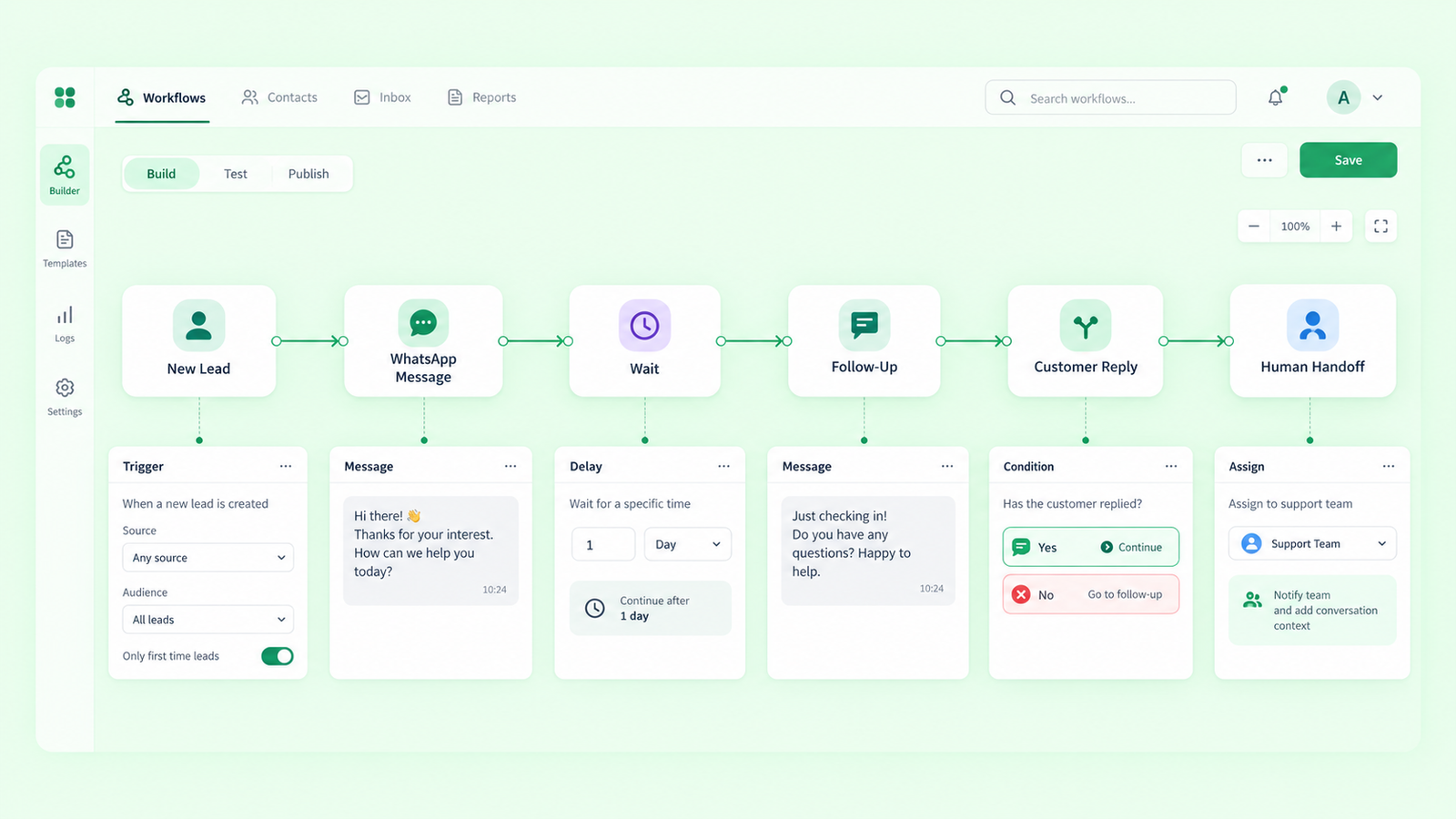
This is where WhatsApp automation becomes useful.A basic automated journey could look like:
New enquiry → Instant WhatsApp reply → Ask qualification questions → Assign sales representative → Follow-up → Human conversation → Conversion
The automation handles repetitive steps while the sales or support team takes over when a real conversation is needed.
WhatsApp’s own Business Messaging Policy allows automation during the customer-service window but requires businesses to provide a clear escalation path to human support. Businesses also need the appropriate permissions and must follow WhatsApp’s messaging policies.
For a small team, that can make a practical difference. Instead of asking employees to remember every follow-up, the system can trigger the right message based on what the customer did.
Why Email Still Remains the Best Communication Tool?
The growth of WhatsApp doesn’t make email irrelevant.
Email remains a strong channel when the customer needs more information or when communication is part of a longer nurturing process.
Use email for:
- Newsletters
- Educational content
- Product guides
- Case studies
- Long-form announcements
- Lead nurturing
- Detailed proposals
- Receipts and business documents
- Onboarding sequences
For example, a SaaS company could send an educational email explaining how a product works, then use WhatsApp to answer questions from interested prospects.
That’s more effective than forcing one channel to handle the entire customer journey.
When to use SMS for the Best Customer Experience?
SMS works particularly well when the message needs immediate attention and doesn’t require a long conversation.
Good examples include:
- OTPs
- Appointment reminders
- Delivery alerts
- Payment notifications
- Event reminders
- Time-sensitive alerts
- Short promotional messages
The message should be concise and useful. If the customer needs to read a detailed explanation, SMS probably isn’t the best place for it.
A Proven Communication Channel Strategy for Small Businesses
Instead of choosing one channel and using it for everything, map the channel to the customer journey.
For example:
Step 1: Email: Introduce the product or educate the prospect.
Step 2: WhatsApp: Follow up with an interested lead and answer questions.
Step 3: WhatsApp automation: Send reminders or personalized follow-ups when the customer doesn’t respond.
Step 4: SMS: Use SMS for an urgent appointment, payment, or delivery notification when appropriate.
Step 5: Human conversation: Let the sales or support team take over when the customer is ready to talk.
This approach is more practical than asking whether WhatsApp Marketing vs Email Marketing or WhatsApp vs SMS has a permanent winner. The right channel depends on the job.
How WhatZCRM Can Help Manage WhatsApp Conversations
For businesses that rely heavily on WhatsApp lead generation and customer communication, managing conversations across multiple numbers can become difficult.
WhatZCRM brings WhatsApp conversations, customer management, follow-ups, automation, and sales workflows into one platform.
Teams can use WhatsApp automation to manage follow-ups, organize conversations, assign chats, segment contacts, and move prospects through the sales process instead of relying on scattered phone conversations.
That becomes especially useful when a business has multiple salespeople handling the same customer pipeline.
To Conclude
The WhatsApp vs SMS vs Email debate is less about finding one winning channel and more about using each channel for the right customer action. Email works well when you need to share detailed information, SMS is useful for quick and time-sensitive updates, while WhatsApp is especially effective when the goal is to start a conversation, follow up with a lead, or provide personalized support.
For small businesses and growing teams, the real opportunity is combining these channels instead of treating them as competitors. If WhatsApp is already part of your sales or customer communication process, WhatsApp automation can help your team follow up consistently without adding more manual work.
If you want to turn WhatsApp conversations into a more organized sales and marketing process, start a 7-day free trial of WhatZCRM and explore how automated follow-ups, customer management, and WhatsApp campaigns can fit into your workflow.