
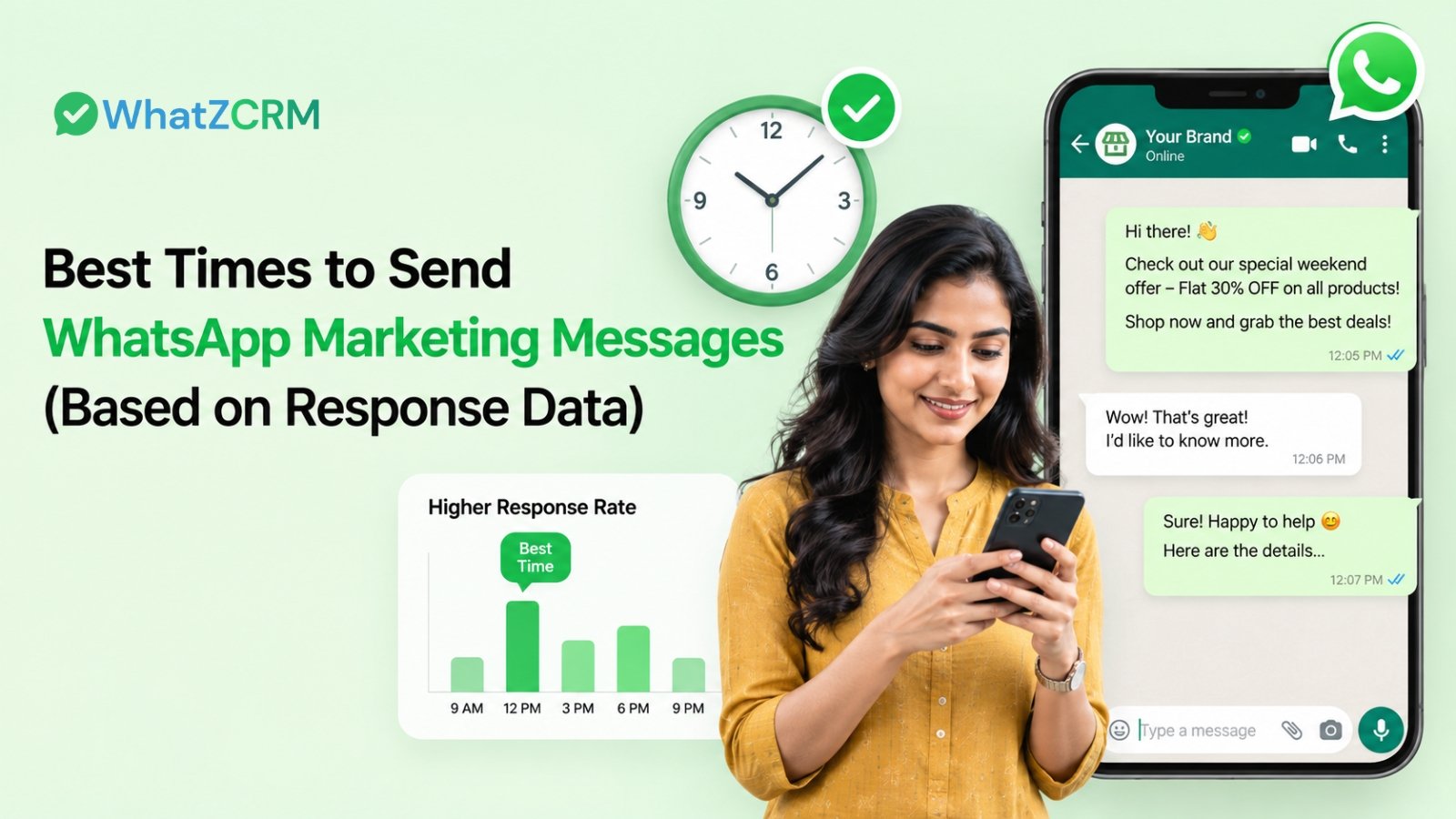

The best times to send WhatsApp messages are generally 10 AM–12 PM and 5 PM–9 PM, but there is no universal winning time for every business. Recent WhatsApp marketing research shows that timing varies by audience, industry, day of week, message type, and customer behavior.
For most businesses, these time ranges are useful starting points:
- 10 AM–12 PM: Strong for B2B, e-commerce, education, and professional audiences.
- 5 PM–9 PM: Often effective for consumer, retail, education, and lifestyle campaigns.
- Tuesday–Thursday: Frequently stronger for B2B and professional audiences.
- Weekends: Can work well for consumer and e-commerce campaigns, but performance depends heavily on the audience.
- Late night: Avoid promotional messages during sleeping hours and other clearly inconvenient periods.
The key is to treat these benchmarks as a starting point, not a fixed rule.
Table of Contents
ToggleWhy WhatsApp Message Timing Affects Response Rates
WhatsApp messages are highly visible, but visibility does not automatically mean action. The real goal of send-time optimization is to increase reply rates, click-through rates, conversions, and revenue, rather than simply maximizing message opens.
For example, a customer may read an offer at 8 AM but ignore it because they are preparing for work. The same offer at 7 PM may generate a reply or purchase because the customer has more time to act.
This is why businesses should analyze their own WhatsApp engagement data instead of relying entirely on generic benchmarks.
Best Times to Send WhatsApp Marketing Messages by Audience
Different audiences have different daily routines.
For B2B and Professional Services
For B2B audiences, start by testing 10 AM–11:30 AM on Tuesday through Thursday. Decision-makers are often busy at the start of the day, so early-morning sends are less suitable for promotional content.
Use these windows for:
- Lead follow-ups
- Product updates
- Demo invitations
- Case studies
- Consultation offers
For E-commerce and Retail
E-commerce businesses can test 10 AM–12 PM and 6 PM–9 PM. Morning campaigns can capture shopping intent during the day, while evening messages can reach customers when they have more time to browse.
Use these windows for:
- Product promotions
- Flash sales
- Restock alerts
- Abandoned-cart campaigns
- Personalized offers
For Education and Coaching
Education audiences may respond better after classes or work. A practical starting point is 5 PM–8 PM, particularly for admission campaigns, webinars, course promotions, and exam-related communication.
Healthcare and Local Services
For appointment-based businesses, timing should follow customer intent. Send appointment reminders according to the schedule rather than waiting for a generic.
Also Read: How Automated WhatsApp Campaigns Increased Engagement by 70%
Best Time to Send WhatsApp Messages by Day
There is also a difference between the best time of day and the best day.
Monday: Often weaker for promotional campaigns because customers are catching up after the weekend.
Tuesday–Thursday: Strong starting days for B2B and many professional campaigns.
Friday: Can work well for retail, lifestyle, and weekend-related promotions.
Saturday: Test morning and afternoon windows for consumer audiences.
Sunday: Can be weaker for some business categories, although consumer, entertainment, travel, and festive campaigns may perform differently.
The important lesson is to compare day + time + audience segment, rather than analyzing timing in isolation.
Best WhatsApp Message Timing by Campaign Type
Not every WhatsApp message should follow the same schedule.
Promotional messages: Test 10 AM–12 PM or 5 PM–9 PM.
Abandoned-cart messages: Trigger based on customer behavior instead of using a fixed broadcast time.
Appointment reminders: Send according to the appointment date and customer journey.
Order and payment updates: Send when the relevant event occurs.
Re-engagement campaigns: Test mid-week periods when customers have time to reconsider an offer.
This distinction is important because marketing messages compete for attention, while transactional messages are expected by the customer.
Also Read: Best Way to Create WhatsApp Marketing Campaign in 2026
How to Find Your Own Best Time to Send WhatsApp Messages
Generic benchmarks can help you start, but your own response data should determine the final schedule.
Use a simple four-step process:
- Segment your audience by industry, location, behavior, purchase history, or engagement level.
- Test two different send windows, such as 10 AM and 7 PM.
- Compare meaningful metrics including replies, clicks, conversions, and revenue.
- Repeat the test across multiple weeks before choosing a winning time.
Avoid judging a campaign only by open or read rates. A time that generates more reads but fewer sales may not actually be the better time.
Use WhatsApp Analytics to Optimize Send Times
The easiest way to improve WhatsApp campaign timing is to connect scheduling with analytics.
WhatZCRM helps businesses segment contacts, schedule WhatsApp campaigns, personalize messages, automate follow-ups, and monitor campaign performance. Its analytics capabilities provide visibility into delivery, clicks, replies, conversions, and other campaign metrics with the WhatsApp Automation tool.
This creates a continuous optimization cycle: Segment → Schedule → Send → Measure → Compare → Optimize
Best Practices for WhatsApp Campaign Timing
Follow these WhatsApp marketing best practices:
- Use recipient time zones for international campaigns.
- Avoid sending promotional messages during sleeping hours.
- Segment B2B and B2C audiences separately.
- Test different days and time windows.
- Track replies, clicks, and conversions—not just reads.
- Personalize messages using customer data.
- Use automated triggers for behavior-based campaigns.
- Review campaign performance regularly.
- Send only relevant marketing messages to opted-in contacts.
Final Takeaway
The best times to send WhatsApp messages are not determined by the clock alone. The strongest results come from combining timing with audience segmentation, relevant messaging, behavioral triggers, automation, and response data.
Start with 10 AM–12 PM and 5 PM–9 PM as test windows, then let your own campaign analytics determine what works. With the right WhatsApp CRM, businesses can turn timing from guesswork into a measurable optimization strategy.
Frequently Asked Questions (FAQs)
A good starting point is 10 AM–12 PM or 5 PM–9 PM, but the ideal WhatsApp marketing send time depends on your audience, industry, message type, time zone, and historical campaign performance. Testing different time windows is the best way to identify when your customers are most likely to engage.
Neither morning nor evening is universally better for WhatsApp marketing. Businesses should test morning and evening campaigns with comparable audience segments and evaluate response rates, click-through rates, conversions, and opt-outs to determine which time performs best.
Tuesday through Thursday can be useful starting points for many B2B WhatsApp campaigns. However, consumer-focused businesses should test both weekdays and weekends because customer behavior can vary significantly by industry, audience, location, and campaign objective.
Use audience segmentation, A/B testing, campaign scheduling, and WhatsApp campaign analytics to compare performance across different days and time windows. Track metrics such as delivery rates, replies, clicks, conversions, and opt-outs to identify the most effective send times for each audience segment.
No. Transactional WhatsApp messages such as order confirmations, shipping updates, payment confirmations, appointment notifications, and other time-sensitive service messages should generally be triggered by the relevant customer event rather than delayed to fit a marketing send window.