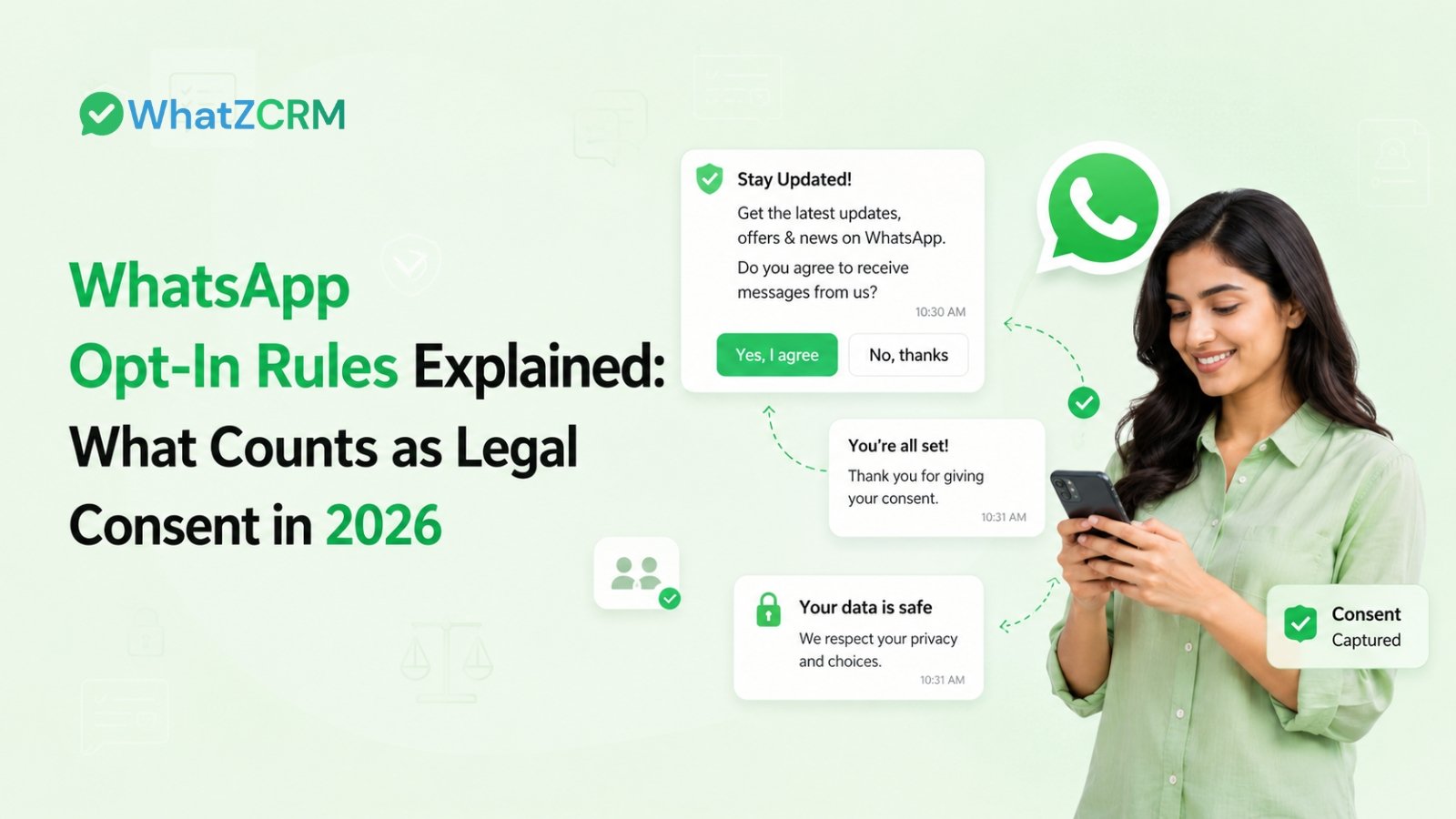

WhatsApp has become an important customer communication channel for marketing, sales, support, and notifications. But having a customer’s phone number does not automatically mean you have permission to send WhatsApp marketing messages.
In 2026, businesses need to think about WhatsApp opt-in as a combination of user permission, transparency, privacy, and platform compliance. WhatsApp’s business guidance emphasizes consent before businesses initiate messaging, while businesses must also consider applicable privacy and marketing laws in the markets where they operate.
So, what exactly counts as legal consent? Let’s break it down.
Table of Contents
ToggleWhat Do We Understand About WhatsApp Opt-In?
WhatsApp opt-in is the permission a customer gives a business before receiving business-initiated communications. In 2026, WhatsApp requires businesses to obtain opt-in in advance and clearly communicate which business the customer is agreeing to receive messages from. Businesses must also follow applicable privacy and marketing laws in the countries where they operate.
Importantly, Meta’s latest 2026 guidance says WhatsApp-specific opt-in consent is no longer required. This means businesses have more flexibility in where they collect consent. However, the permission itself is still required, and customers should understand that they are agreeing to receive messages from the business.
This distinction is important for businesses using WhatsApp Business API, WhatsApp CRM, broadcast messaging, automation, and marketing campaigns.
What Counts as Valid WhatsApp Consent in 2026?
A strong WhatsApp consent process should answer three basic questions:
- Who is contacting the customer?
- What type of messages will they receive?
- Did the customer provide permission before receiving those messages?
For example:
“I agree to receive product updates and promotional offers from ABC Company.”
This is much clearer than simply collecting a phone number and assuming the customer has agreed to WhatsApp marketing.
Meta’s current guidance specifically says businesses should clearly state the business name and that the person is opting in to receive messages from that business.
Also Read: How to Send Bulk WhatsApp Messages Without Getting Banned in 2026
Is Giving a Phone Number Enough for WhatsApp Marketing?
No.
A phone number by itself should not be treated as unlimited WhatsApp marketing permission.
For example, a customer may provide their phone number to:
- Place an order
- Request a quotation
- Download an ebook
- Contact customer support
- Book an appointment
- Register for an event
That information does not automatically mean the customer expects promotional messages.
The safer approach is to explain what communications the customer is agreeing to receive and capture that permission before initiating relevant business messaging.
Also Read: 15 WhatsApp Greeting Message Examples for Businesses (2026)
WhatsApp Opt-In Rules for Marketing Messages
Marketing messages require particular care because customers may not expect promotional content simply because they interacted with a business.
Meta’s 2026 marketing guidance recommends that businesses obtain an opt-in reflecting the types of messages they intend to send, such as order updates or relevant offers. It specifically recommends explicit consent for promotional messages rather than bundling promotional permission with transactional communications.
Example
Better:
☑ I agree to receive promotional offers and product updates from ABC Company.
Riskier:
☑ I agree to the Terms & Conditions.
The second checkbox does not clearly tell the customer what communications they are agreeing to receive.
Where Can Businesses Collect WhatsApp Opt-In?
One major 2026 change is that businesses do not necessarily need to collect consent through a WhatsApp-specific checkbox.
Meta lists several possible opt-in collection methods, including:
- Website forms
- During transactions
- Customer service calls
- SMS
- QR codes
- In-person interactions
- IVR
- Messenger
- Ads that click to WhatsApp
- WhatsApp conversations
The important requirement is transparency: customers should understand what type of communication they are agreeing to receive.
This gives businesses more flexibility when building their WhatsApp CRM and lead-generation workflows.
What About Transactional vs. Promotional Messages?
Businesses should distinguish between service communications and marketing communications.
For example:
Transactional:
“Your order #1234 has been shipped.”
Promotional:
“Get 20% off your next order this weekend!”
A customer who provides information for an order may reasonably expect order-related updates. That does not necessarily mean they expect unrelated promotional campaigns.
For this reason, businesses should design opt-in flows around the actual communication categories they plan to use. Meta recommends making the type of messages clear and keeping promotional consent separate from other communication types where appropriate.
Also Read: Types of WhatsApp Message Templates: Explained in Detail
WhatsApp Opt-Out Rules: Consent Can Be Withdrawn
Consent is not permanent.
Customers should have a clear way to stop receiving WhatsApp communications. WhatsApp’s Business Messaging Policy requires businesses to respect requests to block, discontinue, or opt out of communications, whether the request is made on or off WhatsApp.
For example:
“Reply STOP to stop receiving promotional messages.”
Once a customer opts out, your CRM or marketing platform should update their status and prevent them from being included in future relevant campaigns.
How to Store WhatsApp Consent in a CRM
For businesses running WhatsApp campaigns at scale, simply having an “Opted In = Yes” field may not be enough operationally.
Your WhatsApp CRM should ideally track:
- Customer phone number
- Consent status
- Consent date and time
- Consent source
- Type of communication
- Opt-out status
- Re-opt-in history
- Campaign eligibility
This creates a clearer audit trail and makes it easier to exclude customers who have withdrawn permission.
For example:
Customer → Opt-in → CRM records consent → Customer enters eligible segment → Campaign sent
If the customer later opts out:
Customer → Opt-out → CRM updates status → Customer removed from campaign segments
What Happens If Businesses Ignore WhatsApp Opt-In Rules?
Ignoring consent and messaging policies can create both customer-experience and platform risks.
WhatsApp states that businesses may have their access limited or removed if they violate its Business Messaging Policy. WhatsApp also monitors user feedback, blocks, reports, and messaging quality.
Meta’s 2026 guidance emphasizes expected, timely, and relevant messages and notes that users can block or report businesses.
So compliance is not only about avoiding account restrictions. It also helps protect your WhatsApp number quality, customer trust, and campaign performance.
WhatsApp Opt-In Compliance Checklist for 2026
Before launching a WhatsApp campaign, ask:
- Does the customer know which business will message them?
- Did the customer provide permission before the business initiated messaging?
- Is the intended communication type clear?
- Is promotional consent clearly communicated?
- Can customers easily opt out?
- Is opt-out information synchronized with your CRM?
- Are consent records stored appropriately?
- Are your campaigns following applicable local laws?
- Are you monitoring blocks, reports, and message quality?
If the answer to these questions is yes, your WhatsApp messaging workflow is much better positioned for compliant and customer-friendly communication.
Final Thoughts
WhatsApp opt-in rules in 2026 are about permission, transparency, relevance, and control.
The biggest clarification from Meta’s latest guidance is that WhatsApp-specific opt-in consent is no longer required, but businesses still need to obtain opt-in in advance, identify the business clearly, communicate the expected message types, respect opt-outs, and comply with applicable laws.
For businesses using WhatsApp Business API or a WhatsApp CRM, the best approach is to build consent into the customer journey from the beginning, not try to fix compliance after a campaign has already been launched.
Note: WhatsApp platform policies and local privacy/marketing laws can change. This article is educational information, not legal advice. Businesses should verify the current requirements applicable to their jurisdiction and use case.
Frequently Asked Questions (FAQs)
Yes. Businesses still need customer permission before initiating business messaging. However, businesses have flexibility in how they collect consent, provided the opt-in clearly communicates that the customer agrees to receive messages from the business.
No. Having a customer's phone number alone should not be treated as consent to send WhatsApp marketing messages. Businesses should obtain appropriate permission before initiating promotional communication and follow applicable WhatsApp and data-protection requirements.
Yes. WhatsApp opt-in can be collected through a website or other customer touchpoints. The consent request should clearly explain that the customer is agreeing to receive WhatsApp messages from the business and should comply with applicable consent requirements.
Yes. Customers can withdraw their consent and request that a business stop sending them WhatsApp messages. Businesses should honor opt-out requests promptly and maintain appropriate records so opted-out contacts are not unintentionally included in future campaigns.
Transactional and promotional messages serve different purposes and may create different customer expectations. Businesses should clearly communicate what types of WhatsApp messages customers are agreeing to receive and ensure their messaging practices comply with applicable policies and consent requirements.