
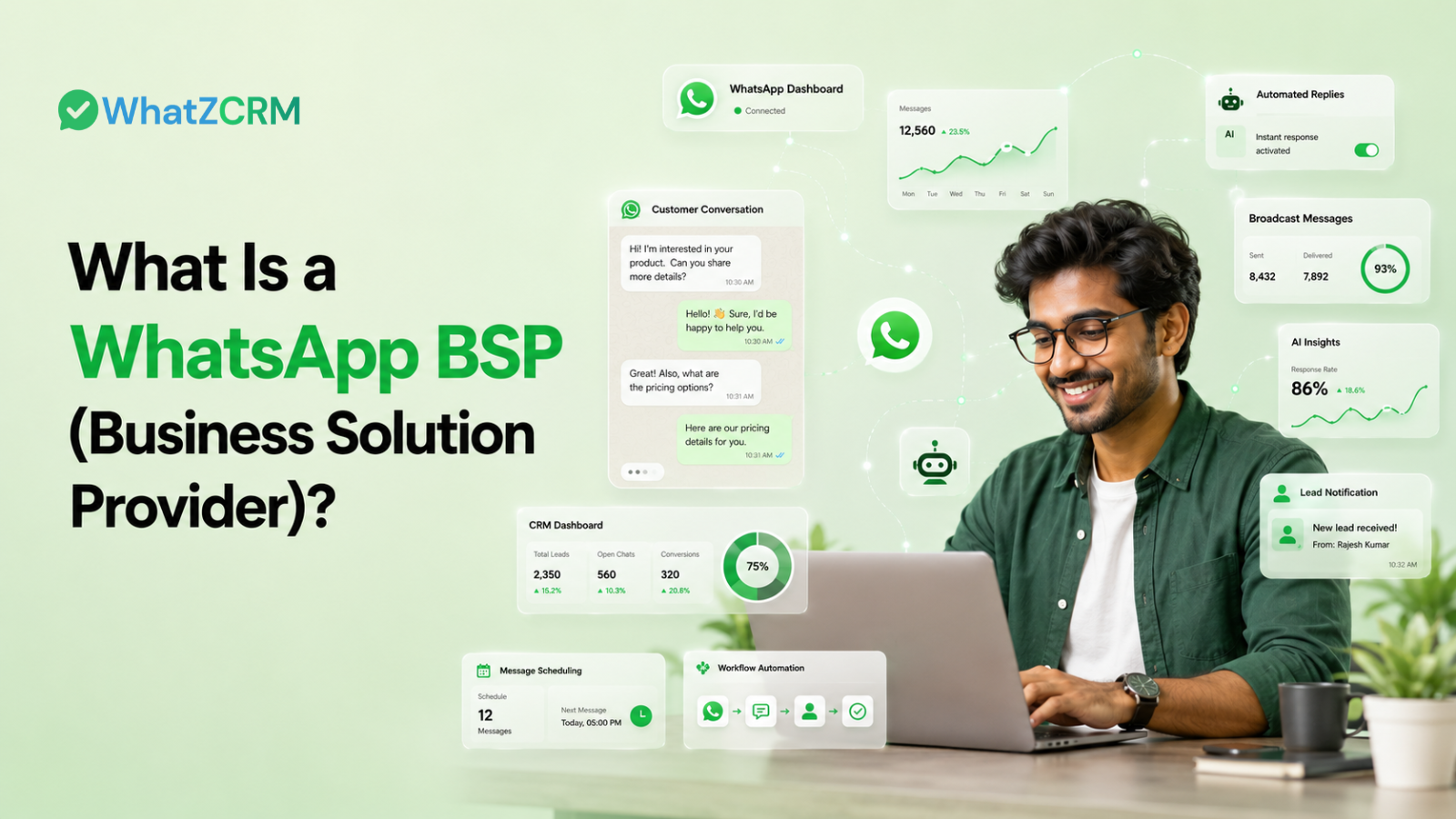

A WhatsApp BSP (Business Solution Provider) is a company officially authorized by Meta to give businesses access to the WhatsApp Business API, along with the tooling needed to actually use it things like a shared inbox, template management, automation, and analytics. You can’t sign up for the WhatsApp Business API directly through Meta’s website; you either go through a BSP or connect via Meta’s Cloud API and build your own tooling around it. Most growing businesses go the BSP route because it comes with a working interface out of the box.
If you’ve been researching WhatsApp automation for your business, you’ve probably run into the term “BSP” without anyone actually stopping to explain it. It gets dropped into pricing pages and comparison articles like everyone already knows what it means. Most people don’t, and that’s not really a knowledge gap on their part; Meta doesn’t make this part of the ecosystem particularly obvious.
So here’s the plain-language version.
Table of Contents
ToggleWhy BSPs exist in the first place
Meta owns WhatsApp, but Meta doesn’t want to be in the business of building CRMs, chatbot builders, and team inboxes for millions of businesses worldwide. So when WhatsApp opened up its Business API years ago, Meta didn’t hand it out directly. It authorized a set of third-party companies to manage that access on its behalf, verifying businesses, handling the technical infrastructure, and enforcing Meta’s messaging policies. Those companies are BSPs.
Think of it this way: Meta owns the road, but BSPs are the ones who hand you the car, teach you to drive it, and make sure you don’t break traffic laws. Without one, you’re not getting anywhere near the WhatsApp Business API.
What a BSP actually does, day to day
It’s easy to describe a BSP in abstract terms (“access provider,” “middleman”) without explaining what that means in practice. Here’s the concrete version:
- Business verification: Getting your business approved and connected to a WhatsApp Business Account
- Template approval and routing: Every marketing or utility message on WhatsApp needs a pre-approved template; BSPs manage submission and Meta’s review process
- Message routing and delivery infrastructure: The actual plumbing that gets a message from your system to a customer’s phone reliably
- Quality and compliance monitoring: Keeping your number’s quality rating healthy so Meta doesn’t restrict it
- The interface you actually use: Inbox, chatbot builder, campaign tools, integrations. This is arguably the part businesses care about most, and it’s also where BSPs differ from each other the most
Also Read: Rule-Based Bots vs AI Agents on WhatsApp
That last point is worth sitting with. Two BSPs can offer identical underlying API access and still be a completely different experience to use, because the tooling wrapped around that access is where all the actual product differentiation happens.
BSP vs. Cloud API: the other path
Meta does offer a second route that doesn’t involve a BSP at all: the Cloud API, which launched a few years ago as a way to connect directly to Meta’s infrastructure without an intermediary company.
Going through a BSP | Meta’s Cloud API (direct) | |
Setup | Business handled by the BSP, usually guided | You build and maintain it yourself |
Interface | Comes with a dashboard, inbox, automation tools | None, you build your own on top of the raw API |
Technical effort | Low | High, needs developer resources |
Ongoing cost | Meta’s per-conversation fee + BSP’s markup or platform fee | Meta’s per-conversation fee only |
Best for | Most businesses have sales, support, marketing teams without development bandwidth | Companies with engineering teams who want full control and lower per-message cost |
Neither path is “better” in absolute terms; it depends entirely on whether you’d rather pay a bit more for a working product on day one, or invest engineering time to build exactly what you need and pay only Meta’s base rate.
See How WhatsApp CRM Pricing Breaks Down
What it Actually Costs
There’s a cost stack here that’s worth separating into its parts, because pricing pages don’t always make this clear:
- Meta’s own per-conversation fee: This is set by Meta, applies no matter which BSP you use (or even if you use none), and varies by country and message category (utility, marketing, authentication)
- The BSP’s charge on top of that: Either a per-message markup or a flat monthly platform fee, depending on the provider’s pricing model
When a pricing page looks unusually cheap, it’s worth checking whether that number includes Meta’s underlying fee or not. A platform quoting a flat monthly rate with no mention of Meta’s conversation fees usually means those fees are billed separately, not that they don’t exist.
Also Read: WhatsApp API Free vs Paid Plans Explained
Do you Actually Need One?
If your team is sending more than a handful of WhatsApp conversations a day, coordinating across multiple people, or wants any kind of automation a chatbot, auto-replies, lead routing you need either a BSP or a fairly serious in-house engineering effort to build the Cloud API equivalent yourself. For the vast majority of businesses, that math points clearly toward a BSP.
The free WhatsApp Business App is the one exception worth mentioning; it works fine for a solo operator or very small team manually handling a low volume of conversations, no BSP needed. It stops making sense the moment you need more than one person managing the same number, or any automation at all.
Final Thoughts
Since the underlying API access is functionally the same everywhere, the real differences between BSPs come down to:
- Transparent pricing: No hidden per-agent fees or vague “contact sales” markups for basic features
- Onboarding speed: Some providers get you live in days, others take weeks
- The tooling itself: Inbox usability, automation depth, integrations with your existing CRM or e-commerce stack
- Support quality: When a template gets rejected, or a number gets flagged, how fast can you get help
This is also, not coincidentally, exactly what separates a good WhatsApp CRM platform from a mediocre one the BSP relationship is the foundation, but the product built on top of it is what your team actually lives in every day.
Sign up for a 7 Day WhatsApp CRM Free Trial
Frequently Asked Questions (FAQs)
BSP stands for Business Solution Provider, a company officially authorized by Meta to provide businesses with access to the WhatsApp Business API. BSPs are also commonly referred to as WhatsApp Partners or WhatsApp Business Service Providers.
No. The WhatsApp Business API is Meta's messaging infrastructure, while a BSP provides access to that API along with tools such as a shared inbox, automation, message templates, analytics, and onboarding support.
Yes. You can use Meta's Cloud API to connect directly to the WhatsApp Business API without a third-party BSP. However, you'll need to build and maintain your own messaging interface, automation, and integrations, which typically requires development resources.
WhatsApp Business API costs generally include two components: Meta's conversation-based messaging fees and the BSP's pricing model, which may be a flat monthly subscription or an additional usage-based charge depending on the provider.
No. Comprehensive WhatsApp CRM platforms such as WhatZCRM typically include BSP-level API access as part of their service, eliminating the need to manage a separate Business Solution Provider relationship.
While every BSP provides access to the same official WhatsApp Business API, they differ in pricing, onboarding experience, automation features, CRM capabilities, customer support, integrations, and overall ease of use.