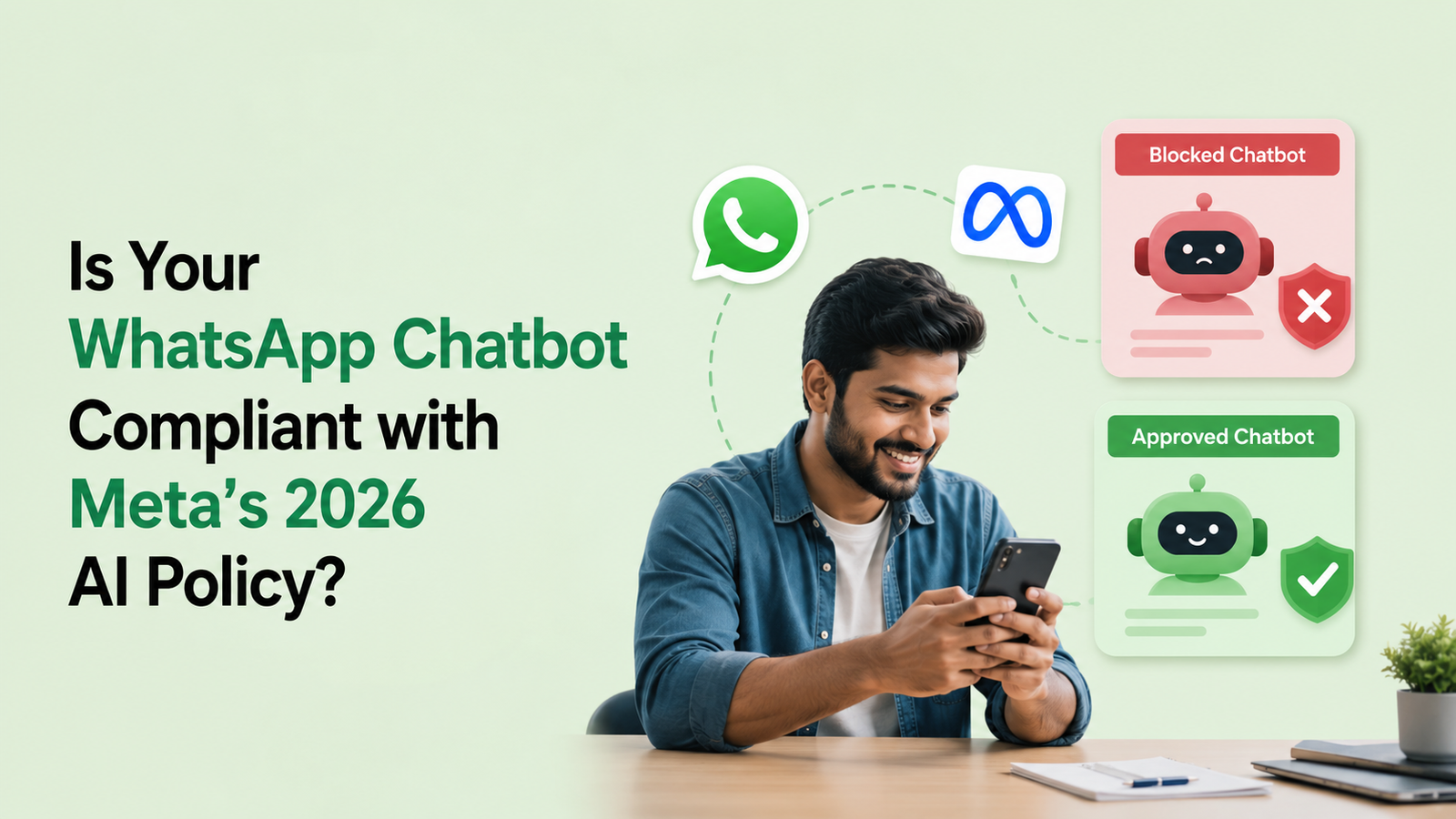

Meta is banning general-purpose AI chatbots and open-ended assistants, such as ChatGPT-style bots, from the WhatsApp Business Platform starting January 15, 2026. New API accounts have followed this rule since October 15, 2025.
- Banned: Chatbots that answer any question on any topic, functioning as a standalone AI assistant rather than a business tool.
- Allowed: Structured, business-specific automation lead qualification, order tracking, appointment booking, proposals, and support workflows tied to a real sales or service process.
- Where WhatZCRM fits in: Because WhatZCRM’s chatbot builder is built around CRM workflows, deal stages, lead segmentation, and follow-ups rather than open-domain chat, it’s designed to operate within Meta’s approved use cases.
Table of Contents
ToggleExactly What Do We Know About Meta’s 2026 AI Policy?
Meta’s update targets a specific category: AI providers whose core product is the AI itself, distributed through WhatsApp as a channel. Think of assistants that let a user ask anything: weather, trivia, document summaries with no connection to a specific business transaction.
These bots generated enormous message volume without fitting WhatsApp’s template-based billing categories (marketing, utility, authentication, support), which is the commercial root of the crackdown.
Business-first automation was never the target. A restaurant confirming a reservation, a real estate agency sharing property details with a qualified lead, or a school sending admission updates all sit inside WhatsApp’s intended use case for the Business API.
Also Read: Rule-Based Bots vs AI Agents on WhatsApp: Which One Is Actually for Your Business?
Is Your Chatbot “General-Purpose” or Business-Specific?
This is the question every WhatsApp CRM user should be asking before January 15, 2026. Ask three things about your bot:
- Does it answer arbitrary questions, or only questions tied to your product, service, or pipeline?
- Does it exist to move a lead through a sales or support process qualification, booking, invoicing or is it a general conversation companion?
- Can it escalate to a human agent when a conversation goes beyond its scope?
If your chatbot was built as an open “ask me anything” assistant, it falls under the ban and needs to be restructured before the deadline. If it’s wired to specific business flows, it’s already compliant.
Why WhatZCRM Users Are Already Policy-Safe
Most WhatsApp automation tools were built primarily as messaging and broadcast layers, with chatbot logic bolted on top, which is exactly the shape of tool that risks drifting into general-purpose territory if left unstructured. WhatZCRM takes a different starting point: the chatbot builder sits on top of a full CRM pipeline, not a standalone messaging thread.
That distinction matters under the new policy:
- Lead-stage-aware conversations: The bot responds based on where a contact sits in the pipeline (new lead, proposal sent, invoice pending), not open-ended prompts.
- Structured automation, not free chat: Drip sequences, proposal sharing, and follow-ups are pre-mapped business flows, the exact category Meta explicitly permits.
- Built-in human handoff: WhatZCRM’s shared team inbox lets any automated conversation escalate to a live agent, satisfying the escalation-path requirement Meta expects businesses to maintain.
- Segmentation over generality: Because bots are tied to tags and pipeline stages, there’s no incentive (or mechanism) to let the AI wander into open-domain territory.
Compliance Checklist Before January 15, 2026
Requirement | General-Purpose Bot (Banned) | WhatZCRM-Style Bot (Allowed) |
Scope of questions | Open-ended, any topic | Tied to leads, orders, support |
Business function | None required | Sales, booking, service, invoicing |
Human escalation | Often missing | Built into shared inbox |
Message intent | Conversational companion | Pipeline-driven automation |
Billing category fit | Doesn’t fit template billing | Fits utility/support/marketing templates |
What to Do If Your Chatbot Is at Risk
If a compliance audit shows your bot leans general-purpose, the fix isn’t to abandon AI; it’s to re-scope it. Rebuild prompts around specific business outcomes: qualifying a lead, answering a catalog question, confirming a booking. Map every automated reply to a pipeline stage or ticket type, and make sure a human agent is always one tap away. This is precisely the model WhatZCRM’s chatbot and CRM structure were built around, so migrating a general chatbot into a compliant, pipeline-based flow doesn’t require starting from scratch.
Frequently Asked Questions (FAQs)
No. Meta's 2026 policy targets only general-purpose, open-domain AI assistants. Business-specific chatbots designed for customer support, lead qualification, sales, appointment booking, order tracking, and similar business workflows remain fully supported.
Yes. WhatZCRM's AI chatbot is designed around business-specific workflows, including CRM pipeline management, lead segmentation, customer support automation, and seamless human handoff. These use cases align with Meta's approved business AI guidelines rather than general-purpose conversational AI.
Chatbots that do not comply with Meta's latest WhatsApp Business Platform policies may face enforcement actions, including messaging restrictions, suspension, or removal from the platform. Keeping your chatbot aligned with Meta's approved business use cases helps protect your business account and messaging capabilities.