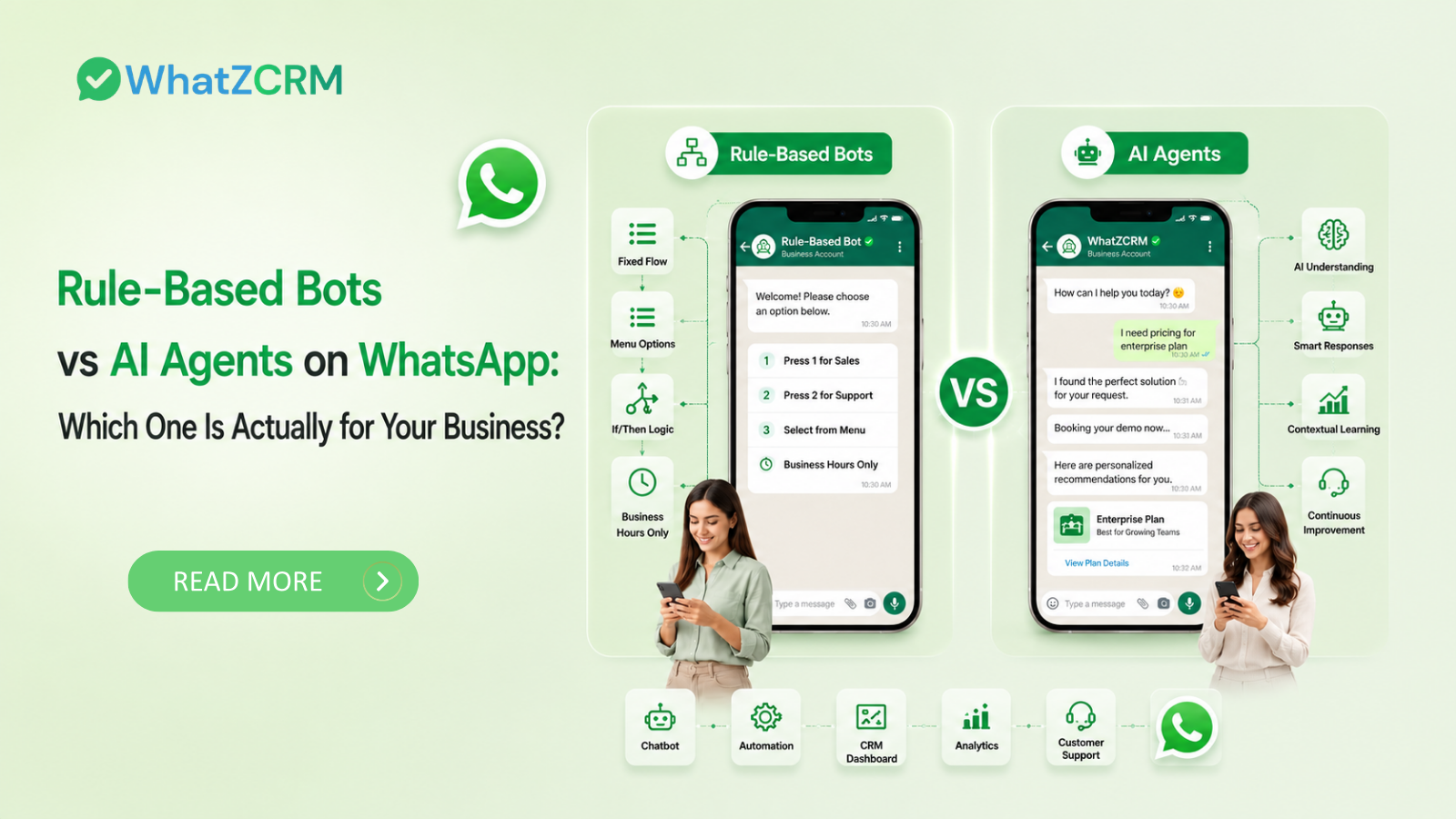

Meta’s 2026 WhatsApp Business API policy doesn’t ban AI. It bans open-ended AI, bots built to answer anything literally, the way a general chatbot would. Rule-based bots were never a compliance risk to begin with, since they only ever say what you told them to say. The real question businesses should be asking isn’t “rule-based or AI”; it’s whether their AI is scoped to their business or left to freelance.
If you run WhatsApp automation for your business, you’ve probably heard some version of this in the last few months: Meta is cracking down on AI chatbots. That’s technically true, and also the kind of headline that causes a lot of unnecessary panic.
Some businesses ripped out working AI systems entirely. Others didn’t touch a thing and are now sitting on a bot that could get their number restricted. Neither reaction is right, and the confusion mostly comes down to one thing: nobody has clearly defined “AI chatbot”. So let’s actually define it.
What Changed, in Terms of WhatsApp Business API
Meta’s updated WhatsApp Business Platform policy took effect for new API users on October 15, 2025, and rolled out to existing accounts by January 15, 2026. The core change is that businesses can no longer run general-purpose conversational AI on a WhatsApp Business number. In other words, you can’t hand your WhatsApp number to something that behaves like an open chat assistant, willing to talk about anything a customer types in, the way you might talk to a general AI tool in a browser tab.
What’s still fine, encouraged, even, is AI that’s built around your actual business: answering questions from your product catalog, checking order status, qualifying a lead, booking an appointment, walking someone through a return. The line Meta is drawing isn’t “no AI.” It’s “no AI without a job.”
That distinction matters more than most explainers give it credit for, because it changes how you should be thinking about your bot architecture altogether.
Rule-based Bots: The Old Reliable
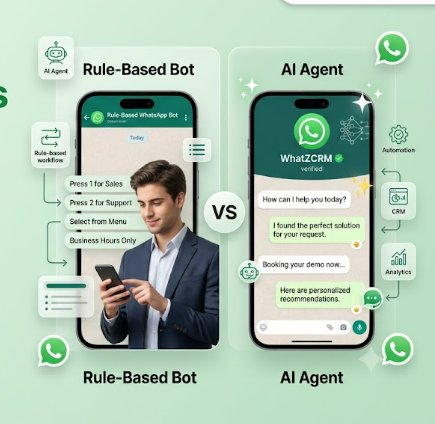
A rule-based bot works off decision trees. Someone messages you, gets a menu, picks an option, and the bot replies with a pre-written response. Think “Reply 1 for order status, 2 for support, 3 to speak with someone.”
These bots are cheap to build and predictable, and this is the part people forget: we were never at any real compliance risk under the new policy. They can’t go off-script because there’s no script to go off. The trade-off is obvious, too: the second someone types something outside the expected options, the bot either loops back to the menu or stalls out.
Anyone who’s ever angrily mashed “0” trying to reach a human on an old phone tree knows exactly how that feels over WhatsApp.
AI Agents: Where the Nuance Actually Lives
An AI agent uses a language model to understand what someone’s asking, regardless of how they phrase it, and to hold a conversation that doesn’t collapse the moment it goes off-script. This is where the policy conversation gets murky because “AI agent” isn’t a single thing; it’s a spectrum.
On one end, you’ve got a genuinely scoped agent: it’s trained on your FAQs, your product catalog, your service policies, and nothing else. Ask it about your return window, and it answers correctly. Ask it to write you a poem or explain quantum physics, and a properly scoped agent either declines or redirects back to what it’s actually there for.
On the other end, you’ve got what’s essentially a general AI model wearing your business’s name tag, a “wrapper” that will answer anything because nobody bothered to restrict its scope. That’s the version Meta is targeting.
Also Read: How AI Chatbot Works with WhatsApp CRM
Not because AI is risky, but because an unscoped bot on a business number creates real problems: it can say things your business never approved, it can be baited into off-topic or inappropriate conversations, and at scale, it’s genuinely harder to audit than a bot that only ever operates inside a defined lane.
The Comparison of Rule-based Bots and AI Agents
| Rule-based bot | Scoped AI agent | Unscoped/general-purpose AI | |
| Handles unexpected phrasing | No, breaks or loops | Yes | Yes |
| Compliant under the 2026 policy | Yes, always was | Yes, if properly scoped | No |
| Can answer off-topic questions | No | No, by design | Yes, this is the problem |
| Setup effort | Low | Moderate | Low (which is exactly why it became common) |
| Best for | Simple, high-volume, predictable requests | Lead qualification, support, bookings, FAQs | Nothing, going forward |
| Risk if left unaudited | Low | Low-moderate | High, account restriction |
So Which One Should you Actually Use?
Here’s the honest answer: it’s not going to be a clean “pick one” because, for most businesses, the right setup is both.
Use a rule-based flow for the handful of genuinely predictable things: business hours, order-tracking status, appointment confirmations. There’s no reason to route “what time do you close” through a language model when a fixed reply does the job faster and cheaper.
Use a scoped AI agent for everything with actual variation in it, the way real customers phrase real questions, which rarely match the neat options in a decision tree. A lead asking “do you have anything under budget for a 2BHK near the metro” isn’t going to navigate a numbered menu well. That’s a job for an agent who understands intent.
Try WhatsApp Lead Qualification Bot
What you shouldn’t have, after this policy rollout, is a bot with no defined edges. One that will happily wander into subjects that have nothing to do with your business, because nobody set a boundary. If you’re not sure which category your current bot falls into, there’s a fast way to check.
A 5-minute Audit You Can Run Right Now
Message your own WhatsApp bot and ask it something completely unrelated to your business, a general knowledge question, something political, anything random. Then look at what happens.
- If it declines, redirects to a human, or steers back to the business topics, you’re in reasonably good shape.
- If it answers fluently, as a general AI assistant would, that’s your sign to fix the scope before it becomes an account-level problem.
It’s a genuinely quick test that tells you more about compliance risk than most audits that cost real money.
Build Your Chatbot for Your Business
Final Thoughts
Step back from the compliance angle for a second, and this policy change is really pushing the entire industry toward something that should’ve been the default from the start: purpose-built WhatsApp bots, not general-purpose ones.
A hybrid setup, rules for the predictable stuff, a scoped AI agent for everything else, and a clean handoff to a human when a conversation needs one, isn’t just the compliant option anymore. In practice, it’s also the one that converts better, because customers aren’t fighting a menu or getting answers that clearly came from outside your business.
If your current setup was built before this shift, it’s worth an afternoon to check where it actually falls on that spectrum before Meta’s enforcement makes that decision for you.