

Logistics companies handle thousands of shipments, delivery updates, and customer inquiries every day. Managing all these interactions through phone calls, emails, or manual SMS notifications often creates delays, confusion, and dissatisfied customers.
This is where WhatsApp CRM for logistics companies becomes a powerful solution. By combining WhatsApp messaging with CRM automation, logistics businesses can streamline communication, automate shipment updates, and improve delivery efficiency.
With more than 3 billion active users worldwide, WhatsApp has become one of the most trusted communication channels for customers. Integrating WhatsApp with a CRM system enables logistics companies to send instant delivery notifications, respond to queries more quickly, and manage operations from a centralized platform.
In this guide, we will explore how WhatsApp CRM works in logistics, the benefits it offers, and how companies can implement it to improve customer experience and operational efficiency.
What Is WhatsApp CRM for Logistics?
WhatsApp CRM for logistics is a communication and operations platform that connects WhatsApp Business API with a CRM system, purpose-built for delivery companies, courier services, and eCommerce fulfillment teams.
Unlike a standard CRM (which manages contacts and deals) or a basic WhatsApp Business account (which handles manual chats), a WhatsApp CRM for logistics does three things simultaneously:
- Automates every stage of the delivery communication lifecycle from order confirmation to proof of delivery
- Manages customer queries through AI chatbots and multi-agent support teams, all inside WhatsApp
- Logs every interaction, photo, signature, and status update in a centralized CRM dashboard
The result is a single platform where your operations team, support agents, and delivery drivers work together without email chains, phone calls, or app-switching.
Also Read: Detailed Overview of Top 5 WhatsApp Automation Tools: Features, Benefits & Comparison
Why Logistics Companies Use WhatsApp CRM
Modern logistics operations rely heavily on real-time communication. Customers expect accurate delivery updates, while internal teams need quick coordination to avoid delays.
A WhatsApp CRM system helps logistics businesses manage all communication in one place while automating repetitive tasks.
One of the biggest advantages is real-time shipment updates. Customers receive automatic notifications when an order is confirmed, dispatched, or delivered. This eliminates the need for manual status checks or repeated customer inquiries.
Another key benefit is centralized communication. Instead of handling messages across multiple platforms, logistics teams can manage conversations with customers, drivers, and support staff through a single dashboard.
Automation also plays a major role. A WhatsApp CRM can automatically send delivery reminders, follow-up messages, and order confirmations. This reduces manual workload and allows teams to focus on critical operations.
Most importantly, consistent communication through WhatsApp improves customer trust. When customers receive timely delivery updates, they feel more confident about the service.
How WhatsApp CRM Works in Logistics
A WhatsApp CRM connects logistics operations to WhatsApp using the WhatsApp Business API. This integration enables automated messaging, real-time updates, and multi-agent communication.
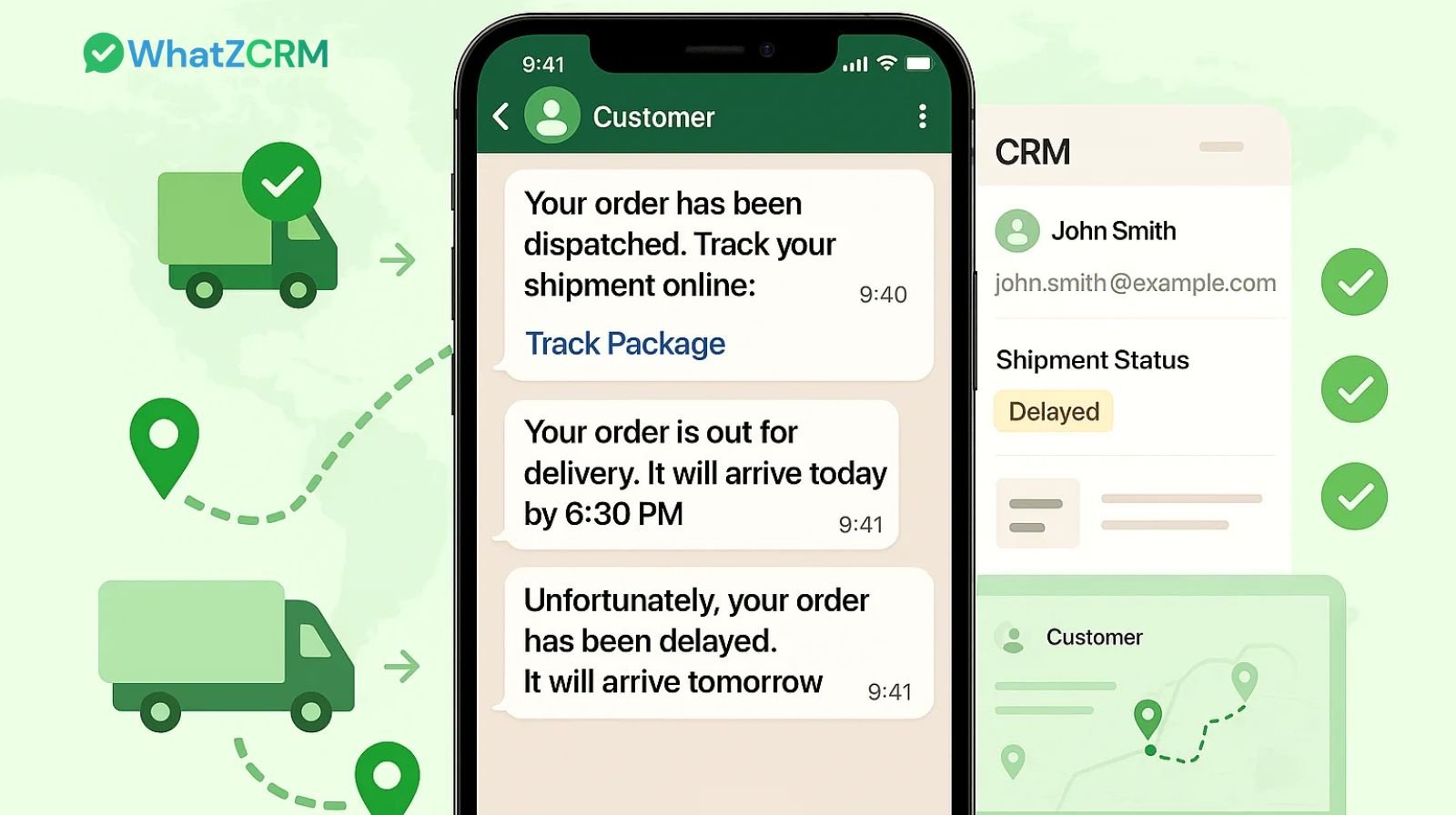
When a customer places an order, the system automatically triggers a message confirming the shipment. As the package moves through different stages, additional updates are sent directly through WhatsApp.
For example, customers can receive messages when their package is dispatched, when it is out for delivery, and when it has been successfully delivered.
The CRM also stores all customer interactions in one place. This means support teams can quickly view previous orders, delivery history, and conversations when handling customer queries.
Another advantage is multi-agent access. Different departments, such as customer support, delivery management, and operations teams, can manage conversations simultaneously without confusion.
Chatbots can also be integrated to handle frequently asked questions. Customers can simply send a message like “Where is my order?” and receive an instant automated response with tracking information.
Real Use Cases of WhatsApp CRM in Logistics
Logistics companies use WhatsApp CRM for several operational tasks that improve efficiency and customer communication.
One common use case is shipment tracking notifications. Instead of forcing customers to visit a tracking website, companies can send a direct tracking link via WhatsApp. Customers can instantly view the current location of their shipment.
Another practical use case is delivery scheduling and rescheduling. If a customer is unavailable during delivery, they can reply on WhatsApp to choose a different time. This reduces failed delivery attempts and improves operational efficiency.
Customer support is another area where WhatsApp CRM makes a significant difference. Customers can ask questions about delivery status, delays, or pickup schedules directly through WhatsApp. Automated responses handle basic inquiries while human agents manage more complex issues.
Logistics companies also use WhatsApp CRM to coordinate with drivers. Dispatch teams can share route updates, address corrections, and urgent instructions instantly.
Also Read: WhatsApp Automation for Small Businesses: 6 Strategies That Generate Leads
WhatsApp Automation Workflow for Delivery Companies
Automation is one of the biggest advantages of implementing WhatsApp CRM in logistics operations.
A typical logistics automation workflow may look like this:
When an order is created, the system automatically sends a confirmation message to the customer. This message includes the order ID and expected delivery date.
Once the shipment is dispatched, the CRM sends another notification informing the customer that the package is on its way. A tracking link is included so customers can monitor the delivery status in real time.
On the day of delivery, customers receive a reminder message that the package will arrive soon. If the customer needs to reschedule, they can reply directly to the message.
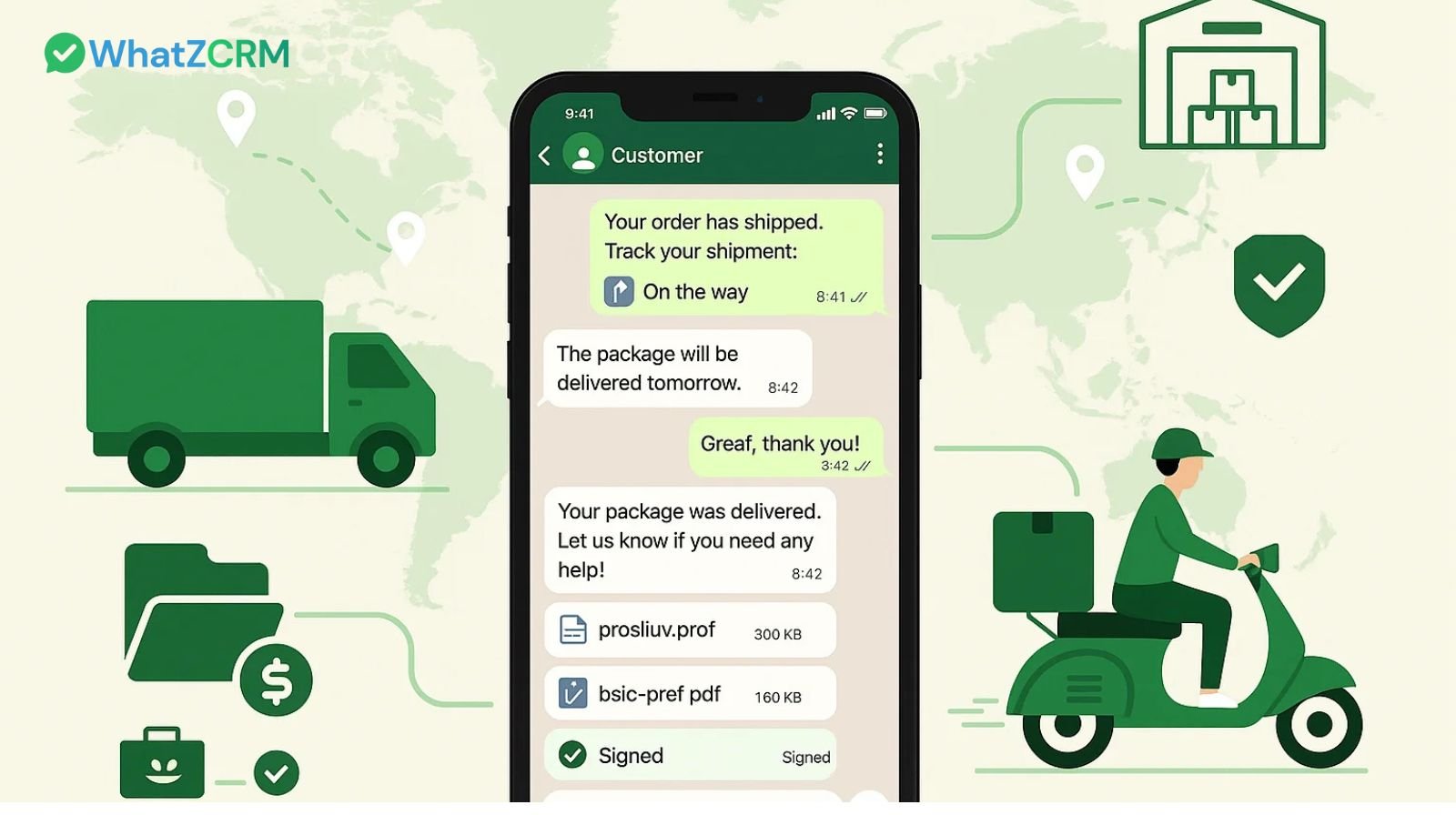
After delivery is complete, the system sends a confirmation message along with proof of delivery, such as a signature or a photo.
This automated workflow reduces manual work for logistics teams while ensuring customers stay informed at every stage of the delivery process.
WhatsApp Automation Workflow for Delivery Companies
Automation is one of the biggest advantages of implementing WhatsApp CRM in logistics operations.
A typical logistics automation workflow may look like this:
When an order is created, the system automatically sends a confirmation message to the customer. This message includes the order ID and expected delivery date.
Once the shipment is dispatched, the CRM sends another notification informing the customer that the package is on its way. A tracking link is included so customers can monitor the delivery status in real time.
On the day of delivery, customers receive a reminder message that the package will arrive soon. If the customer needs to reschedule, they can reply directly to the message.
After delivery is complete, the system sends a confirmation message along with proof of delivery, such as a signature or a photo.
This automated workflow reduces manual work for logistics teams while ensuring customers stay informed at every stage of the delivery process.
Also Read: WhatsApp Automation for Small Businesses: 6 Strategies That Generate Leads
Key Features of WhatsApp CRM for Logistics
A well-designed WhatsApp CRM platform provides several features that help logistics companies manage operations more efficiently.
Automated shipment notifications ensure customers receive updates about their orders without manual intervention. These notifications can include order confirmation, dispatch alerts, delivery reminders, and confirmation messages.
Real-time tracking integration allows customers to monitor their shipment location directly through WhatsApp. Instead of checking multiple websites, they can access tracking details instantly.
Multi-agent support enables multiple team members to handle customer conversations simultaneously. This is particularly useful for logistics companies with large support teams.
AI-powered chatbots can respond to common queries such as order tracking, delivery status, and pickup scheduling. This ensures customers receive quick responses even outside working hours.
Workflow automation simplifies operational processes by automatically assigning tasks, sending reminders, and managing follow-up messages.
Analytics and reporting tools help logistics companies track agent performance, customer engagement, and communication trends. These insights allow businesses to improve their service and optimize delivery operations.
WhatsApp CRM vs Traditional Logistics Communication
Traditional logistics communication methods often rely on phone calls, emails, or manual SMS updates. While these methods work, they are not always efficient for large-scale operations.
With a WhatsApp CRM system, logistics companies can automate communication and manage all interactions from one platform.
In traditional systems, delivery updates are often sent manually through SMS. With WhatsApp CRM, updates are automated and sent instantly whenever shipment status changes.
Customer queries in traditional systems usually require phone calls or email responses. With WhatsApp CRM, customers can simply send a message and receive instant assistance.
Tracking shipments in traditional systems often requires customers to visit a website and enter tracking details. WhatsApp CRM simplifies this process by sending a direct tracking link within the chat.
Support availability is also limited in traditional systems. However, WhatsApp chatbots can provide 24/7 assistance and answer common questions instantly.
Overall, WhatsApp CRM offers faster communication, improved transparency, and better customer experience compared to traditional logistics communication methods.
Real Example: How Logistics Companies Use WhatsApp CRM
Consider a courier company that processes more than 2,000 shipments every day. Managing customer communication through phone calls and emails would require a large support team.
By implementing WhatsApp CRM automation, the company can send automated messages at every stage of the delivery process.
Customers receive an order confirmation message immediately after booking a shipment. When the package is dispatched, another message is sent with a tracking link.
On the day of delivery, customers receive a notification that the package is out for delivery. If they are unavailable, they can reply to reschedule the delivery.
Once the package is delivered, the system automatically sends a confirmation message along with proof of delivery.
This automation significantly reduces customer support calls and improves delivery success rates.
How to Implement WhatsApp CRM in Logistics
Implementing WhatsApp CRM in logistics operations involves several important steps.
The first step is obtaining access to the WhatsApp Business API through an official provider. This allows businesses to send automated messages and integrate WhatsApp with their existing systems.
The next step is integrating the API with a CRM platform that supports logistics workflows. This enables teams to manage customer conversations, shipment updates, and automation from one dashboard.
After integration, businesses can create automated workflows for order confirmations, shipment updates, delivery notifications, and follow-up messages.
The next stage involves deploying AI chatbots that can answer frequently asked questions. This reduces the workload for support teams and ensures customers receive instant responses.
Finally, companies should monitor analytics and communication data to identify areas for improvement and optimize their logistics operations
Also Read: How WhatsApp API Integration Works & Why Your Business Needs It
Why WhatZCRM Is Ideal for Logistics Companies
WhatZCRM is designed to help businesses manage customer communication through WhatsApp while integrating powerful CRM capabilities.
The platform provides a unified dashboard where logistics teams can manage customer conversations, driver communication, and delivery notifications in one place.
Multi-agent support enables different departments to collaborate seamlessly and handle customer queries efficiently.
Automation tools enable businesses to send shipment updates, delivery reminders, and follow-up messages without manual effort.
Real-time tracking integration ensures customers receive accurate shipment information directly through WhatsApp.
Advanced analytics features allow logistics companies to monitor communication performance and improve customer satisfaction.
By combining WhatsApp messaging with CRM automation, WhatZCRM helps logistics companies streamline operations and enhance customer experience.
Conclusion
Efficient communication is essential for successful logistics operations. Customers expect timely updates, accurate delivery information, and quick responses to their queries.
A WhatsApp CRM system enables logistics companies to automate shipment notifications, manage customer conversations, and improve operational efficiency.
By integrating WhatsApp with CRM platforms, logistics businesses can reduce manual work, improve delivery transparency, and provide better customer support.
As logistics operations continue to grow in complexity, adopting a WhatsApp CRM solution can help companies stay competitive while delivering a superior customer experience.