
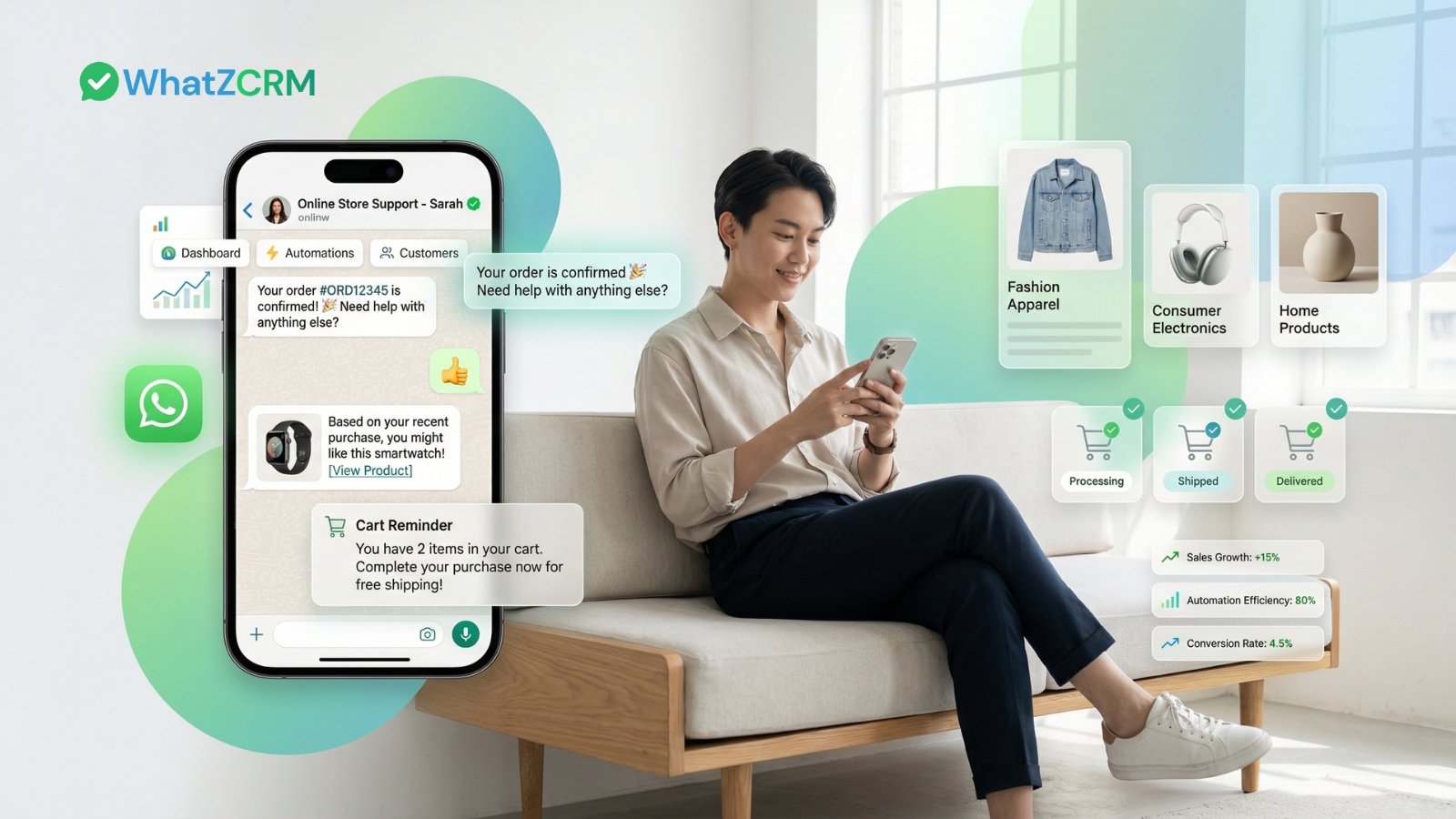

A WhatsApp CRM for online stores is software that sits on top of the WhatsApp Business API and turns raw chats into a structured sales channel, tracking every customer, automating cart recovery and order updates, routing conversations to the right agent, and reporting on what’s actually driving revenue. Plain WhatsApp Business can send a message; a WhatsApp CRM tells you who to message, when, and whether it worked.
If you run an online store, you’ve probably already noticed two things: your customers live on WhatsApp, and your current setup for using it a shared phone, a few saved numbers, maybe the free WhatsApp Business app isn’t built to scale. That gap is exactly what a WhatsApp CRM for online stores closes.
This guide covers what WhatsApp CRM actually does for e-commerce, the specific use cases (order management, retail, cart recovery), how to evaluate an affordable WhatsApp CRM without overpaying for features you won’t use, and where WhatZCRM fits in.
Why WhatsApp Becomes More Effective to Enhance Ecommerce Sales?
Three shifts are pushing online stores to treat WhatsApp as infrastructure rather than an afterthought:
- Rising acquisition costs, falling retention channels. Ad costs keep climbing while email open rates keep sliding, so stores are leaning harder on channels where existing customers actually respond.
- Customers expect a reply inside the app they’re already in. Product questions, order status, and returns increasingly happen in chat, not on a support ticket form.
- Fragmented tools slow teams down. A store running Shopify or WooCommerce, a shared WhatsApp Business number, and a spreadsheet for tracking leads ends up with no single view of the customer, which is exactly the problem a CRM layer is designed to fix.
The result: WhatsApp CRM for online stores isn’t a nice-to-have marketing add-on anymore. It’s becoming the operating layer for sales, support, and retention combined.
Also Read: How to Improve Customer Trust and Experience with WhatsApp CRM
WhatsApp Business App vs. WhatsApp Business API vs. WhatsApp CRM
These three terms get used interchangeably, which causes a lot of confusion when stores are evaluating tools. Here’s the actual difference:
WhatsApp Business App | WhatsApp Business API | WhatsApp CRM (e.g., WhatZCRM) | |
Cost | Free | Pay-per-conversation via Meta | API cost + platform subscription |
Contact limit | ~256 per broadcast | Unlimited (tiered) | Unlimited (tiered) |
Customer history | None — chats are isolated | Raw message logs only | Full contact timeline, tags, pipeline stage |
Automation | Basic quick replies | Requires custom build | Pre-built flows: cart recovery, order updates, FAQs |
Team collaboration | Not supported | Not supported natively | Multi-agent inbox, routing, internal notes |
Reporting | None | Delivery/read receipts only | Conversion tracking, agent performance, campaign ROI |
Best for | Testing WhatsApp with under 250 contacts | Developers building custom infra | Stores that want to run sales + support at scale without building it themselves |
The API is the pipe. The CRM is what makes that pipe useful for running a business.
How WhatsApp CRM Enhances More Sales for Ecommerce Businesses?
These are the specific, high-frequency use cases stores implement first: the practical answer to what a WhatsApp business CRM actually does for e-commerce.
1. Cart Abandonment Recovery
Roughly 7 in 10 online shopping carts get abandoned before checkout. A WhatsApp CRM triggers a personalized recovery message with a product image, price, and a direct checkout link within minutes of the drop-off, often paired with a time-limited discount. Stores using WhatZCRM’s cart recovery automation have recovered 25–40% of otherwise-lost carts.
2. WhatsApp CRM for Order Management
This is one of the most searched and most underestimated use cases. Order management on WhatsApp means:
- Automatic order confirmation the moment a purchase is placed
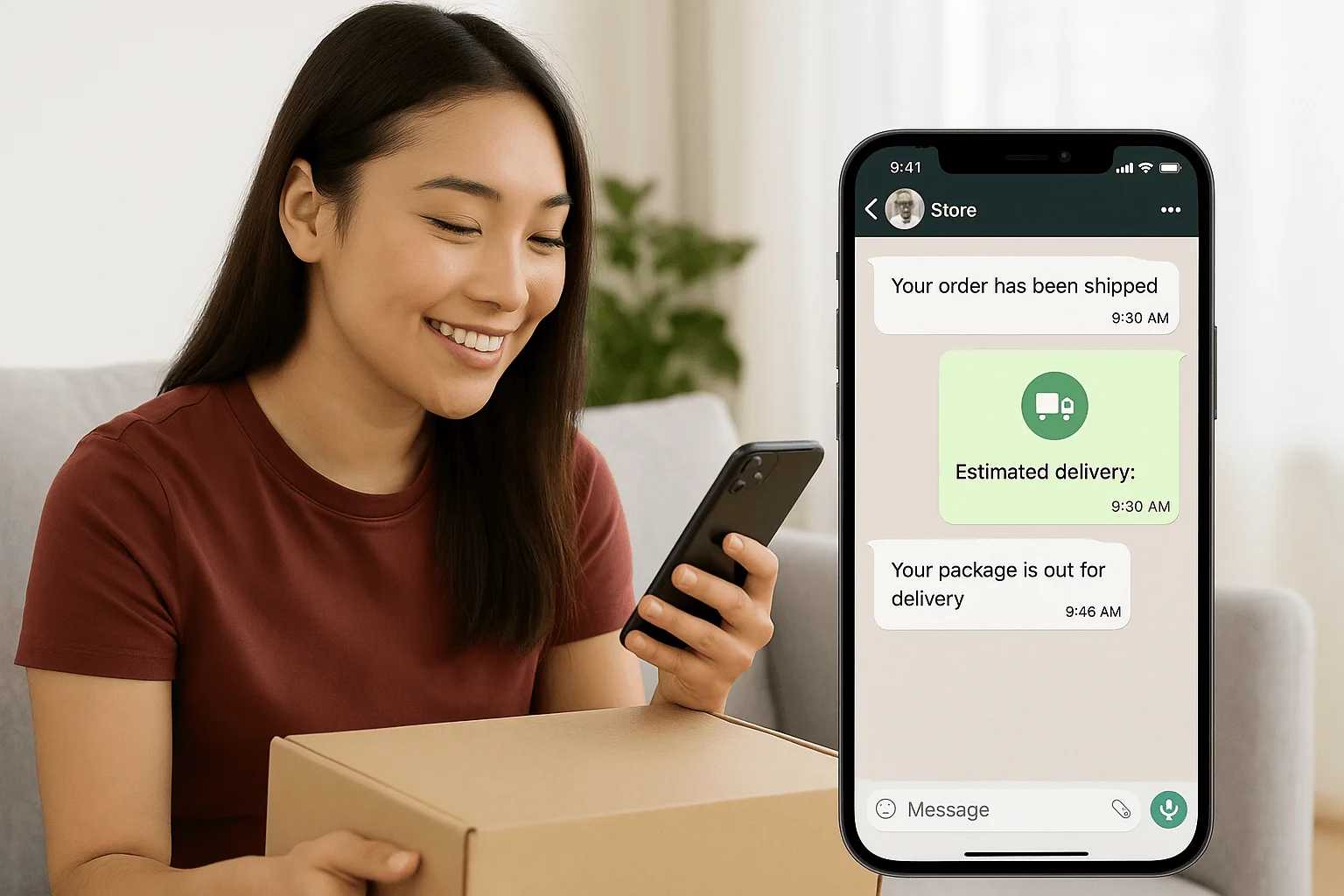
- Real-time shipping and delivery status updates, cutting down “Where Is My Order?” queries
- Post-delivery messages that prompt reviews or flag issues before they become refund requests
- A synced record so any agent can pull up a customer’s order history mid-chat, instead of asking them to repeat it
Handling order management through a CRM instead of manual messages is what lets a two-person support team keep pace with a growing order volume.
3. WhatsApp for Retail Industry: In-Chat Product Discovery to Checkout
Retail and D2C brands use WhatsApp catalogs and AI chatbots so a customer can ask “show me summer dresses under ₹2,000,” browse images inside the chat, and check out without leaving WhatsApp. This shortens the path from inquiry to purchase, which matters most for retail categories with high consideration (fashion, electronics, beauty).
4. Automated Customer Support
AI chatbots handle repetitive queries (order status, return policy, sizing) around the clock, and hand off to a human agent with full chat context for anything more complex. This is usually where stores see the fastest drop in support ticket volume.
5. Segmented Marketing Campaigns
Broadcast promotions, restock alerts, and festive offers to specific customer segments using Meta-approved templates, instead of blasting the same message to everyone on the list.
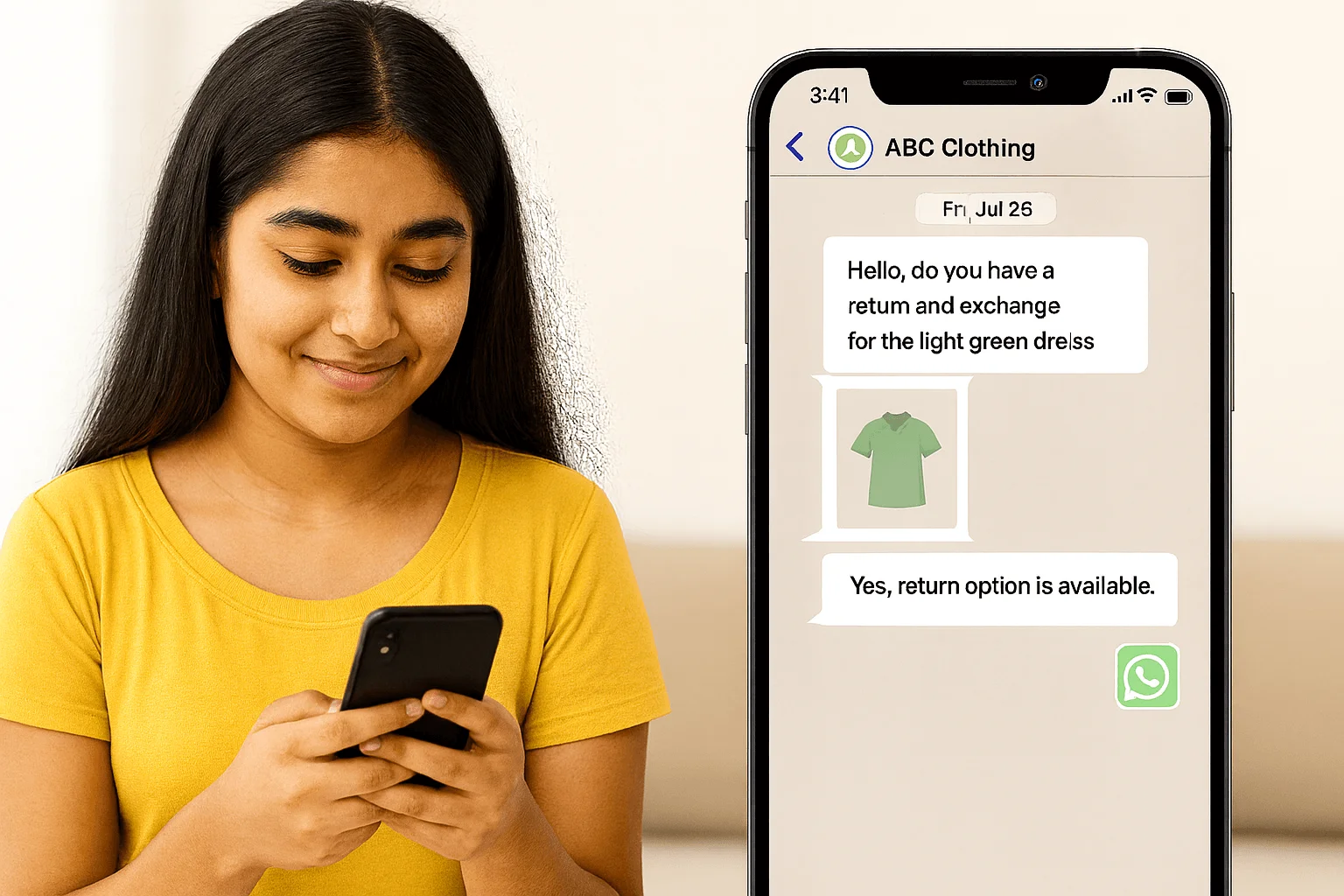
6. Return & Exchange Automation
Customers raise a return request, get a return label, choose a pickup slot, and get confirmation all inside the same chat thread, without a support agent manually coordinating each step.
Also Read: How to Improve Customer Trust and Experience with WhatsApp CRM
The Proven Workflow to Boost E-commerce Sales with WhatsApp
- Customer browses your store and adds items to cart, or clicks a “Chat on WhatsApp” button from an ad or product page.
- The CRM triggers an automated message; a cart reminder, a catalog link, or a greeting flow that qualifies what the customer’s looking for.
- The customer replies or asks a question. An AI bot answers FAQs instantly or routes the conversation to the right agent with full context attached.
- The agent (or bot) shares an offer, tracks an order, or resolves a query directly in the chat.
- The customer converts, requests support, or gets flagged for a follow-up, and the whole interaction is logged against their contact profile for next time.
This loop is what separates we also reply to customers on WhatsApp from a real WhatsApp CRM for online stores strategy.
Proven Results That WhatsApp CRM Achieved for Ecommerce Businesses
From WhatZCRM e-commerce deployments across fashion, beauty, electronics, footwear, and accessories brands:
- A fashion D2C brand recovered ₹3.2 lakhs in abandoned-cart revenue in two weeks, with a 35% lift in cart conversion without increasing ad spend.
- A beauty retailer cut order-status support queries by 60% after automating order notifications end-to-end.
- An electronics seller brought first-response time down to under 15 seconds, with AI resolving 80% of incoming queries before a human needed to step in.
- A footwear brand hit a 92% open rate on WhatsApp broadcast campaigns for a new collection launch, well above what the same brand saw on email.
Results vary by category and starting point, but the pattern holds: automation removes the repetitive load, and personalization on a high-open-rate channel converts better than email or SMS for the same audience.
Consider While Choosing an Affordable WhatsApp CRM that Actually Matters
Affordable doesn’t mean cheapest; it means not paying for capacity or features a store doesn’t need yet. When evaluating a WhatsApp CRM for an online store, weigh these:
- Pricing model: Per-conversation (via Meta) plus a platform fee is standard. Check what’s bundled at each tier before comparing sticker prices.
- E-commerce integrations: Confirm native support for your actual platform Shopify, WooCommerce, Magento rather than a generic webhook you’ll have to build around.
- No-code automation: A drag-and-drop flow builder means marketing or support teams can launch cart-recovery or FAQ flows without waiting on a developer.
- Multi-agent support: If more than one person will ever reply from the business number, this isn’t optional; it’s what prevents duplicate replies and dropped chats.
- Reporting depth: Look for conversion tracking and agent-level performance data, not just message delivery stats.
- Scalability: Confirm the platform can grow from a few hundred to tens of thousands of contacts without a plan change that breaks your existing automations.
WhatZCRM is built around these priorities specifically for Indian SMBs and D2C brands: a no-code workflow builder, native Shopify/WooCommerce/Magento integrations, a unified multi-agent inbox, and AI segmentation, without needing separate tools bolted together.
Try Ecommerce WhatsApp CRM with WhatZCRM
Why WhatZCRM Is the Best WhatsApp CRM for Online Stores in 2026
Unlike traditional CRMs, WhatZCRM provides:
- Advanced automation for the entire customer journey—from lead generation to post-purchase engagement.
- AI-powered tools for smarter, faster lead qualification and follow-ups.
- Team collaboration features to improve customer service and speed up resolutions.
- Seamless integration with your eCommerce platform (like Shopify) and marketing tools.
- Email integration and Mailbox: consolidates WhatsApp and email communication in one place, allowing businesses to manage all customer interactions without switching between different platforms.
Final Thoughts
WhatsApp has become a core sales channel for online stores, but growth takes more than just messaging back and forth. A WhatsApp CRM centralizes every conversation, automates the repetitive parts of the journey cart recovery, order updates, FAQs and lets your team focus on the interactions that actually need a human.
The result: chats turn into conversions, operations stay lean, and customer relationships compound instead of resetting with every new thread.
For startups and growing D2C brands, affordable WhatsApp CRM plans put this automation within reach without a heavy upfront investment. And once your CRM is properly integrated with your e-commerce platform, the entire customer journey from first inquiry to repeat purchase runs on one channel your customers already check dozens of times a day.