

Sales teams in 2026 are losing deals in the gap between first contact and first response. The average business takes over 10 hours to respond to a new inquiry. WhatsApp, by contrast, opens within minutes of a message arriving, and businesses that respond there do so quickly.
That gap is why WhatsApp CRM has moved from a nice-to-have to a core sales tool. Research shows that WhatsApp-driven engagement produces a 27% increase in sales for businesses that use it systematically, and companies using automation through the WhatsApp Business API have seen sales growth of up to 127% in select categories. The platform now has over 3 billion monthly active users globally, and more than 200 million active business accounts use it to manage customer relationships.
This article breaks down how WhatsApp CRM works for sales teams, what sets it apart from traditional CRM tools, and what to look for when choosing one. We’ll also walk through how WhatZCRM is built specifically for this workflow.
What is WhatsApp CRM, and why do sales teams need it?
A WhatsApp CRM is a customer relationship management system that places WhatsApp conversations at the center of your sales workflow rather than treating messaging as an afterthought bolted onto an email-first system.
The distinction matters. Traditional CRMs were designed when email was the primary sales channel. They track pipelines, store contact records, and log calls well. But they have no native way to manage WhatsApp conversations at scale, no real-time inbox for chat-based selling, and no automation layer that works inside a messaging thread.
A WhatsApp CRM solves those gaps by giving sales teams a shared inbox for all incoming WhatsApp messages, automatic lead capture when a new contact messages in, a pipeline view tied to conversation state, and automated follow-ups that trigger based on what a prospect said or did.
The result is a sales process that operates at messaging speed, which is increasingly the speed buyers expect.
Also Read: How AI-Powered WhatsApp CRM Improves Customer Engagement
Why WhatsApp Outperforms Email and Phone for Sales in 2026
The numbers here are difficult to argue with. WhatsApp messages achieve a 98% open rate, compared to roughly 20–25% for email. Messages sent through the WhatsApp Business API are opened within 5 minutes in 80% of cases. Click-through rates on contextual WhatsApp campaigns reach up to 60%, a figure that email campaigns cannot approach.
Beyond open rates, the channel’s nature is different. WhatsApp conversations are customer-initiated when someone messages your business on WhatsApp; they have already crossed the threshold of buying interest. This makes WhatsApp leads qualitatively different from cold email responses or form fills. They arrive warmer, they convert faster, and they require less persuasion to move through a pipeline.
For sales teams specifically, this means three things: faster qualification (you get intent signals in real time through the conversation itself), shorter sales cycles (two-way messaging resolves objections faster than email threads), and higher close rates for teams that respond promptly and personally.
What to Look for in a WhatsApp CRM for your Sales Team
Not every WhatsApp CRM is built the same way. When evaluating options, sales teams should focus on five capabilities.
Shared team inbox. Multiple agents need to be able to see and respond to conversations from a single interface, with clear ownership and assignment. Without this, you cannot scale WhatsApp beyond one or two people.
Automated lead capture. When a new contact messages in, the system should automatically create a lead record with the contact’s name, number, and the opening message without requiring manual data entry.
Workflow automation. The system should support automated greetings, qualification sequences, and follow-up reminders. Crucially, it should also support seamless handover to a human agent at the right point in the conversation, with full context preserved.
Pipeline visibility. You need to see where every WhatsApp lead sits in your sales process, not just that a conversation happened, but what stage it is at, and what the next action is.
Analytics. Response time tracking, agent performance metrics, conversion rates by conversation stage, and drop-off analysis are the signals that let you improve the process over time.
Also Read: How AI Sales Chatbot Qualifies Leads and Closes Deals Faster
How WhatZCRM Approaches for WhatsApp-first Sales
WhatZCRM is built on the premise that WhatsApp conversations should be the organizing principle of a sales workflow, not an add-on channel. That architectural choice shows up in a few specific ways that differentiate it from CRM tools that have added WhatsApp as an integration.
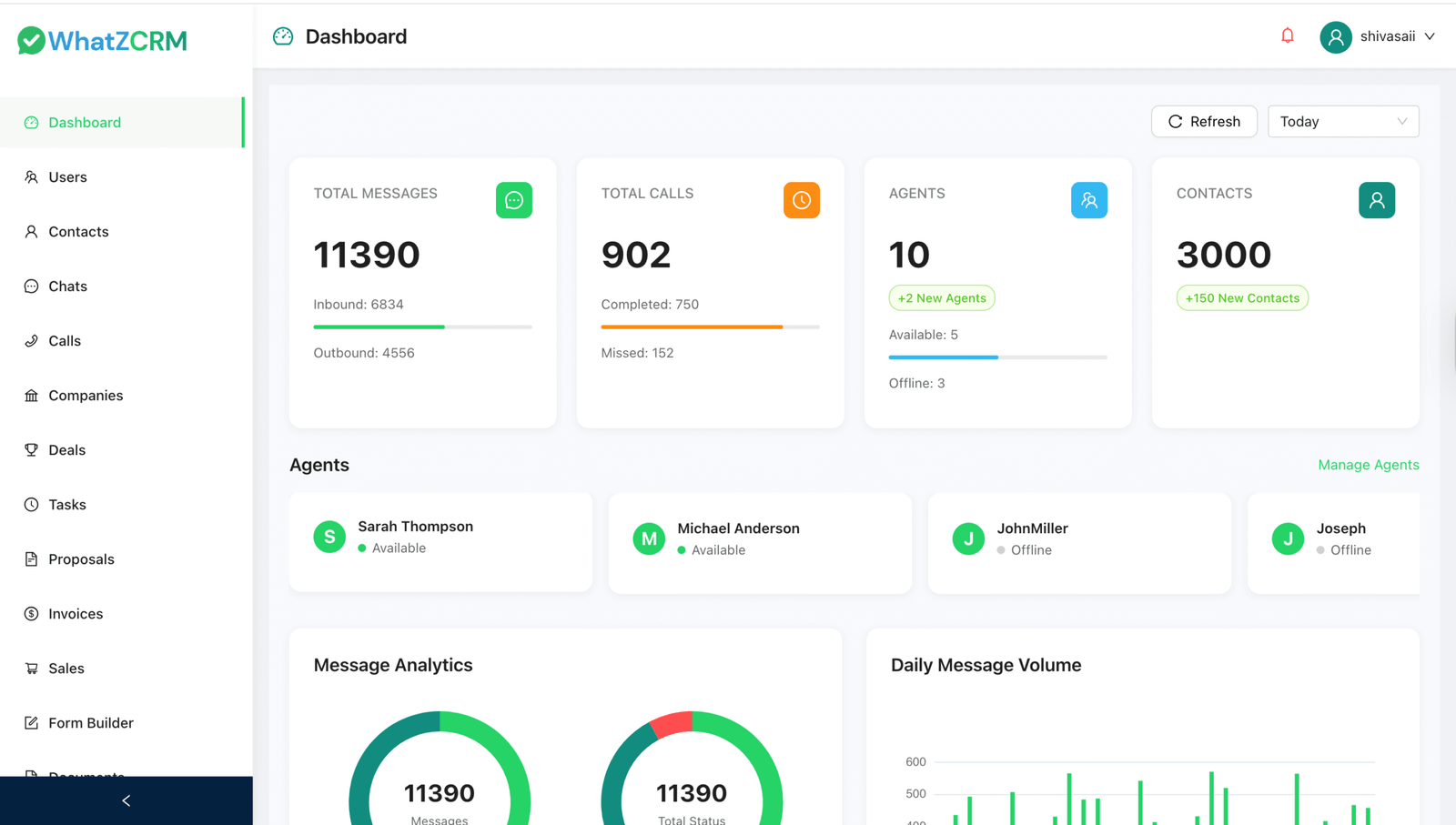
The platform uses a centralized multi-agent inbox as its primary interface, not a contact record with a messaging tab. This means the sales team’s actual working surface is the conversation stream, with CRM data (lead score, history, pipeline stage) surfacing alongside it rather than requiring a separate window.
The lead qualification chatbot runs through an AI bot layer that can be configured without technical expertise. When a prospect messages in, the bot handles initial greeting, gathers qualifying information, scores the lead based on responses, and routes it to the right agent before a human has to intervene.
Follow-up automation in WhatZCRM is behavior-triggered rather than time-triggered. Rather than sending a follow-up message three days after first contact, regardless of what the prospect said, the system can respond to specific signals a prospect is asking about pricing, for example, or opening a product message, without replying with a contextually appropriate next step.
The analytics layer tracks the full conversation lifecycle, from first message to closed deal, giving sales managers visibility into response times, conversion rates at each stage, and individual agent performance. This is the data infrastructure that makes continuous improvement possible in a conversational sales environment.
Also Read: Top 10 WhatsApp CRM Tools Compared (2026)
How WhatsApp CRM Fits Into a 2026 Sales Strategy
The practical question for most sales teams is not whether to use WhatsApp CRM, but how to integrate it into their existing processes without adding complexity.
The starting point is identifying where WhatsApp already appears in your sales motion. For most businesses, it is either inbound (customers already messaging in and being handled informally) or outbound (follow-ups being sent from personal phones). Both scenarios present the same opportunity: the channel is being used, but there is no infrastructure in place to make it systematic.
A WhatsApp CRM formalizes what is already happening. Inbound messages get routed and tracked. Outbound sequences get automated and measured. The conversations that were happening anyway became a structured, reportable sales channel.
The next step is defining the qualification criteria that the system should apply automatically. What questions should the chatbot ask? What answers indicate high intent versus low intent? Which responses should trigger immediate agent assignment versus automated nurture? These decisions do not require technical expertise to implement, but they do require sales leadership to articulate what good looks like.
Finally, the analytics layer becomes the feedback loop. Response time data tells you where the team is slow. Drop-off data tells you where prospects are losing interest. Conversion data by source tells you which WhatsApp entry points produce the best leads. The system improves because the data makes the right interventions visible.
Improving Sales Team Productivity with Centralized WhatsApp CRM
When conversations are scattered across devices and numbers, sales teams lose productivity.
WhatZCRM solves this with:
- A shared WhatsApp inbox for all teams
- Clear lead ownership and assignments
- Reduced internal coordination
- Better collaboration between sales and support
Teams spend less time managing tools and more time closing deals.
Data-Driven Sales Decisions with Actionable Insights
Sales growth in 2026 depends on measurable performance insights, not guesswork.
WhatZCRM provides:
- Response time analysis
- Lead conversion tracking
- Agent performance metrics
- Conversation-stage drop-off insights
These insights help leaders optimize workflows, messaging, and team performance.
WhatsApp CRM vs traditional CRM: a direct comparison
Capability | Traditional CRM | WhatsApp CRM (e.g., WhatZCRM) |
Primary channel | Email/phone | WhatsApp conversations |
Lead capture | Manual data entry | Automatic from the first message |
Follow-up | Manual reminders | Behavior-triggered automation |
Team inbox | No native WhatsApp inbox | Centralized shared inbox |
Conversation history | Not tracked | Full thread stored |
Real-time engagement | Not supported | Native |
Analytics | Pipeline-focused | Conversation + pipeline |
Final Thoughts
WhatsApp CRM is not a future trend; it is the present operational standard for sales teams that generate a significant share of their revenue through conversational channels. The 2026 shift is that it is no longer confined to markets where WhatsApp dominates culturally. As messaging overtakes email for B2C and, increasingly, for B2B initial contact, the teams with the right infrastructure will respond faster, qualify better, and close more deals.
WhatZCRM is built for teams that want that infrastructure without the complexity of enterprise software. If your sales team is already using WhatsApp informally, the question is not whether to adopt a Best WhatsApp CRM; it is how quickly you can make the transition systematic.
Try WhatZCRM free and see how your WhatsApp conversations can become a structured sales channel.