
Most businesses on WhatsApp make the same mistake: they treat every incoming message like an interested buyer. The result is sales teams chasing dead ends, slow follow-ups, and a pipeline full of low-intent contacts who were just browsing.
WhatsApp lead qualification fixes this. It is the process of identifying, scoring, and prioritising the contacts most likely to buy, so your team spends time where it converts. With nearly 3 billion active users and open rates that dwarf email, WhatsApp is not just a messaging app; it is the highest-intent sales channel most businesses are still using incorrectly.
This guide covers exactly what WhatsApp lead qualification is, which signals matter, and seven actionable methods for implementing it, including automation strategies that work even outside business hours.
What Is WhatsApp Lead Qualification?
WhatsApp lead qualification is the process of using conversation data, user behaviour, and automation to determine whether a contact is worth pursuing by your sales team. A qualified lead is not just someone who messaged you; it is someone who matches your customer profile, shows genuine buying intent, and has the authority or ability to make a purchase decision.
Depending on where a contact sits in your funnel, they typically fall into one of three categories:
| Lead Type | What It Means | What to Do |
| MQL | Engaged with content (downloaded a guide, clicked an ad) but not actively buying | Nurture with drip campaigns and educational content |
| SQL | Asked about pricing, requested a demo, or contacted sales directly | Hand off to the sales team for direct follow-up |
| PQL | Has used a free trial or freemium product and experienced value firsthand | Target with upgrade offers or direct sales outreach |
The goal of WhatsApp lead generation is to move contacts through these stages faster and identify SQLs before your competitors do.
Also Read: How to Build a WhatsApp Chatbot (No Code)
6 Ways to Qualify Leads on WhatsApp
1. Use a WhatsApp Chatbot to Pre-Qualify Every Inquiry
A chatbot is the most scalable way to qualify leads as they arrive, not hours later, when a human is available. The moment someone messages your WhatsApp number, a chatbot can ask the right question: “What are you looking for?” What is your budget range? When do you need this by?
These intent-based questions map directly to classic qualification frameworks like BANT (Budget, Authority, Need, Timeline). The chatbot collects structured answers, tags the lead, and either routes the lead to a sales rep or adds it to a nurture sequence, all without any manual effort.
For example, a real estate agency using WhatZCRM can configure a chatbot to ask incoming leads about their preferred location, property type, and budget. High-budget leads in the right area get routed to an agent instantly. Leads outside the budget range receive an automated sequence of listings and educational content.
2. Build Qualification Flows with WhatsApp Flows
WhatsApp Flows are interactive, in-app forms that allow leads to fill in structured information without leaving the chat. Unlike a simple back-and-forth conversation, Flows present menus, dropdowns, and text fields that guide a user through a qualification process in minutes.
You can build a WhatsApp Flow that:
- Asks the lead to select their industry or use case from a menu
- Captures company size, role, and decision-making timeline
- Book a discovery call directly in the same conversation
Flows are especially powerful for B2B businesses where the qualification criteria are specific. A lead who completes a flow has already self-selected as serious; filling in structured information signals intent far more clearly than a single ‘Hi, interested’ message.
3. Score and Segment Leads Automatically via CRM Integration
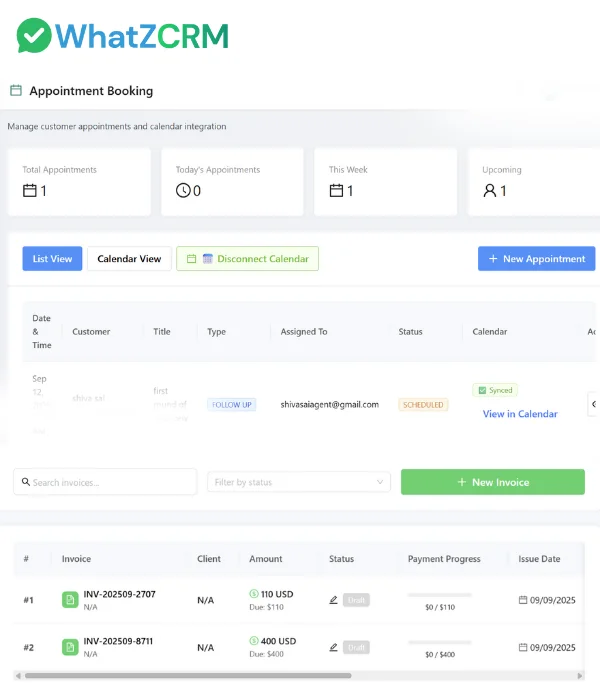
WhatsApp messages that live only in your phone are invisible to your sales process. CRM integration changes this entirely. When WhatsApp is connected to a CRM like WhatZCRM, every conversation is automatically logged, every lead is captured as a structured record, and every follow-up is tracked.
More importantly, CRM integration enables lead scoring, assigning numerical values to behaviours that indicate buying intent. A lead who asked about pricing scores higher than one who asked a general question. A lead who has messaged three times in two days scores higher than one who has not responded to a follow-up.
| Lead Behaviour on WhatsApp | Suggested Score |
| Responded to a chatbot qualification question | 10 |
| Asked about pricing or availability | 25 |
| Requested a demo or callback | 40 |
| Opened a product brochure sent via WhatsApp | 15 |
| Did not respond to two follow-ups | -20 |
Once scores cross a threshold, the CRM can automatically assign the lead to a sales rep, trigger a priority alert, or move it to a different pipeline stage, without any manual review.
4. Run Click-to-WhatsApp Ads to Capture High-Intent Leads
One of the most effective ways to ensure the leads entering your WhatsApp pipeline are already qualified is to filter them at the source. Click-to-WhatsApp ads on Facebook and Instagram bring users directly into a chat, bypassing landing pages, forms, and the drop-off that comes with them.
Because the user chose to click an ad and open a conversation, their intent level is measurably higher than someone who stumbled onto a contact form. You can amplify this further by targeting ads by industry, location, job title, or interest category, so only your ideal customers see the ad.
Once the chat opens, your pre-configured chatbot immediately begins the qualification process. By the time a sales rep sees the conversation, the lead’s intent, budget, and requirements are already captured.
5. Nurture Unqualified Leads with Drip Campaigns
Not every lead that messages you is ready to buy today. Pushing too hard too early is one of the fastest ways to lose a prospect permanently. WhatsApp drip campaigns solve this by staying in contact with low-intent leads over time, building trust until they are ready to convert.
A typical nurture sequence for a B2B SaaS company might look like this:
- Day 1: Welcome message + one useful resource (guide or video)
- Day 3: A customer success story relevant to their industry
- Day 5: Product feature highlight with a direct CTA to book a demo
- Day 8: A limited-time offer or a direct ‘Are you still interested?’ message
The key difference between a good drip campaign and spam is personalisation. When each message references what the lead asked about, their industry, or their stage in the buying journey, open and response rates increase significantly. This is where CRM data becomes essential; it provides the context that makes personalisation possible at scale.
Also Read: How Automated WhatsApp Campaigns Increased Engagement by 70%
6. Personalise Every Touchpoint Using Conversation History
Generic messages are the enemy of WhatsApp lead qualification. When a lead receives a message that clearly ignores what they told you last time, trust erodes, and the probability of conversion drops sharply. The remedy is simple in principle and powerful in practice: use everything you already know.
With a WhatsApp CRM, agents see the full conversation history, previous messages, product pages viewed (if integrated with your website), and the lead’s current score, all in a single inbox. This means:
- A returning lead never has to repeat their requirements
- Follow-ups reference the specific product or service they asked about
- Agents know whether to open with educational content or a closing conversation
Personalisation at this level is no longer a luxury; it is expected. Leads who feel understood by a brand convert at significantly higher rates and are more likely to refer others. The infrastructure to make it happen is a WhatsApp CRM with full conversation context.
How to Know if a Lead is Qualified
Before investing sales time in a contact, look for these four signals:
- They match your Ideal Customer Profile (ICP): the right industry, the right company size, the right role. If they do not fit your ICP, qualification ends here.
- They show specific interest: They are asking about pricing, timelines, or specific features, not just browsing.
- They have decision-making power: They can say yes to a purchase, or they have direct influence over who can.
- They are actively engaging: They respond to follow-ups, ask clarifying questions, and keep the conversation moving.
Best Practices for WhatsApp Lead Qualification
- Define your qualification criteria before building automation. Know what makes a lead SQL-ready for your specific business before configuring chatbots or flows.
- Always get opt-in consent. WhatsApp Business API requires explicit consent before outbound messaging. Build consent capture into your entry points.
- Set response SLAs for hot leads. A lead who asks about pricing should hear from a human within 5 minutes during business hours. Automation can bridge the gap outside those hours.
- Review your qualification questions quarterly. What qualifies a lead today may not be the right criteria in six months. Adjust as your product and market evolve.
- Use labels and tags consistently. Tag every conversation in your CRM (Hot Lead, Nurture, Not a Fit) so your pipeline data stays clean and reportable.
Also Read: WhatsApp for Business: Step-by-Step Setup Guide 2026
Start Qualifying WhatsApp Leads Today
The gap between a WhatsApp message and a closed deal is not about volume; it is about qualification. Businesses that treat every inquiry as equal waste the majority of their sales capacity on low-intent contacts. Businesses that use chatbots, CRM scoring, drip campaigns, and structured flows consistently convert a higher percentage of leads from smaller, more focused pipelines.
WhatZCRM is built specifically to make this process straightforward. From the moment a lead messages you, automation handles qualification, scoring, and routing, so your team can focus only on the conversations ready to close.
Final Thoughts
WhatsApp has become a high-impact lead engagement channel, but results depend on how effectively conversations are managed after the first message. Generating inquiries alone isn’t enough; businesses need structured processes to respond, qualify leads, and follow up with intent.
By combining automation, chat widgets, personalization, and CRM integration, businesses can turn WhatsApp inquiries into consistently qualified leads. These approaches enable faster responses, better engagement, and smarter decision-making across the customer journey.
With the right system in place, WhatsApp inquiries shift from simple conversations to measurable growth drivers. Tools like WhatZCRM help businesses streamline lead management, improve conversions, and scale efficiently in 2026 and beyond.