
Healthcare providers are under growing pressure, with rising patient volumes, stretched staff, and patients who now expect instant, always-on communication. The phone queues, missed appointment reminders, and manual follow-up calls that defined traditional healthcare communication are no longer sustainable.
A WhatsApp chatbot for healthcare changes this equation. Built on the WhatsApp Business API, these chatbots automate the high-volume, repetitive front-desk tasks that consume your team’s time so patients get faster responses and your staff can focus on care.
In this guide, you will learn what a WhatsApp chatbot for healthcare actually does, which use cases deliver the most value, what you are legally allowed (and not allowed) to automate, and how WhatsApp CRM for healthcare brings everything together in one system.
What Do We Know About Healthcare WhatsApp Chatbot?
A WhatsApp chatbot for healthcare is an automated conversational assistant that interacts with patients through WhatsApp. It runs on the WhatsApp Business API and uses automated flows and increasingly AI to understand patient queries, trigger workflows, and deliver instant responses at any hour.
Unlike a basic messaging tool, a healthcare WhatsApp chatbot connects to your appointment system, CRM, and patient database to handle real tasks: booking appointments, sending reminders, answering FAQs, routing queries, and notifying patients about test results, all without human intervention for routine requests.
Importantly, a WhatsApp chatbot does not replace clinical staff. It takes over the administrative layer, freeing your team to focus on higher-value interactions.
Also Read: Proven WhatsApp Automation Strategies for Small Businesses
How WhatsApp is the Right Choice to Pick for Healthcare Communication?
Healthcare chatbots can be deployed on websites or mobile apps, but adoption is the bottleneck, as patients do not want another login or app. WhatsApp solves this:
- Over 3 billion active users globally, patients already have it installed
- 98% message open rate, far exceeding email or SMS
- Supports rich media: share PDFs, lab report links, video instructions, and appointment confirmations
- End-to-end encryption for messages in transit
- Works on any smartphone, no technical skills required for patients
For healthcare organizations, this means meeting patients on a channel they already trust, with near-zero onboarding friction.
Two Types of Healthcare WhatsApp Chatbots
Type | Rule-Based Chatbot | AI-Powered Chatbot / Agent |
How it works | Fixed menus, buttons, predefined flows | Natural language understanding, free-text input |
Best for | Appointments, FAQs, reminders, routing | Complex queries, multi-step workflows, dynamic lookup |
Compliance risk | Lower controlled, non-clinical outputs | Higher requires careful PHI guardrails |
Implementation | Faster to set up | Requires training and content governance |
Most healthcare providers benefit from a hybrid approach: rule-based automation for structured tasks such as booking and reminders, with an AI layer to handle varied patient queries and intelligent routing.
Top 10 High-Impact Use Cases for WhatsApp Chatbots in Healthcare
1. Appointment Booking, Reminders, and Cancellations
This is the highest-ROI use case. Integrating your WhatsApp chatbot with your scheduling system allows patients to book, reschedule, or cancel appointments through a simple chat flow with confirmations sent instantly via WhatsApp. Automated reminders sent 24 and 2 hours before appointments have been shown to reduce no-show rates by 20–30%, a critical efficiency gain for busy clinics.
2. 24/7 Patient Query Handling Without Wait Times
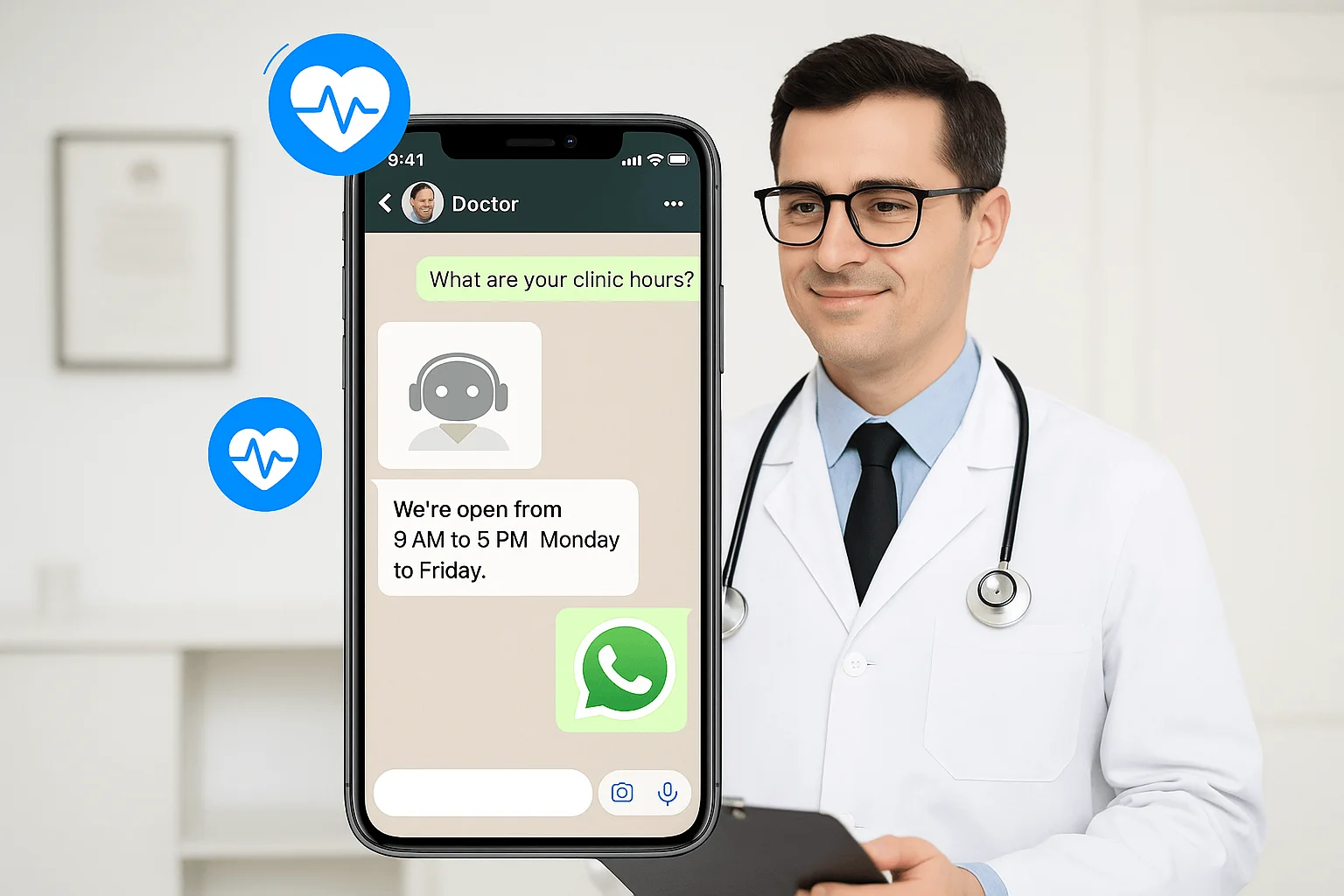
Patients frequently have questions outside office hours about clinic timings, required documents, directions, insurance coverage, or how to prepare for a procedure. A WhatsApp chatbot handles all of these instantly and consistently, reducing inbound call volume and improving patient confidence.
3. Intelligent Triage and Routing
A well-designed chatbot acts as a smart receptionist: it asks the patient what they need (an appointment, billing, test results, or to speak to a nurse), then instantly routes them to the right team or an automated flow. This eliminates internal transfer time and ensures the fastest path to resolution.
4. Medication and Treatment Reminders
WhatsApp chatbots can send personalized medication reminders, dosage instructions, and prescription refill notifications. For chronic disease management, diabetes, hypertension, and mental health, automated adherence reminders improve treatment outcomes and reduce hospital readmissions without requiring staff intervention.
5. Lab Report and Document Notifications
When results are ready, the chatbot sends an instant WhatsApp notification: ‘Your lab report is available.’ The patient receives a secure, authenticated link to your patient portal. This approach delivers speed and patient satisfaction while remaining fully compliant. Sensitive results never appear inside the chat window itself.
6. Post-Discharge and Follow-Up Care
After discharge, WhatsApp chatbots can send recovery instructions, symptom-monitoring check-ins, and wound-care reminders. If a patient reports a concerning symptom, the chatbot can flag the case for clinical staff to review. This proactive care improves outcomes without proportionally increasing staff workload.
7. General Health Education and Awareness Broadcasts
Clinics and hospitals can use a WhatsApp broadcast bot to send seasonal health alerts, vaccination campaign reminders, screening notifications, and general wellness tips. These messages are general and non-personalized, educating your patient population at scale on a channel with exceptional open rates.
Also Read: Key Differences Between WhatsApp Broadcast & Groups
8. Billing, Payments, and Insurance Status Updates
Patients frequently contact administrative staff to ask about outstanding bills, payment links, or the status of insurance claims. A WhatsApp chatbot can handle these automatically: share digital bills, send payment links, and provide non-clinical status updates (e.g., ‘Your insurance claim has been submitted’). This shortens the billing cycle and reduces administrative overhead.
9. Service Feedback and Patient Satisfaction Surveys
Immediately after an appointment, your chatbot can send a short satisfaction survey via WhatsApp. Given WhatsApp’s near-universal open rates, survey completion rates are significantly higher than email. This real-time feedback helps identify service gaps and improve patient experience over time.
10. Multilingual and Accessible Patient Communication
WhatsApp supports multilingual messaging. For hospitals and clinics serving diverse patient populations, including rural or elderly patients who may be less comfortable with apps, WhatsApp provides a familiar, accessible interface. A multilingual chatbot removes communication barriers and increases engagement from underserved groups.
Also Read: How to Build a WhatsApp Chatbot Without Coding (Step-by-Step Guide)
What You Cannot Do With a WhatsApp Chatbot for Healthcare
This is a critical section that many healthcare organizations overlook. WhatsApp’s Commerce and Business Policies, combined with healthcare data regulations, impose clear restrictions.
Restriction | Reason |
Do not share PHI (Protected Health Information) in chat | WhatsApp does not sign a Business Associate Agreement (BAA). Without a BAA, transmitting clinical data inside WhatsApp chat is not HIPAA-compliant. Always redirect to a secure patient portal. |
Do not sell medical products or prescription drugs via WhatsApp Commerce | WhatsApp’s Commerce Policy prohibits the direct sale of pharmaceuticals and most medical devices. Informational use is permitted; transactional e-commerce for regulated medical products is not. |
Do not request sensitive identifiers in chat (SSN, full card numbers) | Even with E2EE, WhatsApp chat is not designed as a secure data input form. Redirect patients to your encrypted web portal to collect sensitive data. |
Do not run a fully automated bot with no human handoff option | When a patient requests a human agent, or a query is complex or urgent, the system must offer an escalation path. Blocking this violates Meta’s policies and harms patient experience. |
How WhatZCRM Delivers WhatsApp CRM for Healthcare
WhatZCRM is a WhatsApp CRM platform built on the WhatsApp Business API. For healthcare organizations, it enables the following end-to-end communication workflow:
- A patient sends a WhatsApp message to your verified business number
- The AI chatbot responds instantly, handling booking, FAQs, or routing based on patient intent
- The conversation is logged in the CRM with full patient history visible to your team
- Complex or clinical queries are escalated to the appropriate human agent with full context
- Follow-up reminders, care instructions, and satisfaction surveys are sent automatically
- Reporting and analytics give your team visibility into response times, resolution rates, and patient satisfaction
This workflow eliminates fragmentation across phone calls, email, and manual follow-ups, centralizing all patient communication in a single, accessible, automated system.
Also Read: How WhatZCRM Helps Businesses Drive Sales Growth in 2026
Who Should Use WhatsApp CRM for Healthcare?
WhatsApp CRM for healthcare is best suited for organizations that handle a high volume of patient communication. This includes:
- Multi-specialty hospitals and clinics
- Diagnostic laboratories and imaging centers
- Dental, dermatology, and specialty practices
- Telemedicine and virtual care providers
- Home healthcare and nursing services
- Pharmacy chains and wellness centers
The higher your inbound patient communication volume, the faster the ROI from deploying WhatsApp CRM automation.
Also Read: WhatsApp Automation for Small Businesses: 6 Strategies That Generate Leads
How to Get Started with WhatsApp Chatbot for Healthcare
Getting started requires three components:
- WhatsApp Business API Access: Apply through an official WhatsApp Business Solution Provider (BSP). Approval typically takes a few business days.
- A Healthcare-ready Automation: Your platform should support multi-agent inbox, CRM integration, automated workflows, and escalation to human agents.\
- A Compliance-first Configuration: Define exactly what your chatbot handles, only non-clinical tasks. Build in human handoff triggers. Never transmit PHI in chat. Direct patients to your secure portal for sensitive information.
WhatZCRM handles all three. You get access to the WhatsApp Business API, a full chatbot builder, a multi-agent CRM, and the automation workflows healthcare organizations need, with implementation typically completed in days.
Final Thoughts
Healthcare communication should be simple for patients and providers alike.
A WhatsApp chatbot for healthcare removes the friction: no hold music, no missed reminders, no manual follow-ups. Your team gets time back, and patients get the instant, connected experience they expect.
The clinics winning at patient engagement today are not doing more; they are automating smarter.